The Mathematics of Structure: Why the Market is Not a Coin Toss

Introduction: The Myth of Randomness
Trading is often compared to a coin toss. The Efficient Market Hypothesis (EMH) suggests that price instantaneously reflects all available information, and future changes are essentially random. If this were absolute truth, market charts would represent pure Brownian motion, making any systematic profit impossible in the long run.
However, a close look at the charts reveals certain patterns. The market has a "memory." It has a structure. And this structure is strikingly similar to objects found in nature—from jagged coastlines to the branching of vascular systems. In this article, I want to share the results of my research into non-linear structures—a journey from the theoretical foundations of Benoit Mandelbrot to a concept currently being implemented in an algorithmic solution. I am currently developing an indicator designed to mathematically identify and visualize this hidden market structure.
1. Inefficiency as a Foundation
My starting point is the recognition of the fundamental inefficiency of the market. An efficient market is like an ideal gas: its particles do not "remember" their previous collisions. But financial markets are created by humans and algorithms that possess memory, fear, and expectations.
Price is a point of emotional consensus. Traders remember their losses and gains at specific levels, creating a "collective memory" that forms fractal patterns. If every participant forgot the price immediately after a trade, structure would not exist. This psychological inertia creates the very inefficiency that can and should be exploited. Thus, the market is not a chaotic flow, but a self-organizing system that leaves clear footprints.
2. The Philosophy of Filtering: Structure vs. Noise
One of the primary challenges in trading is the lag inherent in technical indicators. Most classical tools work directly with price, attempting to smooth its values (Moving Averages, etc.). However, price is merely a symptom—a consequence of deeper processes. By trying to filter the price itself, we are always destined to be late.
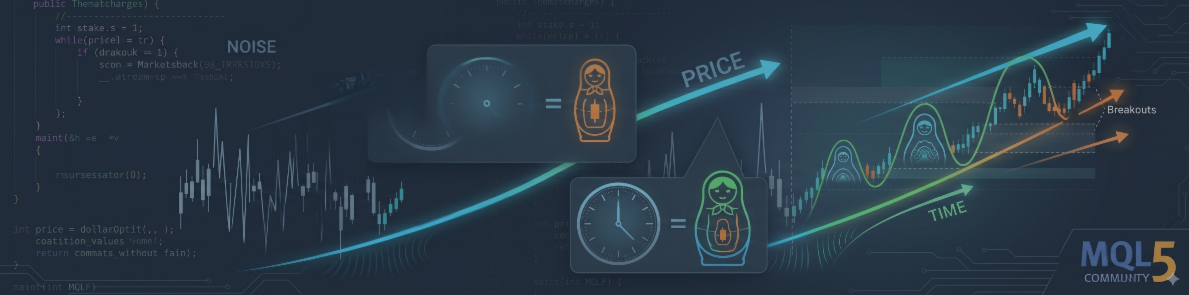
My approach lies in identifying the invariant structure. Unlike chaotic noise, structure possesses stability and repeatability. Noise consists of instantaneous fluctuations caused by random factors and small volumes. Structure is the framework that holds the movement together and provides direction. When we shift our focus from "cleaning" the price to identifying structural nodes, the problem of lag becomes secondary. We are not looking for the "average price," but for the underlying logic of the market event's construction.
3. Liquidity and Peters’ "Comfort Zones"
Drawing on Edgar Peters' fractal analysis, we can define critical market states through the lens of liquidity. Fractal structures do not appear out of nowhere; they form where market participants find certain "comfort zones" that are understandable and suitable for their current goals.
Many call such zones "flat," "corridors," or "consolidations." Within these boundaries, the market possesses high liquidity: buyers and sellers are harmoniously distributed, and their expectations are balanced. Here, the structure is stable and self-similar across different timeframes. But at some point, this equilibrium is disrupted: either one group begins to prevail, or the liquidity within the zone is exhausted.
At this moment, the market ceases to be liquid in the previous sense. Quotes move rapidly in the direction of the prevailing force, the old structure collapses, and momentum is formed. It is important to understand that this occurs discretely. Sometimes the structure begins to break down, but the participants' momentum is insufficient to sustain the move, and the market immediately begins to build a new structure, adapting to the changes. The goal of my current research is to teach an algorithm to recognize this transition from the "harmony of the corridor" to the "imbalance of the breakout" in real-time.
4. Fractal Time and Rhythm: The "Fractal Trend" Concept
In classical technical analysis, much has been written about the "trend," but most definitions are too abstract for actual decision-making. I propose looking at this through the prism of a Fractal Trend.
For convenience, we will use the common term "swing" as a basic unit of movement. Any swing can potentially be the start of a trend, but we define a fractal trend only as a movement where an ordered series of swings is created, and the point of each swing eventually becomes the foundation for a new wave.
This becomes possible due to two factors: time and rhythm.
-
Rhythm is the internal frequency of the system that allows the momentum of movement to be maintained.
-
Time in a non-linear model does not hinder the price but aligns with it.
When time does not obstruct movement in the chosen direction, and the preservation of rhythm allows a new wave to be launched at the point of each swing, we achieve a stable, self-similar structure. In this model, a trend is not just a direction; it is a resonance of price, time, and rhythm.
5. Non-linear Time as a Second Vector
In classical analysis, time is viewed as a static X-axis. However, in my model, price and time are inseparable; they form a single, holistic structure. Time can compress or stretch in response to the speed of structural formation.
Events that are considered "impossible" in standard (Gaussian) statistics—the so-called "Black Swans"—occur with striking frequency in a fractal environment. This happens because, during moments of market imbalance, time "contracts," packing a vast amount of market information and energy into a short chronological interval.
Conclusion
The market is inefficient, and that gives us an edge. Understanding that behind price fluctuations lies a rigorous mathematical structure and rhythm allows us to move away from guesswork toward analyzing market architecture. The development of the structure indicator is an attempt to translate this philosophy into the language of numbers—to see not the noise, but the framework upon which every movement is built.