
What this is
The VISTmany approach, powered by the iVISTscalp5 indicator, is a timing-based framework for market analysis.
It focuses on one key idea:
Markets don’t move randomly — they move when liquidity is activated in time.
⸻
Core Concept
We define specific moments called:
Liquidity Activation Points (Timings)
These are short time windows where:
volatility expands
liquidity enters the market
price is likely to move
⸻
What the system provides
Each timing contains three elements:
1. Time
A precise moment (shown on a flag or ray).
👉 This is the primary signal.
⸻
2. Direction
🔵 Blue → Buy
🔴 Red → Sell
👉 Indicates the most probable direction.
⸻
3. Movement (points)
Displayed in parentheses.
👉 Example: +731 points
Represents expected movement potential
Typically short-term impulses
⸻
How to read timings
A timing is not a guaranteed trade.
It is a window of opportunity.
👉 Interpretation:
Timing appears → market is ready to move
Price behavior inside this window → defines your decision
⸻
How to trade it (simple model)
Step 1 — Identify timing
Know all timings in advance (weekly forecast).
⸻
Step 2 — Wait for activation
Do not enter before the timing.
👉 The move starts inside the time window, not before.
⸻
Step 3 — Observe price reaction
Inside the timing:
impulse → entry opportunity
no reaction → skip
⸻
Step 4 — Manage position
Two approaches:
⚡️ Impulse trading
capture small movements
quick entry/exit
📈 Context trading
combine timing + market structure
scale in positions
hold longer
⸻
Timeframes
Main analysis: M1 (1-minute)
Reason: movements are often small
On higher timeframes, signals may be less visible
⸻
Weekly structure model (risk reduction).
History_weeks - iVISTscalp5 indicator calculation parameter depending on the trading week number
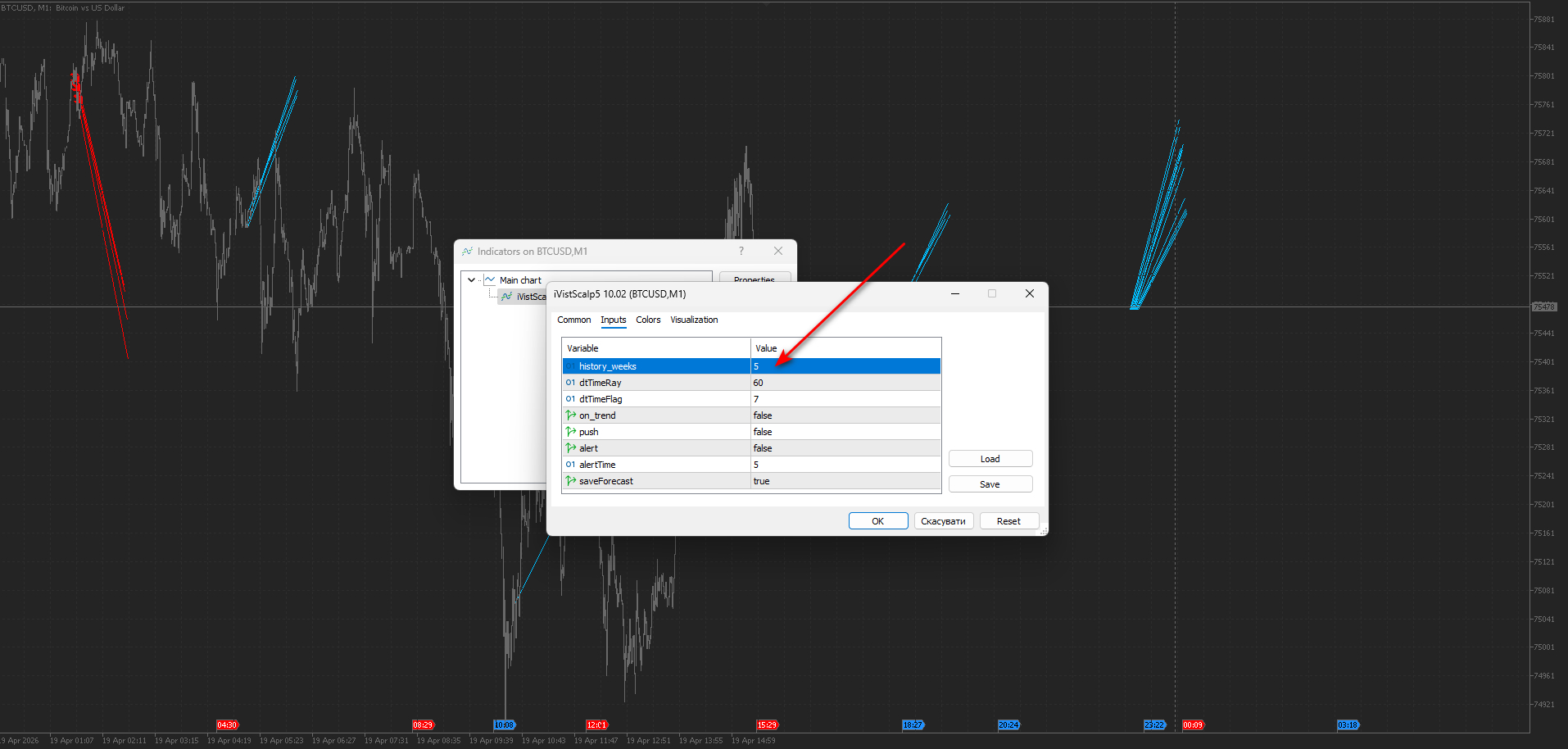
To balance probability and frequency:
Week 1 → History_weeks=8-week model (high probability, fewer timings)
Week 2 → History_weeks=5-week model
Week 3 → History_weeks=5-week model
Week 4 → History_weeks=8-week model
⸻
Key insight
Not all timings are equal.
Focus on:
clusters (multiple timings close together)
repeated levels
strong point values
👉 These create the strongest moves.
⸻
Important
This system:
does not guarantee outcomes
does not replace decision-making
It provides structure and timing.
The trader makes the final decision.
⸻
Application scope
Timings can be calculated for any market:
Forex
Metals
Oil
Indices
Stocks
Crypto
(All instruments available in MT5)
⸻
Technology
The implementation layer can evolve independently of the model logic.
Currently:
main version → MT5
⸻
Final idea
The question is not:
“Where will price go?”
The real question is:
“Is this the moment when the market is ready to move?”
If yes — act.
If not — wait.
The system projects time, direction, and expected movement
through Liquidity Activation Points (timings).