Fractal Mathematics of the Market and the Architecture of Nonlinearity

Introduction
Trading is often compared to a coin toss, where future changes are seen as random. However, anyone who has spent thousands of hours in front of a terminal notices that the market has "memory" and a structure resembling natural objects. In this series, I share research on non-linear structures — a journey from Mandelbrot’s theories to a concept tested in real trades. We focus on the mathematics of structure.
The Market is Inefficient
I believe the market is inefficient. Financial markets are created by participants with memory and expectations. The "gold standard" for evaluating this memory is the Hurst exponent (H):

-
If H > 0.5, the market is persistent (has memory).
-
If H = 0.5, it is pure noise.
Psychological inertia creates the inefficiency we exploit.
Mandelbrot and DNA of Movement: Concept of Self-Similarity
Benoit Mandelbrot gave us the understanding of self-similarity. A fractal is an object that looks equally complex at any magnification. Mathematically, this is described by the fractal dimension (D):
In trading, this means every significant movement has its own "DNA". Most indicators fail because they look at volatility or averages, ignoring the structure of the entire system. We look for invariants — stable forms that persist across scales.
| Parameter | Classical Technical Analysis | Fractal Structure Mathematics |
|---|---|---|
| Market Model | Linear, Random Walk | Non-linear, Persistent System |
| Primary Object | Price (Individual Quotes) | Structural Node (Interconnection) |
| Time Perception | Linear (X-axis, Constant) | Fractal (Compressible/Extensible) |
| Noise Filtration | Mathematical Averaging (Lag) | Invariant Search (Chaos Removal) |
| TF Analysis | Isolated or Summed | Hierarchical Nesting ("Matryoshka") |
| Directional Movement | Confirmed Post Factum | Driven by Level Synchronization |
Non-linear and Fractal Time: The Second Vector of Structure
In our framework, price and time are inseparable. In non-linear systems, time flows differently: it can compress or stretch based on the speed of events. We express this via the scaling relationship:
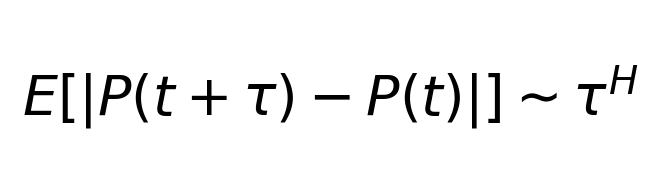
Using 21 timeframes is a technical necessity. When fractal speed increases, time "compresses," packing massive structural changes into hours of intense directional movement
Technological Foundation: Data Hierarchy in SQLite
Analyzing such data density requires SQLite. Persistence is critical: fractal structures are objects with a history. The DB allows for the storage of "portraits" even after a terminal restart. Each symbol has an isolated database (e.g., MTF_Structure_DB_EURUSD.sqlite ).
History Synchronization and the "Cold Start" Problem
In MetaTrader 5, history may load unevenly. We implemented Intelligent History Validation. At launch, the algorithm checks data continuity across all 21 periods. If a gap is found, the system initiates a connection restoration procedure using SQLite data, ensuring the fractal portrait remains undistorted.
The Precision Challenge: Finding the True Moment of an Event
We use a Precision Time algorithm. For each node on a higher timeframe, the indicator "descends" to M1 to find the very minute the price formed its peak or trough. Without this surgical accuracy, cycle synchronization is impossible.
Anatomy of a "Fractal Portrait" and Status
The "Fractal Portrait" is a digital fingerprint including a "genealogical tree" (Family ID)
// Example of a Fractal Portrait structure in the indicator code
struct FractalPortrait {
    long      parent_id;     // ID of the higher-order parent structure
    int       timeframe;     // Timeframe of the current node
    datetime  exact_time;    // Exact minute of the extremum formation
    double    price_level;   // Price level of the node
    string    family_id;     // Genealogical link identifier
};
Visual Hierarchy and Future Roadmap
To manage complexity, we developed Dynamic Visual Scaling. The user sees only the structures relevant to the current scale, while the global hierarchy is calculated in the background. Our roadmap includes a signaling indicator to detect fractal resonance points.
Practical Case: The Structural Trap
On M5, we see a breakout. Visually, a directional movement has started. However, fractal analysis shows the H4 foundation is static, and the cycle hasn't reached density. The M5 portrait has no "relatives". This is noise. We ignore it and preserve capital.
Conclusion
Understanding market architecture is the path to conscious analysis. In the next article, we will discuss the "Mathematics of Connections" and hierarchical synchronization.
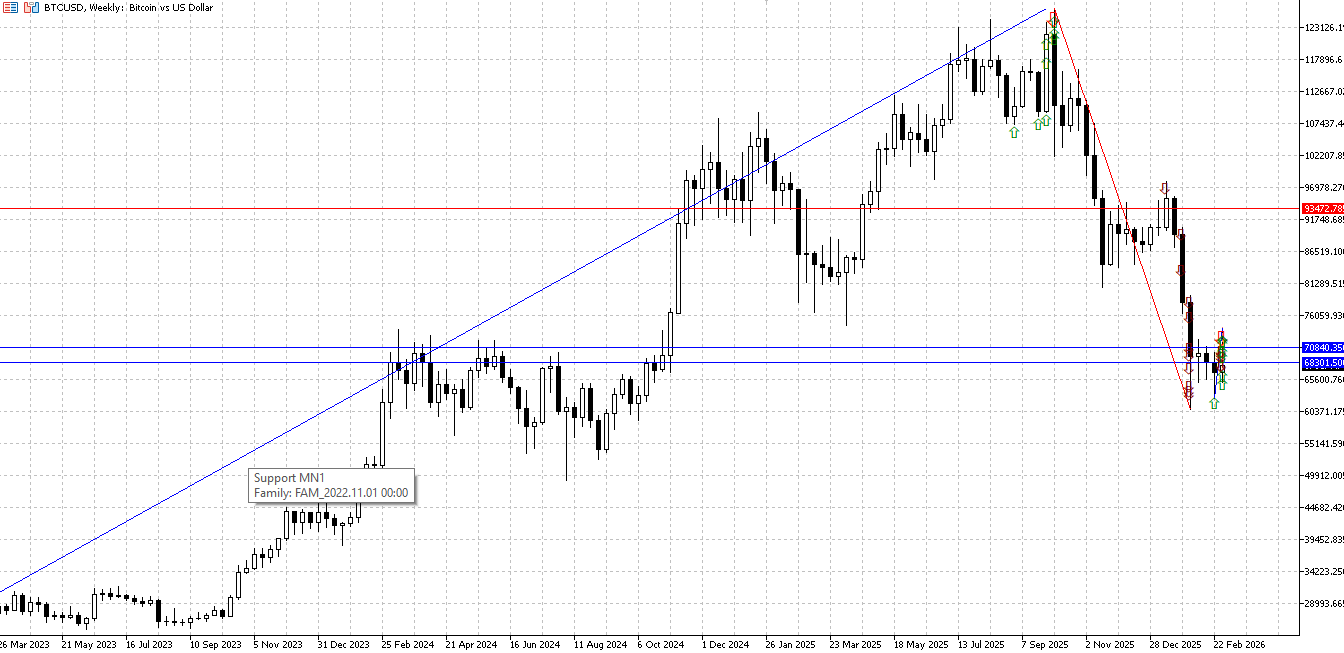
This screenshot clearly demonstrates the algorithm's ability to identify the market's "load-bearing walls." Note the tooltip: the support level identified on the Weekly timeframe is directly linked to a global Monthly foundation (Support MN1).
The unique Family ID: FAM_2022.11.01 confirms that this structure is part of a hierarchy that originated back in November 2022. The directional movement arrows and synchronization lines do not repaint because they are strictly anchored to the "birth minute" of each node stored in the SQLite database. This serves as the "roadmap" described in the article, allowing the trader to see the architectural logic behind long-term movements rather than just isolated price action.