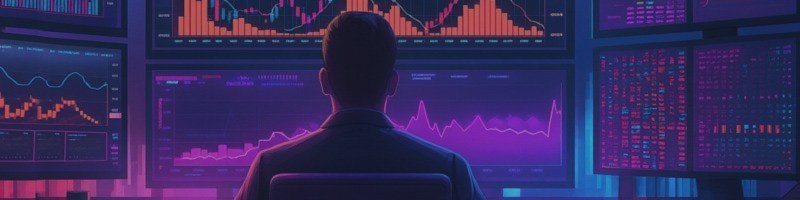

Every seasoned trader has walked this path.
You wake up and open the chart. If you have a position, you watch it. If you don’t, you still watch—just to see price movement. Gradually, you become glued to the screen, unsure why you can’t stop.
This isn’t a failure of discipline or willpower. It’s neuroscience. Market makers and trading platforms understand this deeply. They design charts to trigger your brain exactly the way they want.
1. The First Trap: “I need to look to feel safe”
When you’re new to trading, everything feels risky. Maybe you missed a perfect entry once because you were busy. That frustration creates a fear of missing out—FOMO. Your brain hates uncertainty. It learns: “Looking at the chart = feeling safer.”
So you start checking the chart whenever you’re free. Even if there’s nothing to do, just watching gives relief. That comfort comes from dopamine—a chemical that makes you feel good. The more you look, the more dopamine you get. It becomes a habit. This is the reinforcement loop. It’s the same mechanism that keeps you scrolling your phone aimlessly.
2. Entering a Trade: The Brain’s Defense Mode
Ever closed a trade too early, afraid to lose the small profit? Then watched price move exactly as you predicted—far beyond your exit?
When real money is on the line, your brain sees danger. The amygdala—the fear center—screams: “You could lose money!” Adrenaline kicks in. Your heart races. Eyes sharpen. You stare at the chart, trying to “control” the situation. But the more you look, the more anxious you become. Cortisol floods your system, clouding your logic. Your prefrontal cortex—the rational part—gets exhausted. You stop trading the plan. You start trading your emotions.
3. No Trade, No Thrill: Dopamine Withdrawal
When you’re not in a trade, dopamine drops. Your brain hates boredom. It craves stimulation. So you open the chart again. Price ticks up—dopamine rises. Price ticks down—dopamine rises again. Any movement excites the brain. It learns: “Looking at charts feels good.” This is mild stimulation addiction.
4. Why Charts Are Designed to Hook You
Trading platforms know how your brain reacts to motion, color, and sound. They exploit it to keep you engaged:
-
Bright red and green candles for instant visual feedback
-
Tiny timeframes (1-min, 5-min) to simulate constant action
-
Flickering prices, alert sounds, smooth animations—all feeding dopamine
Your brain gets “fed” every second. Soon, you feel uneasy if you’re not watching. The more you watch, the more you trade. The more you trade, the more fees they earn.
5. The Danger of Overwatching: Attention Narrows
Your brain has limits. Staring at charts for hours wears down your focus. You stop seeing the big picture. You only notice tiny movements. This is attention narrowing.
You:
-
Enter trades too early, mistaking noise for signals
-
Exit trades too soon, fearing reversals
-
Trade more, but with less accuracy
Eventually, you suffer decision fatigue—mental exhaustion from constant choices. By day’s end, you’re drained and ineffective.
6. Losing Money: The Urge to “Recover”
Losses hit harder than gains. This is loss aversion. Your brain hates losing. It pushes you to “get it back.” You open the chart again, desperate for a setup. But in that emotional state, your judgment is impaired. You often make another mistake.
7. When Habit Becomes Dependency
Each time you look at the chart, dopamine rises. Each time you close it, dopamine drops. Your brain starts needing the chart just to feel normal. This is dopamine dependence. It’s no different from compulsively checking your phone or email. Over time, your mind loses balance. You stop seeing trading as a profession. It becomes a game.
8. Breaking the Cycle
Here’s how to reclaim control:
-
Set strict chart-watching hours. Only check during key sessions: Sydney–Tokyo, Tokyo–London, London–New York. Outside those windows, shut it down.
-
Avoid small timeframes. Stick to H1, H4, or D1. The smaller the frame, the more stimulation—and temptation.
-
Plan your trade before entering. Define entry, stop-loss, and take-profit. Then walk away.
-
Track your emotions. Every time you feel restless and want to open the chart, write down why. This helps you realize when you’re trading feelings—not strategy.
9. Final Thoughts
The human brain is wired to react to movement. Markets are always moving. Chart designers know this—and use it to keep you hooked.
But a professional trader learns to master their mind. They know when to look—and when to walk away. Because clarity comes not from staring at the screen, but from stepping back and thinking clearly.
The traders who survive aren’t the best analysts. They’re the ones who don’t let the market consume their mind.