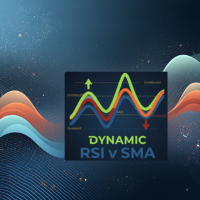
Clr-Dynamic RSI v SMA Indicator: A Comprehensive Analysis of Features and Advantages
The Clr-Dynamic RSI v SMA indicator represents a significant evolutionary leap in technical analysis tools, transforming the classic Relative Strength Index (RSI) from a potentially ambiguous oscillator into a sophisticated, multi-dimensional trading system. At its core, this indicator retains the mathematical foundation of the RSI, measuring the speed and change of price movements, but radically enhances its utility through intelligent visual encoding, contextual filtering, and automated pattern recognition. By dynamically colouring the RSI line and its Simple Moving Average (SMA) based on their real-time slope, and by integrating these visual cues with filtered signals, it provides traders with an instantaneous, intuitive, and high-probability framework for assessing momentum, trend direction, and potential reversal points. Below is a detailed exploration of the indicator’s features, advantages, parameter set, and the underlying trading philosophy it embodies, demonstrating how it functions as a comprehensive decision-support system.
Philosophical Foundation: From Interpretation to Declaration
Traditional technical indicators often present data in a static form, requiring the trader to perform mental calculations of derivative values (like rate of change) and cross-referencing with other rules or indicators to formulate a thesis. This process is not only time-consuming but is also highly susceptible to subjective bias and analysis paralysis. The Clr-Dynamic RSI v SMA is built on a different principle: declarative clarity. It processes the first and second derivatives of the RSI line (its slope and its acceleration) and declares their state through an unambiguous visual language, colour. This shifts the trader’s cognitive load from calculating and interpreting to recognising and acting, fostering a more disciplined and responsive trading approach. The system is designed to align with core trading tenets: follow the trend, gauge momentum strength, avoid counter-trend entrapment, and heed major reversal warnings.
Deconstructing the Key Features and Advantages
The indicator’s prowess stems from the synergistic integration of its features. Each component addresses a specific weakness in standard RSI usage, and together they form a robust, layered filtering system.
1. Dual Dynamic Colouring: The Core Visual Engine
Feature: This is the foundational innovation. Both the RSI line and its SMA line change colour in real-time based on the instantaneous calculation of their slope.
Advantage – Eliminates Ambiguity: In a standard RSI chart, determining whether momentum is building, fading, or stagnant requires visually comparing the current RSI value to its recent past, a process prone to error, especially in fast-moving markets. With dynamic colouring, the chart itself announces the state. A green RSI line immediately signifies upward momentum; a shift to deep green indicates that upward momentum is accelerating. Conversely, a transition from red to deep red signals accelerating downward momentum. The SMA line’s colour provides a higher-timeframe perspective on the momentum trend itself. This instant visual feedback removes guesswork, allowing traders to grasp the market’s momentum structure at a glance. It turns the oscillator from a line to be decoded into a dynamic, colour-coded narrative of buyer and seller aggression.
2. Trend Filter (SMA Colour): The Strategic Gatekeeper
Feature: The SMA of the RSI line is not just a smoothed curve; it is assigned a three-state colour scheme (Up, Down, Flat) based on its slope, acting as a primary trend filter.
Advantage – Higher Win Rate and Improved Trade Quality: This feature institutionalises the classic trading adage, "The trend is your friend," directly into the momentum oscillator. The SMA’s colour represents the established trend of momentum itself. For instance, if the RSI line is above 30 (a potential bullish condition) but the SMA line is coloured red (indicating the momentum trend is still downward), the indicator visually discourages a long entry. This filter prevents traders from "catching a falling knife" or buying into dead-cat bounces within a broader bearish momentum structure. By requiring that short-term RSI signals align with the direction of the momentum trend (SMA colour), the indicator filters out low-probability, counter-trend setups. This enforced discipline naturally leads to a higher win rate and better risk-reward ratios, as trades are taken in the direction of the underlying momentum tide, not against it.
3. Velocity Meter (RSI Colour): The Tactical Precision Tool
Feature: The RSI line employs a granular, five-state colour gradient: Steep Up, Slight Up, Flat, Slight Down, and Steep Down. This is controlled by configurable slope thresholds.
Advantage – Better Timing and Conviction: While the SMA colour gives the strategic direction, the RSI colour provides tactical velocity. A "Slight Up" (e.g., light green) indicates nascent bullish momentum, which could be early or weak. A "Steep Up" (e.g., dark green) signals powerful, accelerating bullish force. This allows traders to refine their entries. Instead of buying the moment the RSI crosses above 30, a trader can wait for the RSI line to not only be in "Up" territory but to manifest a "Steep Up" colour, indicating the move has strength and conviction behind it. This helps avoid entries on weak, meandering moves that are prone to failure and allows traders to position themselves during the strongest phase of a momentum wave, thereby improving entry price and reducing the time a trade spends in drawdown.
4. Filtered Crossover Signals: The Confirmed Trigger
Feature: The indicator can plot buy/sell arrows for crossovers of the RSI line and its SMA. Critically, these signals are only generated when the SMA’s colour confirms the crossover direction.
Advantage – Reliable Entries and Reduced Whipsaw: The classic RSI/SMA crossover is a common signal but is notoriously whipsaw-prone in ranging markets. This indicator adds a crucial logical layer. A bullish crossover (RSI crossing above its SMA) will only generate a buy arrow if the SMA line itself is coloured bullish or is transitioning to bullish. If a crossover occurs while the SMA is solidly red (bearish trend), no arrow is plotted. This means the signal is not just based on the lines crossing but on that cross occurring within a supportive momentum trend context. This double-confirmation mechanism dramatically reduces false signals, ensuring that the arrows that do appear carry significantly higher statistical reliability, giving traders greater confidence to execute.
5. High-Probability Divergence Detection: The Early Warning System
Feature: The indicator automatically scans for and visually highlights classical bullish and bearish divergence patterns between price and the RSI line.
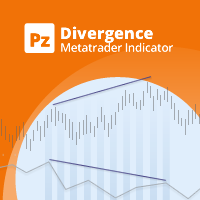
Advantage – Predicts Major Reversals: Divergence is one of the most powerful concepts in technical analysis. Bullish divergence (price makes a lower low, RSI makes a higher low) suggests selling momentum is waning even as price falls. Bearish divergence (price makes a higher high, RSI makes a lower high) suggests buying momentum is fading. Manually spotting these patterns, especially on lower timeframes, is challenging. The indicator automates this detection, drawing clear trend lines on both the price and RSI charts and often marking them with labels. This serves as a proactive warning system, alerting traders to potential trend exhaustion and impending reversals before they are evident in price action alone. It allows for the preparation of counter-trend positions or the securing of profits on existing trend-following positions.
6. Comprehensive Customisation: Adapting to Market and Style
Feature: Nearly every aspect of the indicator’s behaviour, from calculation periods to slope sensitivity to visual appearance, is adjustable via input parameters.
Advantage – Adaptability: Markets have different personalities (e.g., forex pairs vs. small-cap stocks), and traders have different styles (e.g., scalper vs. swing trader). The extensive parameter set allows the tool to be fine-tuned. A scalper might use a shorter `RSIPeriod` and lower slope thresholds for faster, more sensitive signals. A swing trader might use longer periods and higher thresholds to capture only the most significant momentum shifts. The ability to adjust the `SMA_SlopeThreshold` is particularly crucial for defining what constitutes a "trend" for the filter. This flexibility ensures the indicator remains a valuable servant to the trader’s strategy, not a rigid, one-size-fits-all master.
Deep Dive into Indicator Parameters and Configuration
The indicator’s logic is organised into clear, logical parameter sections, allowing for structured customisation.
A. Core Calculation Settings
These parameters define the foundational mathematics of the oscillator, familiar to any RSI user but essential for setting the indicator’s core sensitivity.
`RSIPeriod`: The look-back period for the RSI calculation. Lower values (e.g., 10) make the RSI more sensitive and volatile, suitable for capturing short-term swings. Higher values (e.g., 21, 30) smooth the RSI, making it better for identifying longer-term momentum shifts.
`SMAPeriod`: The period for the SMA applied to the RSI line. This is the heart of the trend filter. A shorter SMA period (e.g., 5) will closely track the RSI, making the trend filter very responsive. A longer period (e.g., 14) will provide a smoother, more stable trend definition, filtering out more noise but potentially lagging.
`SMAShift`: Allows horizontal shifting of the SMA line forward or backward in time. This can be used for advanced predictive or alignment techniques, though default (0) is standard.
`AppliedPrice`: Determines which price value feeds the RSI calculation (Close, Open, High, Low, Median, etc.). The close is most common, but other prices can be experimented with for different perspectives.
`OverboughtLevel` & `OversoldLevel`: Set the traditional horizontal bands. The default of 80 and 24 (as opposed to the classic 70/30) is noteworthy, as it makes the overbought/oversold conditions more stringent, aligning with the indicator’s philosophy of focusing on high-conviction, filtered signals rather than simple level touches.
B. RSI Slope Colours (5-State Velocity Control)
This section governs the behaviour of the Velocity Meter, the most detailed visual component.
Colour Parameters (`RSI_FlatColor`, `RSI_SlightUpColor`, etc.): Define the visual palette for each momentum state. Traders can set these to their preference (e.g., using bright red for "Steep Down" and a milder pink for "Slight Down").
Threshold Parameters (`SlightSlopeThreshold`, `SteepSlopeThreshold`): These are the critical sensitivity controls for the RSI colouring. The `SlightSlopeThreshold` defines the minimum positive or negative slope value required to move out of "Flat" and into "Slight Up" or "Slight Down." The `SteepSlopeThreshold` defines the higher slope value required to trigger the "Steep" coloration. For example, setting `SlightSlopeThreshold = 0.05` and `SteepSlopeThreshold = 0.20` means the RSI line must have a slope of at least 0.05 units per bar to be considered trending, and a slope of 0.20 or more to be declared "Steep." Adjusting these allows traders to define what "strength" means for their trading style, a day trader may use lower thresholds to catch smaller moves, while a position trader may raise them to ignore all but the most powerful momentum surges.
C. SMA Slope Colours (3-State Trend Filter)
This section controls the primary Trend Filter.
Colour Parameters (`SMA_UpColor`, `SMA_DownColor`, `SMA_FlatColor`): Define the colours for the SMA’s trend states.
`SMA_SlopeThreshold`: Perhaps one of the most important parameters for system tuning. This value determines how much slope the SMA must have to switch from "Flat" to a definitive "Up" or "Down" colour. A very low threshold (e.g., 0.01) will cause the SMA to almost constantly be in an Up or Down state, making the trend filter very permissive. A higher threshold (e.g., 0.10) will require a more pronounced, established slope, meaning the SMA will spend more time in "Flat," and only declare a trend during strong, sustained momentum moves. This allows the trader to calibrate the strictness of the trend filter to match market volatility and personal risk tolerance.
D. Divergence Settings
These parameters manage the automated divergence detection system.
`drawIndicatorTrendLines` & `drawPriceTrendLines`: These Boolean (True/False) switches control whether the indicator draws the corresponding trend lines on the RSI subchart and the main price chart, respectively. Visualising lines on both charts is crucial for quickly verifying the divergence pattern.
`displayAlert`: When set to True, this enables pop-up, sound, or push notifications (depending on the trading platform) the moment a divergence pattern is confirmed. This is vital for traders who cannot watch the charts continuously, ensuring they are alerted to these high-significance events in real-time.
Practical Application and Trading Integration
The Clr-Dynamic RSI v SMA is not a "black box" holy grail but a superior lens through which to view market dynamics. Its most effective use comes from integrating its signals into a complete trading plan.
Sample Trading Workflow:
1. Trend Assessment: Upon loading a chart, the trader’s eyes are first drawn to the SMA colour. Is it consistently green (bullish momentum trend), red (bearish), or oscillating (ranging)? This sets the primary bias. In a strong green SMA environment, the focus is on buy setups.
2. Momentum Scan: Next, observe the RSI line colour. Within the bullish SMA context, is the RSI currently in a "Steep Up" (dark green) pullback phase ("Slight Down" or "Flat")? The trader waits for a pullback in momentum (RSI cools to oversold or flat) that does not break the primary bullish SMA trend.
3. Signal Confirmation: The trader looks for a Filtered Crossover arrow as a potential trigger. A buy arrow appearing after an RSI pullback, while the SMA remains green or is turning green again, constitutes a high-quality, multi-factor signal.
4. Divergence Vigilance: Concurrently, the trader remains aware of any divergence alerts or drawn lines. A bearish divergence warning during an uptrend would not necessarily signal an immediate short, but it would advise against taking new long positions and suggest tightening stop-losses on existing ones.
5. Risk Management: All entries must be governed by prudent stop-loss placement (e.g., below the recent swing low for a long trade) and a profit-taking strategy. The indicator provides superior entry context but does not replace risk management.
Integration with Other Tools:
While powerful on its own, the Clr-Dynamic RSI v SMA can be effectively combined with other analyses:
Support/Resistance and Price Action: Use the indicator’s signals in confluence with key horizontal support/resistance levels or classic price action patterns (pin bars, engulfing candles) for added confirmation.(look at our range of CPR, Volume Profile and Connecting Fractals indicators)
Volume Analysis: A "Steep Up" RSI signal accompanied by surging volume provides even stronger conviction. ((try it with our CVD versions in same indicator window)
Higher-Timeframe Analysis: Use the indicator on a daily chart to establish the primary trend bias, then switch to a lower timeframe (e.g., 4-hour or 1-hour) using the same trend-aligned philosophy to fine-tune entries. (or try the Multi TimeFrame version)
Conclusion
The Clr-Dynamic RSI v SMA indicator transcends the limitations of its ancestor by embedding critical analytical layers, trend filtering, momentum velocity grading, signal confirmation, and pattern recognition, directly into its visual output. It replaces the often-subjective interpretation of a standard oscillator with a clear, declarative system of coloured states and context-dependent signals. By doing so, it actively promotes trading discipline, enforcing a trend-following bias and encouraging patience for high-conviction momentum accelerations. Its comprehensive customisation ensures it can be adapted from the fast-paced forex markets to the more gradual equity swing trading landscapes. Ultimately, this indicator is more than a tool; it is a structured framework for understanding momentum. It empowers traders to make faster, more confident, and statistically-sound decisions by turning complex derivative calculations into an intuitive, colour-coded story of market force and direction.
The trend is your friend until the bend at the end. Let colour guide your conviction, let filters protect your capital, and let divergence warn you when friendship is about to end.