+3,959 USD — USD/JPY Is Becoming an “Accident Market” Intervention Risks and Yen-Short Unwinding Are Becoming Increasing

Intervention Risks and Yen-Short Unwinding Are Becoming Increasingly Dangerous
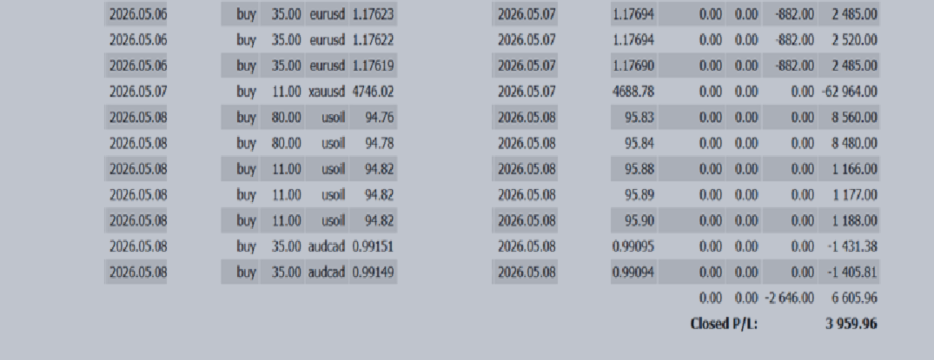
Weekly Trading Results (May 4 – May 8)📊 Weekly Realized P/L: +3,959 USD
■ Weekly OverviewThis week’s market was both very clear and extremely dangerous.
The winning markets were obvious:
-
AUD/CAD
-
Crude oil longs
-
EUR/USD
These were relatively clean trend environments where simply following capital flows produced profits.
The biggest failure, however, was GOLD.
A sharp collapse from elevated levels heavily damaged overall performance.
As a result, the week still closed positive at +3,959 USD, but the real story was:
“Profits were made in trending markets, but GOLD erased a large portion of the gains.”
■ Market Structure This Week
The structure was actually very straightforward.
-
Commodity currencies were strong
-
Oil remained resilient
-
The euro stayed strong
-
The dollar weakened
-
GOLD alone collapsed sharply
In other words:
“Capital flowed into commodities and EUR, while GOLD became the isolated casualty.”The key lesson is this:
Not all assets should be viewed through the same lens.
This market is becoming increasingly selective.
Strong assets become even stronger.
Weak assets collapse violently.
Selection matters more than ever.
■ USD/JPY Is Becoming an “Accident Market”
This is the most important warning right now.
At first glance, USD/JPY still appears to have upside pressure.
But internally, the structure is becoming extremely dangerous.
Why?
Because USD/JPY is no longer rising due to:
“Dollar strength”
Instead, it is being supported by:
“Yen weakness”
And even that yen-selling dynamic is beginning to change.
Now the market faces:
-
intervention fears
-
Ministry of Finance warnings
-
hawkish BOJ elements
-
yen-short unwinding
As a result, USD/JPY is no longer a normal trend market.
The current structure is:
-
If it rises → intervention fears appear
-
If it falls → dip buyers return
-
Sharp drops → aggressive short covering
-
Rallies → renewed caution
This is no longer a trend.
It is a tug-of-war.
And these are not markets designed for consistent profits.
They are markets where accidents happen.
■ Middle East & Oil
The Middle East was one of the major drivers this week.
During the first half:
-
Strait of Hormuz concerns
-
Iran tensions
-
strong oil prices
triggered temporary safe-haven USD buying.
But later in the week:
-
U.S.-Iran peace expectations
-
easing blockade concerns
caused crude oil to collapse sharply.
That completely shifted the market toward:
-
USD weakness
-
equity strength
-
risk-on sentiment
-
commodity currency buying
The market leadership changed midweek.
The trades that adapted to this transition worked well.
The ones caught on the wrong side — like GOLD — suffered badly.
■ Current Currency Strength
Strong
-
EUR
-
AUD
-
NZD
-
GBP
-
CHF
Neutral
-
CAD
-
JPY
Weak
-
USD
The euro and Australian dollar remain especially strong.
EUR/USD continues to display a very clean bullish structure with effective dip-buying behavior.
AUD pairs are also benefiting from:
-
risk-on sentiment
-
commodity currency inflows
Meanwhile, the USD remains heavy overall.
The dollar is increasingly becoming:
“A currency that only gets bought during crises.”Outside of geopolitical fear, it struggles to rally.
This is critically important.
■ Lessons From GOLD
The GOLD positioning was simply wrong.
In previous market environments:
“Geopolitical fear = buy GOLD”
was often correct.
But the structure has changed.
Now GOLD can rise because of:
-
USD weakness
-
equity rallies
-
geopolitical stress
But once capital flows rotate away, it can collapse violently.
This makes GOLD an increasingly unstable asset at elevated levels.
GOLD remains attractive —
but chasing highs right now is dangerous.
Especially after large extended rallies.
■ Outlook: May 11 – May 16
The biggest event next week is clearly:
U.S. CPIThis could dramatically shift market direction.
If CPI is soft or in line:
Likely continuation of:
-
USD weakness
-
EUR strength
-
equity strength
-
commodity currency strength
If CPI surprises higher:
Possible outcome:
-
reduced Fed easing expectations
-
USD rebound
-
USD/JPY recovery
-
equity market correction
USD/JPY could easily retest 157–158 depending on the CPI outcome.
But intervention risks still exist above.
Meaning:
upside is dangerous
downside is volatile
USD/JPY remains an extremely difficult market.
■ Core Strategy Going Forward
The strategy remains simple:
-
Buy EUR
-
Buy AUD
-
Buy NZD
-
Sell USD rallies
-
Be cautious with yen shorts
-
Do NOT chase GOLD highs
The key right now is:
Do not try to trade everything.
Especially USD/JPY.
It looks attractive because of the volatility.
But this is no longer a market that gives easy profits.
Both longs and shorts can get destroyed.
Sometimes the best trade is:
“No trade.”That itself is a professional strategy.
■ Final Conclusion
The current market structure is:
-
USD weak
-
JPY attempting to bottom
-
EUR and commodity currencies strong
-
GOLD unstable at elevated levels
-
USD/JPY turning into an accident market
Most importantly:
Traders must abandon the old “permanent yen-selling” mindset.
This is no longer a market where:
“Just buy USD/JPY dips”works automatically.
Now the focus should be:
-
buy strong currencies
-
avoid unstable structures
Concentrate on markets with clean trends.
Stay away from dangerous environments.
That is the most rational way to protect capital and generate consistent returns.
■ Final Note: Is That Coffee Really Improving Your Focus?
For traders, coffee feels inseparable from market life.
-
One cup in the morning
-
One before London open
-
Another before New York
I used to feel the same way.
But recently, more research has become increasingly interesting.
Caffeine may increase:
cortisol—the body’s primary stress hormone.
This is especially important in the morning.
Humans are naturally designed to experience peak cortisol levels shortly after waking.
Adding strong caffeine on top of that may contribute to:
-
elevated heart rate
-
restlessness
-
irritability
-
poorer sleep quality
-
overstimulation
Meaning:
“Feeling focused”
may actually just mean:
“being overstimulated.”
This becomes extremely dangerous in trading.
Especially in short-term trading environments.
Overstimulation often leads to:
-
unnecessary entries
-
delayed stop losses
-
overtrading
-
emotional averaging down
These mistakes happen most often during heightened emotional states.
That is why recently I’ve started to believe:
Maintaining calmness is far more important than artificially increasing intensity.
Research consistently points toward:
-
sleep
-
exercise
-
time in nature
-
meditation and mindfulness
as powerful stress-management tools.
Trading is no different.
The traders who survive long term are usually:
-
calm
-
quiet
-
emotionally stable
And the biggest winners are often the people who know how to say:
“Today, I do nothing.”Next week, instead of becoming emotional and overheated,
I want to approach the market: