Risk management tools
As an example:
============
Money Management
The forum
- MM (money management) calculation, indicators, discussion, tools: calculate your lot size and so on. Original thread with several versions.
- MoneyManagement EA is on this thread: it shows you market information and money management on the chart.
- Forex Money Management, Part 1 - good small thread
- Useful money management expert - the thread with the EA
- Stop Your Mind From Causing You to Take Profits Too Soon - the post with the educational video
- Money Management: How to Determine an Initial Stop Level - the post with the educational video
- Why Most Traders Lose Money and The Solution - the post with the educational video
The articles
- Statistical Verification of the Labouchere Money Management System
- Money management in trading -
- Functions for Money Management in an Expert Advisor
- Fallacies, Part 1: Money Management is Secondary and Not Very Important
- MQL5 Wizard: How to Create a Risk and Money Management Module
- Money Management Revisited
- Cross-Platform Expert Advisor: Money Management
- Limitless Opportunities with MetaTrader 5 and MQL5
- Money Management by Vince. Implementation as a module for MQL5 Wizard
CodeBase
- Money Management Script - script for MetaTrader 4
- Account Watch - Control entries - indicator for MetaTrader 5
- Money Managment Indicator - indicator for MetaTrader 4
- Example of SAR Automated - with Advanced Money Management - expert for MetaTrader 4
- Money Manager Graphic Tool - indicator for MetaTrader 4
- Order Manage EA - expert for MetaTrader 4
- Master Tools - indicator for MetaTrader 4
- Money Fixed Margin - expert for MetaTrader 5
- Money Fixed Risk - expert for MetaTrader 5
What are the best risk management tools you have used in trading and why ?
To minimize drawdown and manage risk effectively:
-
Limit Position Size: Risk only 1–2% of your capital per trade.
-
Use Automated Tools: Utilize Money Management EAs to calculate lot sizes automatically based on your stop-loss distance.
-
Filter Volatility: Use time filters to avoid trading during high-impact, unpredictable market hours.
-
Partial Closures: Scale out of positions to lock in profits and reduce exposure as the trade moves in your favor.
-
Implement Trailing Stops: Protect gains by automatically adjusting your stop-loss level as prices trend.

- 2024.08.14
- www.mql5.com
Sergey's list and Conor's point (time filter + risk-percent lot multiplier + trailing) already cover the standard toolbox, so I'll add the two things that in my experience move drawdown more than the choice of tool:
1) What you anchor the risk percent to. Risking 1-2% is only half the rule - the question is 1-2% of what. If it's the account balance or the opening balance, the sizing quietly works against you: after a winning streak you scale up into the same setups and give the gains back, and inside a drawdown you keep risking the same absolute amount and dig deeper. Anchoring the percent to the running equity high-water mark makes the lot auto-de-risk when you're underwater and only re-expand once you recover. That is also exactly what a funded/prop daily-loss limit measures, so it doubles as challenge protection.
2) Correlated exposure. Position sizing, partial closes and trailing are all per-trade tools - none of them cap how much of the book is really one bet. Running 1% on EURUSD, 1% on GBPUSD and 1% on XAUUSD at once is not 3% across three markets, it's closer to 3% on a single factor (the US dollar), because those legs move together. The missing tool for most setups is a portfolio-level cap on net exposure per currency, not just per trade.
So before adding another MM tool I'd fix the anchor (percent off the high-water mark) and add a net-exposure check by currency. Those two do more for real drawdown than any single trailing or partial-close method.
Even if a water level only temporarily rises, it leaves a stain behind. Note that Sylvain Christian Mercier said "equity high-water mark..." (emphasis added).
Presumably, that analogizes to Maximal Drawdown:
Forum on trading, automated trading systems and testing trading strategies
Eleni Anna Branou, 2020.05.16 10:14
https://www.mql5.com/en/articles/1486
-
Absolute drawdown is the difference between the initial deposit and the smalles value of equity within testing:
AbsoluteDrawDown = InitialDeposit - MinimalEquity
-
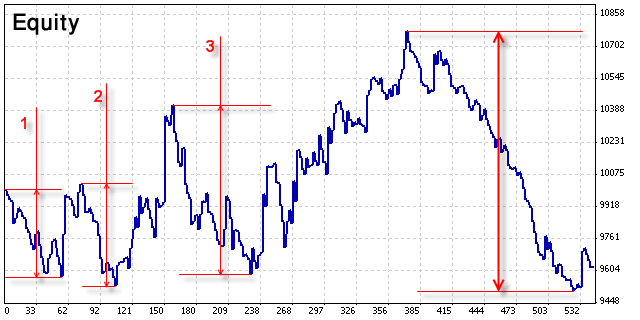
Maximal drawdown is the highest difference between one of local upper extremums of the equity graph and the following lower extremums:
MaximalDrawDown = Max of (Maximal Peak - next Minimal Peak)
The basic stages of changing the maximal drawdown value within testing are given in the picture below. The total maximal drawdown value is in the thick arrows.
- The maximal drawdown percentage shows the ratio between the maximal drawdown and the value of respective local upper extremum (of equity):
MaxDrawDown % = MaxDrawDown / its MaxPeak * 100%

- Free trading apps
- Over 8,000 signals for copying
- Economic news for exploring financial markets
You agree to website policy and terms of use