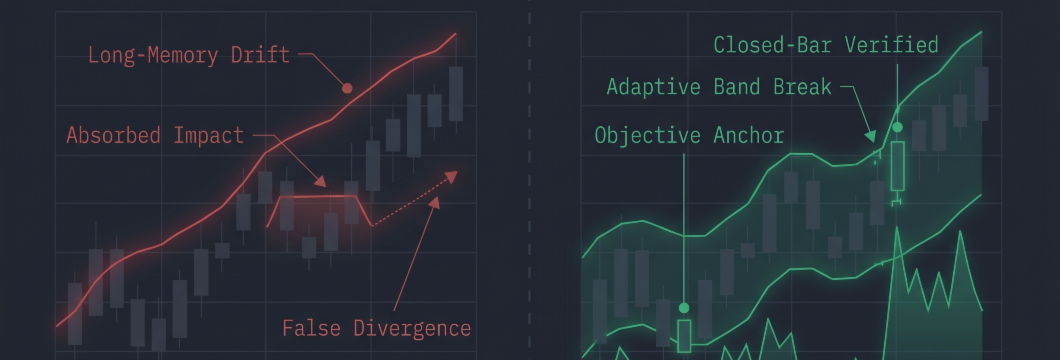
The Diffusivity Puzzle: Why Persistent Order Flow Doesn't Guarantee a Trend (and How to Anchor Volume Properly)

Why does market order flow exhibit long-term memory—with buy orders clustering after buy orders and sells clustering after sells—while price movements still remain largely diffusive?
In market microstructure and econophysics, this paradox is known as the diffusivity puzzle. A November 2026 study by Shunta Fujiwara, Yuki Sato, and Kiyoshi Kanazawa ("Is price-impact decay statistically identifiable by propagator estimation? Diffusive prices force the inferred kernel to be transient and fine-tuned", arXiv: 2611.10574) challenges a long-standing assumption about how order flow translates into price.
🔬 The Core Microstructure Finding
- Order Flow Has Long Memory: Because large institutional participants split metaorders into many child orders over time, order signs remain strongly autocorrelated across long lags.
- The Propagator Illusion: Traditional propagator models explain diffusive prices by inferring that price impact must slowly decay to zero. However, the authors prove this decay is statistically non-identifiable: even in a null model where impact is strictly permanent and concave (with zero true decay), standard propagator estimation still produces an artificial, fine-tuned decay curve simply because diffusive prices constrain the math.
- The Practical Trading Takeaway: A model—or a retail volume indicator—can easily misread the relationship between persistent order flow and price movement when it ignores non-linearity and diffusive absorption.
Why Raw Cumulative Volume Tricks Traders
Many traders treat raw On-Balance Volume (OBV) or unanchored Cumulative Volume Delta as a direct directional predictor: if volume delta keeps climbing, they assume price must follow. In reality, because persistent order flow coexists with diffusive price dynamics, unanchored cumulative curves can drift indefinitely across sessions without producing a tradable breakout.
To extract clean, falsifiable information from volume and order flow, you need two structural guardrails: anchoring (resetting the measurement to an objective market reference point) and adaptive statistical bounds (measuring whether current flow pressure actually exceeds recent diffusive noise on closed bars).
Tools for Anchored Volume & Order Flow Measurement
Every tool in my catalog is built on closed-bar integrity with zero repainting. For measuring order-flow pressure without the drift of unanchored cumulative curves:
📈 VOLUME AND ORDER FLOW
- ▸ Anchored Volume Delta with Adaptive Bands (MT5) · 🆓 · MT4 Version (🆓) — Anchors volume delta to objective structural points and evaluates pressure against adaptive statistical bands
- ▸ OBVCD Pro (MT5) · $49 · MT4 Version ($49) — Structured OBV convergence/divergence diagnostics engineered for closed-bar reliability
👉 Explore all 18 non-repainting measurement tools on my MQL5 profile: mql5.com/en/users/naamo (@naamo)
🛠️ That is why I built Anchored Volume Delta with Adaptive Bands and OBVCD Pro: instead of trusting unscaled, endlessly drifting cumulative volume, anchor order-flow pressure and test it against adaptive bounds on finalized bars.
📚 References & Further Reading:
- Fujiwara, S., Sato, Y., & Kanazawa, K. (2026). Is price-impact decay statistically identifiable by propagator estimation? Diffusive prices force the inferred kernel to be transient and fine-tuned (arXiv: 2611.10574): https://arxiv.org/abs/2611.10574