Why discipline, patience and money management matter more than finding the perfect settings
I want to share something that I consider extremely important, not just for MoonDog users, but for anyone using an Expert Advisor.
After spending so much time developing, testing and working with automated trading strategies, there's one thing I strongly believe:
Sometimes, the biggest enemy of a trading strategy isn't the market. It's the person constantly interfering with it.
Let me explain what I mean.
1. THE MOST DANGEROUS SENTENCE IN TRADING
"Ah, if I had used another SET, that trade would have won!"
"If I had changed the stop loss, I would have made money!"
"SET 4 made more money than SET 1 this week. I should switch!"
Sounds familiar?
I see this mentality all the time, and I think it's one of the biggest traps in automated trading.
YOU CANNOT BUILD A PROFITABLE TRADING APPROACH BY CONSTANTLY TRYING TO FIX YESTERDAY'S LOSSES.
Why?
Because you already know what happened yesterday!
Of course you can find a configuration that would have performed better.
Of course you can look at a losing trade and say, "If I had done this instead, I would have won."
But what does that actually prove?
Absolutely nothing about what will happen tomorrow.
When you repeatedly optimize your decisions around past outcomes, you risk falling into OVERFITTING.
You're not necessarily improving your strategy. You may simply be adapting it to historical events that will never repeat in exactly the same way.
And that's a dangerous habit.
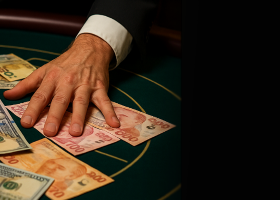
2. LET ME GIVE YOU A SIMPLE POKER EXAMPLE
Imagine you're sitting at a poker table against the best player in the world.
You play one hand.
You win.
Does that mean you're better than him?
Of course not!
Now imagine you beat him ten times.
Does that automatically make you the better player?
ABSOLUTELY NOT.
You might have been incredibly lucky.
The better player can still lose several hands, even when making better decisions.
That's how probability works.
And trading has a very similar problem.
You can have an excellent trading strategy and experience a losing streak.
You can also have a terrible strategy and experience a fantastic week.
A GOOD RESULT DOESN'T AUTOMATICALLY MEAN A GOOD STRATEGY. AND A BAD RESULT DOESN'T AUTOMATICALLY MEAN A BAD STRATEGY.
What matters is the quality of your decisions and the statistical evidence over a meaningful period.
This is something every trader needs to understand.
3. THE NEVER-ENDING SEARCH FOR THE PERFECT EA
This is where I think many traders lose their way.
Monday: your EA loses money.
Tuesday: you start looking for another SET.
Wednesday: you find another Expert Advisor with beautiful backtest results.
Thursday: you install it.
Friday: it loses a trade.
Next Monday?
You're searching for something new again.
And this cycle can continue for years.
You will spend your entire trading life searching for something better, without ever giving a properly validated strategy a fair opportunity to work.
There's always another EA.
Always another SET file.
Always another optimization.
Always somebody posting a screenshot showing how much money they made this week.
And there's always that little voice saying:
"Maybe I should try that instead."
But here's the problem.
If your strategy is to constantly replace your strategy, what exactly are you following?
You're not trading a system anymore.
You're chasing recent results.
And chasing recent results can be extremely expensive.
4. IF MAKING MONEY EVERY WEEK WERE THAT EASY...
Let's be serious for a moment.
If there were an EA that reliably made money every single day, every single week, without risk or losing periods...
NONE OF US WOULD NEED TO WORK ANYMORE!
Let's admit it!
We'd all be sitting on a beach, watching our accounts grow while doing absolutely nothing.
But we know the reality is different.
Financial markets involve uncertainty.
Even strategies with a genuine statistical edge experience losing trades, losing days and sometimes losing months.
That's normal.
The goal is not to create a system that never loses.
The goal is to develop or select a strategy with a positive expected return, keep its risks under control and allow its statistical advantage to play out over time.
And even then, future profitability is never guaranteed.
STOP EXPECTING EVERY WEEK TO BE PROFITABLE. THAT'S NOT HOW REAL TRADING WORKS.
5. MONEY MANAGEMENT IS YOUR FIRST DEFENSE
I cannot emphasize this enough.
You can have a very good EA, but if your risk management is terrible, you can still destroy your account.
Why?
Because losing streaks happen.
They are not necessarily evidence of a broken strategy.
They're part of dealing with probabilities.
If you're risking too much money on every trade, even a relatively short losing streak can become disastrous.
This is why I always encourage conservative money management.
Don't increase your lot size because you had a great week.
Don't double your risk because you want to recover your last loss.
Don't try to force a particular monthly profit target by increasing your exposure.
YOUR JOB IS NOT TO WIN EVERY TRADE. YOUR JOB IS TO CONTROL HOW MUCH YOU CAN LOSE WHEN YOU'RE WRONG.
We're here to make money, not to lose it through unnecessary risks!
And protecting your trading capital is what allows you to stay in the game.
6. DISCIPLINE DOESN'T MEAN BLINDLY TRUSTING AN EA FOREVER
Now, I want to clarify something important.
I'm not saying you should never change your settings.
And I'm certainly not saying you should keep running an EA forever if it clearly stops working.
I'm a developer myself.
I constantly test ideas, research improvements and analyze performance.
There's nothing wrong with improving a strategy.
But there's a massive difference between RESEARCH and EMOTIONAL REACTION.
If you change a configuration because you've conducted proper testing, evaluated enough data and validated the improvement on unseen market conditions, that's research.
If you change it because yesterday's trade would have won with a different stop loss, that's hindsight-driven optimization.
And if you do that continuously, you're increasing the risk of overfitting.
Changes should be based on evidence, not frustration.
Likewise, if reliable data shows that a strategy is no longer behaving as expected, reducing risk, pausing it or investigating the problem can be the disciplined decision.
DISCIPLINE IS NOT STUBBORNNESS. DISCIPLINE IS FOLLOWING A PROCESS INSTEAD OF FOLLOWING YOUR EMOTIONS.
7. STOP COMPARING YOUR RESULTS TO EVERYONE ELSE
Another common problem is constantly comparing trading accounts.
You open Telegram.
Someone posts a fantastic week.
You look at your account.
Your EA didn't make as much money.
Immediately, you start questioning everything.
Maybe their SET is better.
Maybe their EA is better.
Maybe you should increase your risk.
But you're forgetting something.
You don't necessarily know their drawdown, their trading costs, their leverage, how much they're risking or what happened during their previous losing periods.
A screenshot is not a complete trading history.
And someone else's profitable week doesn't invalidate your own trading strategy.
STOP TRYING TO WIN A COMPETITION THAT DOESN'T EXIST.
Your objective is not to beat every screenshot you see online.
Your objective is to build a sustainable trading approach that matches your own capital, risk tolerance and expectations.
8. THE REAL SECRET IS BORING
I know.
Everybody wants the perfect settings.
The perfect entry.
The perfect EA.
The perfect combination of filters that eliminates every losing trade.
But successful systematic trading isn't necessarily exciting.
Sometimes it's boring.
You choose a strategy based on evidence.
You define your risk.
You let the system operate according to its rules.
You monitor execution and performance.
You accept that some trades will lose.
You review the results objectively.
And you repeat the process.
No panic after every loss.
No random changes after every disappointing week.
No desperate attempts to recover money immediately.
CONSISTENCY IS MORE IMPORTANT THAN CONSTANTLY TRYING TO BE CLEVER AFTER THE FACT.
And this applies to MoonDog just as much as any other Expert Advisor.
MY FINAL MESSAGE TO ALL EA TRADERS
I developed MoonDog because I believe in systematic trading, research, probability and continuous improvement.
But I want people to understand something.
Buying an EA does not automatically make you a profitable trader.
Even an excellent trading system can be undermined by excessive risk, poor discipline or constant interference.
You don't need to find a new EA every time you have a bad week.
You don't need to change your settings every time another configuration would have won a particular trade.
You don't need to chase every impressive screenshot you see.
What you need is a properly tested strategy, sensible expectations, careful risk management and the discipline to follow a consistent process.
If your strategy has a genuine edge, give it a fair opportunity to demonstrate that edge.
If the evidence genuinely changes, be prepared to adapt.
But stop confusing normal losses with failure.
REMEMBER: WE ARE HERE TO MAKE MONEY, NOT TO LOSE IT.
And the best way to pursue that goal isn't by trying to predict every winning trade.
It's by controlling your risk, understanding probabilities and making rational decisions even when the latest results are disappointing.
MONEY MANAGEMENT. PATIENCE. DISCIPLINE.
Three simple principles.
Easy to understand.
Much harder to follow.
And in my opinion, among the most important lessons any trader can learn.
I hope this article helps not only MoonDog users, but everyone in the MQL5 community trying to become a more disciplined trader.
James
Developer of MoonDog EA