Is Drawdown Protection Essential in a Forex Copier? — COPYLATOR – MT5 Trade Copier

Product link:
https://www.mql5.com/en/ market/product/191385
The question sounds as though it should have a simple answer. Either a Forex copier needs drawdown protection or it does not. Either the feature is essential or it is optional.
The honest answer is more nuanced. It depends on who owns the account, what happens if the strategy experiences a substantial loss, and whether someone is available to intervene when that loss develops.
For some traders, drawdown protection can be an important safeguard against account failure. For others, it is an additional layer of risk management that may rarely be activated.
The more useful question is not whether drawdown protection is essential in every situation. It is whether your particular trading arrangement can afford to operate without it.
THE CASE FOR ESSENTIAL
There are several situations in which drawdown protection becomes particularly important.
When the account belongs to someone else.
A signal provider or money manager may understand and accept the risks of a strategy, but clients can have different financial circumstances and risk tolerances. A strategy's historical drawdown does not automatically represent a loss that every client is willing or able to accept.
Receiver-side drawdown protection allows each client to configure limits appropriate to their own account. Without an effective control, the client's preferred loss threshold may remain only an intention rather than an automatically enforced copying restriction.
When the account has external limits.
Prop firm challenges and funded accounts often impose daily and total loss limits. Exceeding those limits can result in disqualification or loss of the account.
A copier that replicates trades without considering the Receiver's external restrictions can expose the account to risks that the original strategy was not designed to accommodate.
Drawdown protection can help the Receiver stop accepting additional copied trades when a configured threshold is reached. However, its settings must be aligned with the firm's actual rules, including how losses are calculated and when daily limits reset.
When leverage and margin usage are high.
An account using a large proportion of its available margin may have limited capacity to absorb adverse market movements. The broker's margin call or stop-out process may intervene before a strategy reaches its expected drawdown.
Drawdown protection can provide an additional control, but it must be configured with reference to actual margin requirements, account equity, open exposure, and the broker's stop-out rules. It does not replace adequate margin management.
When the trader cannot monitor the account continuously.
A trader may be working, sleeping, travelling, or operating in a different time zone when a drawdown develops. Automated protection can enforce a previously configured limit without requiring the trader to watch the market continuously.
These situations share an important characteristic: a substantial loss can have consequences that the account owner cannot easily reverse, and manual intervention may not be available in time.
THE CASE FOR OPTIONAL
There are also situations in which drawdown protection may be less critical, although it can still be useful.
When the account is small and the loss is affordable.
A trader using a small personal account may consciously accept the possibility of losing the entire amount. In that situation, the financial consequence may be limited to the capital allocated to that account.
Protection is still worth considering, but the trader may reasonably decide that the risk is already bounded by the amount invested.
When the strategy is well tested and closely monitored.
A trader following a strategy with a substantial performance history and actively monitoring the Receiver may have more information and more opportunities to intervene than someone copying an unfamiliar strategy without supervision.
However, historical performance cannot guarantee future behavior. Market conditions, execution quality, and strategy performance can change.
When position sizes are small relative to account equity.
A strategy using modest position sizes may expose the account to less immediate risk than one using aggressive leverage. This can reduce the likelihood of reaching a drawdown threshold quickly.
Nevertheless, small individual positions do not automatically mean low overall risk. Multiple simultaneous positions, correlated instruments, and prolonged adverse market movements can create substantial combined exposure.
These circumstances may make drawdown protection less likely to be the difference between survival and failure. They do not make risk controls universally unnecessary.
WHY SOME TRADERS CONSIDER PROTECTION ESSENTIAL IN EVERY CASE
One argument for always using drawdown protection is that unexpected events are part of trading.
A strategy with a five-year track record has not necessarily experienced every market condition it may encounter in the future. A previously successful approach can behave differently when volatility, liquidity, interest rates, or market structure changes.
Likewise, a trader who monitors the account every day may be unavailable at the exact moment when intervention becomes necessary.
An account that is small today may also become substantially larger over time. The same percentage drawdown can have a very different financial impact as the account grows.
For these reasons, configuring a suitable protection limit can be a sensible precaution even when the strategy appears reliable.
WHY MISCONFIGURED PROTECTION CAN BE INEFFECTIVE
Having a drawdown feature is not the same as having effective drawdown protection.
A limit that is too tight may be triggered during normal fluctuations in the strategy's performance. Frequent interruptions can prevent the system from operating as intended and may tempt the trader to disable the protection.
A limit that is too wide may allow losses to approach the account's external limits or broker stop-out level before the copying restriction is activated.
An inappropriate reset procedure can undermine the purpose of the protection. Repeatedly resetting a breached limit without investigating the cause may simply allow the same risk to accumulate again.
Confusing blocking with closing can also create a false sense of security. Blocking new copied trades does not necessarily close positions that are already open. The configured response must be understood before relying on it.
The objective is not merely to activate a feature. It is to configure a response that matches the account's actual risk requirements.
THE CORRECT QUESTION: IS THE PROTECTION CONFIGURED FOR YOUR SITUATION?
Four considerations can help determine the appropriate configuration.
1. Are there external restrictions?
Consider whether a client agreement, prop firm rule, broker margin requirement, or other external condition imposes a maximum acceptable loss. If so, the copier's threshold should be set with sufficient room below the relevant limit. The exact buffer depends on the account, the firm's calculation method, market volatility, and execution conditions.
2. What happens if the drawdown becomes severe?
Would the account simply experience a temporary reduction in equity, or could the loss result in disqualification, forced liquidation, financial hardship, or loss of a client relationship? The more serious the consequence, the more important an effective automated control becomes.
3. Can someone monitor the account?
If the strategy trades while the account owner is unavailable, automated protection becomes more valuable. Manual supervision should not be treated as a reliable substitute for predefined risk limits.
4. Is the strategy's risk behavior understood?
If the strategy has limited history or its maximum drawdown is not well established, conservative risk settings and controlled testing are particularly important. A longer history can help with calibration, but it cannot eliminate uncertainty.
These questions help determine the appropriate thresholds and response settings. They also help distinguish between a feature that is merely available and one that provides meaningful protection.
THE PROP FIRM CASE
Prop firm accounts require particular attention because their rules can make drawdown breaches especially costly.
Daily and total loss limits vary between firms. Some calculate losses using equity, while others may apply specific balance-based or other calculation methods. Daily reset times, treatment of floating losses, and restrictions on open positions can also differ.
A Receiver copying a strategy must therefore be configured with the actual firm's rules in mind.
Drawdown protection can help stop further copying when the configured threshold is reached. If the option to close positions and delete pending orders is enabled, the Receiver can also perform those configured actions.
However, no copier threshold guarantees that a prop firm's limit cannot be breached. Slippage, gaps, execution delays, and differences in loss calculations can cause the final result to exceed the configured threshold.
For prop firm traders, drawdown protection should be treated as an important part of a broader risk-control process, not as a guarantee of passing or retaining a funded account.
THE SIGNAL PROVIDER CASE
For signal providers, drawdown protection is particularly important because clients may have different expectations and financial limits.
A provider may be comfortable accepting a 20% drawdown on a personal account because they understand the strategy and have chosen to tolerate that risk.
A client may not have agreed to the same level of risk.
With independently configured Receiver protection, each client can define suitable daily and total drawdown limits. The Receiver can then block further copying when its configured threshold is reached.
This allows the provider to distribute a strategy without assuming that every client should accept the provider's personal risk settings.
It is still important for providers to explain the limitations of the protection clearly. The client should understand whether existing positions are closed when a limit is reached, what happens to pending orders, and how the reset procedure works.
THE RETAIL TRADER CASE
For a retail trader copying a strategy with personal funds, the decision depends on the amount of capital involved and the consequences of losing it.
If the account represents a small amount that the trader can comfortably afford to lose, drawdown protection may be considered an additional safeguard.
If the account represents a significant portion of the trader's savings or trading capital, predefined loss limits become much more important.
When the trader is uncertain about the strategy's behavior or cannot monitor the account regularly, configuring protection is generally the more prudent approach.
WHAT DRAWdown PROTECTION ACTUALLY PROVIDES
Drawdown protection offers several practical benefits when configured correctly.
It establishes a predefined risk boundary.
The trader decides in advance when the Receiver should stop accepting additional copied trades. This helps prevent decisions from being made entirely under the pressure of a rapidly developing loss.
It automates a risk-control decision.
Instead of relying on someone to notice a threshold breach and manually stop copying, the Receiver can apply its configured response automatically.
It operates when the trader is unavailable.
Automated protection can respond without requiring the account owner to be watching the screen at that moment, provided the terminal is running and functioning correctly.
There is an important limitation: a configured drawdown threshold is not an exact maximum-loss guarantee. Market gaps, slippage, execution delays, and broker conditions can cause the realized loss to exceed the threshold. If existing positions remain open, their market risk also continues.
HOW COPYLATOR HANDLES DRAWDOWN PROTECTION
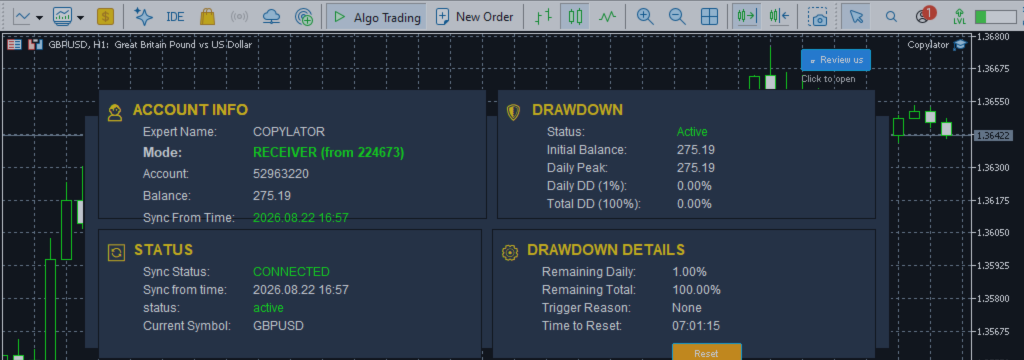
COPYLATOR includes drawdown protection settings on the Receiver side, allowing each receiving account to apply its own configured limits.
The protection supports daily and total drawdown controls. When a configured limit is breached, the Receiver can block further copying.
The CloseOrdersOnDrawdown setting determines the additional response:
- True: The configured drawdown response includes closing open positions and deleting pending orders.
- False: Copying is blocked without automatically performing those closing and deletion actions.
Daily automatic reset can be configured using ResetHour and ResetMinute, based on broker server time. This daily reset does not reset the initial balance used for total drawdown calculations.
A manual Reset option is also available in Drawdown Details on the Receiver. When used, it resets the daily and total drawdown calculations and sets the initial balance to the account's current balance.
These reset options should be used deliberately. A reset changes the reference point for drawdown calculations; it does not recover previous losses or reduce the account's actual financial risk.
THE HONEST ANSWER
Is drawdown protection essential in a Forex copier?
It is especially important when a substantial drawdown could cause the loss of a funded account, breach a client-agreed risk limit, trigger broker liquidation, or create financial consequences that the account owner cannot comfortably absorb.
For a small personal account where the entire allocated capital is affordable to lose, it may be an additional safeguard rather than an absolute requirement.
For situations between these extremes, the decision should be based on the account's exposure, the strategy's behavior, external restrictions, and the trader's ability to monitor the account.
In every case, correct configuration matters more than simply switching the feature on.
THE CONFIGURATION THAT MATTERS
A useful drawdown configuration should take account of:
- The strategy's historical and expected drawdown.
- The account's balance, equity, leverage, and open exposure.
- The broker's margin call and stop-out rules.
- Any prop firm or client-imposed loss limits.
- Whether the protection should block new copying only or also close positions and delete pending orders.
- The broker server time used for daily resets.
- The procedure for reviewing and resetting a breached limit.
Do not choose a threshold simply because it is a popular percentage. A suitable setting for one strategy or account may be inappropriate for another.
SUMMARY
Drawdown protection is an important risk-management feature for Forex copying, particularly when account losses can have consequences beyond an ordinary trading setback.
It is especially valuable for prop firm accounts, client accounts, highly leveraged accounts, and traders who cannot monitor their positions continuously.
For smaller personal accounts with clearly limited and affordable risk, it may be an additional safeguard rather than an absolute necessity.
COPYLATOR provides Receiver-side daily and total drawdown controls, configurable responses to limit breaches, and automatic or manual reset options.
The key is to configure those controls according to the account's real risk requirements and understand their limitations. Drawdown protection cannot eliminate trading risk, but it can help make risk decisions more structured, consistent, and automatic.
Product link:
https://www.mql5.com/en/ market/product/191385