Tilt and FOMO in trading: what happens after a loss and how to build a cooldown habit

Tilt and FOMO are two words traders borrowed for a familiar state: after a loss, or after watching a move run without you, decisions start to come from emotion instead of the plan. Emotional trading is part of trading psychology that no amount of strategy work removes. What helps is a trading mindset that expects it, and a habit for the minutes after it starts. This article explains what tends to happen after a loss and how to build a cooldown habit, with or without a tool, and where DuoFX Trading Psychology (user guide) fits in.
DuoFX Trading Psychology is free for MT5 and MT4, and it will stay free.
What tilt is
Tilt comes from poker. It describes a player who keeps playing after a bad beat, but plays worse: looser, faster, larger. In trading it looks similar:
- entries come faster and with less evidence,
- position size goes up,
- stops get wider or disappear,
- the goal shifts from "trade my plan" to "get back to zero today".
Tilt rarely feels like tilt from the inside. It feels like seeing opportunities everywhere.
What FOMO is
FOMO, the fear of missing out, is the pull to enter because a move is happening, not because your setup is there. It often follows a loss ("that was my trade, and I missed the real move"), and it often follows a win as well ("I am on a run"). FOMO trades tend to enter late, after the move, with stops in awkward places.
What happens after a loss
A typical chain looks like this:
- 1. A trade hits its stop. A normal outcome, inside the plan.
- 2. The market turns and moves the way you expected. The loss now feels unfair.
- 3. A new entry, quickly, to catch the move. Often bigger.
- 4. If that loses too, the next one comes even faster.
The chain usually breaks only when something interrupts it: a rule, a break, or the account balance. A cooldown habit is a way to choose the first.
Building a cooldown habit
A cooldown is a fixed pause after defined triggers, decided in advance. Some guidelines:
- Define the triggers in writing. Common ones: three losses in a row, the daily loss limit, any trade taken within 15 minutes of a loss.
- Define the pause. 30 to 60 minutes, or the rest of the day for the daily loss limit.
- Define what you do in the pause. Leave the desk, walk, eat, write two lines about the trades. Not "watch the chart without trading", which keeps FOMO alive.
- Define the restart. Come back, read your plan, and take only a clear setup at your normal size.
- Decide it while calm. A rule made in the middle of tilt tends to be broken in the middle of tilt.
- Review weekly. How often did the cooldown trigger? Did you keep it? What happened on days you did not?
Like any habit, it takes repetition. The first few cooldowns feel like missed chances. After a few weeks, many traders find the pause is the part of the day that saves the most money.
Where DuoFX Trading Psychology helps
DuoFX Trading Psychology turns the triggers into something you can see and, if you choose, enforce:
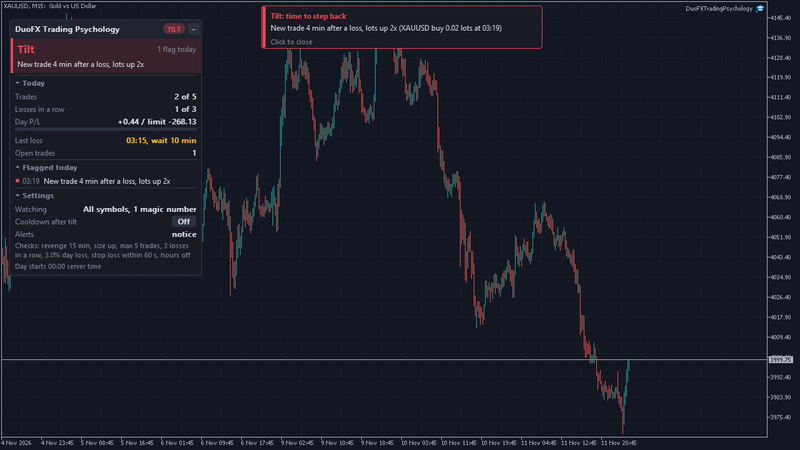
- The discipline meter shows Calm, Warning or Tilt with the reason in plain words: "3 losses in a row", "Daily loss limit reached", "2nd trade 4 min after a loss, lots up 2x".
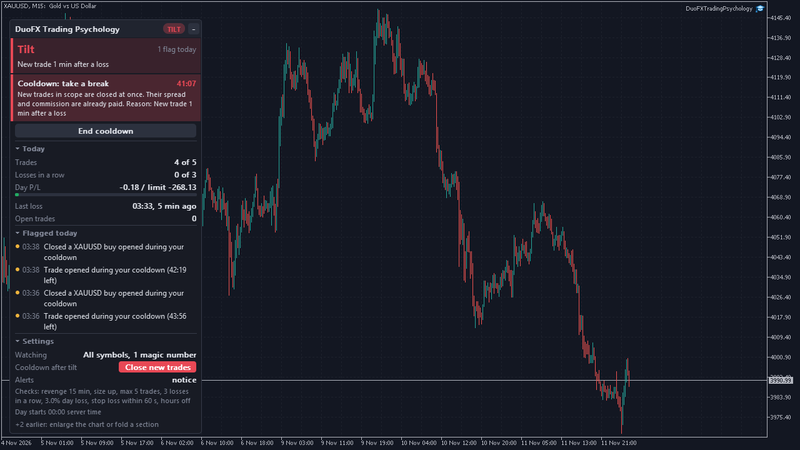
- The optional cooldown, switched on by you while calm, starts when the meter turns to Tilt through a losing streak, the daily loss limit or a revenge trade. It runs for the minutes you set or until the next trading day, with a countdown on the panel.
- In Warn only mode, every trade opened during the cooldown is flagged. In Close new trades mode, such a trade is closed at once. Trades that were open when the cooldown began are never touched. A closed trade still costs its spread and any commission, so the close mode is about stopping the chain, not about saving that trade.
- End cooldown ends it early, after a confirmed second click. The confirmation is deliberate: you set the rule for moments like this.
- It sees phone trades too, as long as the terminal runs, so the cooldown is not only for the desktop.
Starting small
If a forced cooldown feels too much, start with Warn only for two weeks. Each flag during a cooldown is a data point: you can count how many there were and how those trades did. Most traders who try this find the answer in their own numbers, and switch to the close mode, or to a shorter trading day, on their own terms.
FAQ
- Is tilt the same as revenge trading? Revenge trading is one form of tilt: trading to win back a loss. Tilt also covers overtrading, moving stops and sizing up.
- Can FOMO happen after a win? Yes. A run of wins can make a trader take setups they would normally skip.
- Will a cooldown make me miss good trades? Sometimes. A cooldown trades a few missed setups for fewer large losing days.
Try it free: DuoFX Trading Psychology for MT5 and DuoFX Trading Psychology for MT4. Free now and free for good, with a step by step user guide.
Risk note: trading carries a high risk of loss. This article and the tool are for education and information, not financial or psychological advice, and they do not promise results.