Trader burnout and exhaustion: signs to watch for and how to set limits before they cost you

Trader burnout and exhaustion are part of trading that few people talk about. Long screen hours, short nights, markets open around the clock and money moving on every tick add up. Mental health in trading is not a side topic: a tired trader makes different decisions from a rested one. This article covers the common signs of burnout, practical limits on screen time, sleep and breaks, and when to step away, with general good practice only. It is not medical advice. If stress from trading feels serious or lasts, talk to someone you trust or a professional.
DuoFX Trading Psychology is free for MT5 and MT4, and it will stay free.
Why it is free
We trade too, and we know how it feels at the end of a bad day: tired, frustrated, tempted to win it back. Mental health and exhaustion are part of trading that nobody talks about. This tool is our contribution, free now and free for good.
Signs worth noticing
Burnout tends to build slowly. Some signs traders often describe:
- Screen hours creep up. Checking the phone in bed, trading the Asian session after a full London and New York day.
- Sleep gets shorter or lighter, with positions on your mind at night.
- Small losses feel large and small wins feel like relief rather than satisfaction.
- Rules slip: stops moved, trades taken outside your plan, a trading plan that no longer gets read.
- Irritation and flat mood outside trading, less interest in things you used to enjoy.
- Results fall while effort rises. More hours, worse decisions.
None of these alone means burnout, and only you can judge your situation. A pattern over weeks is worth taking seriously.
Limits that help
Screen hours
- Decide your trading hours before the week starts and write them down. Two focused sessions usually beat a whole day of half attention.
- Close the charts outside those hours. Alerts on your phone can cover setups you truly cannot miss.
- Keep one day a week fully away from the markets.
Sleep
- Avoid trading in the hour before you sleep, and keep the phone with its trading app out of reach at night.
- If you hold trades overnight, set stops and alerts so you do not need to check.
- A late session after a short night is a good session to skip.
Breaks
- Take a short break every hour: stand up, look away, move.
- Take a longer break after any trade that made you feel strongly, win or loss.
Stepping away after a losing streak
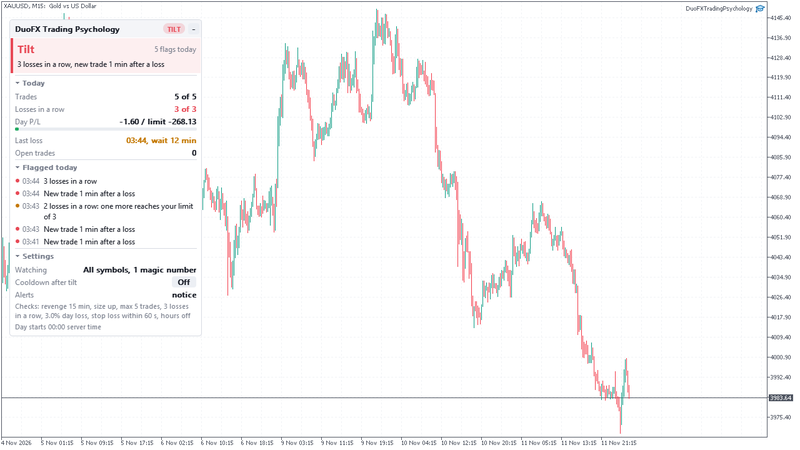
- Have a fixed rule: for example, after three losses in a row, the day is over.
- Have a daily loss limit in money, decided before the session.
- When you hit either, close the platform. Write two lines about the day, then do something unrelated.
These limits are useful because they are set while you are rested, and they apply when you are not.
Where DuoFX Trading Psychology helps
DuoFX Trading Psychology (user guide) watches the trades themselves, so it can point at the patterns that often come with exhaustion:
- Planned hours: list your sessions (for example 08:00-12:00, 14:00-18:00, server time) and a trade outside them is flagged. Late-night trades show up for what they are.
- Losing streak: a Warning one loss before your limit and a Tilt at the limit, with a clear line on the panel.
- Daily loss limit: a meter against your limit, with a Warning at 75%.
- No stop loss: a sign of rules slipping, flagged after a short grace time.
- An optional cooldown after a losing streak or the daily loss limit, chosen while calm, for the minutes you set or until the next trading day.
It also watches trades placed from the phone, as long as the terminal it runs in is on, for example on a VPS. That matters for the late-night trade from bed.
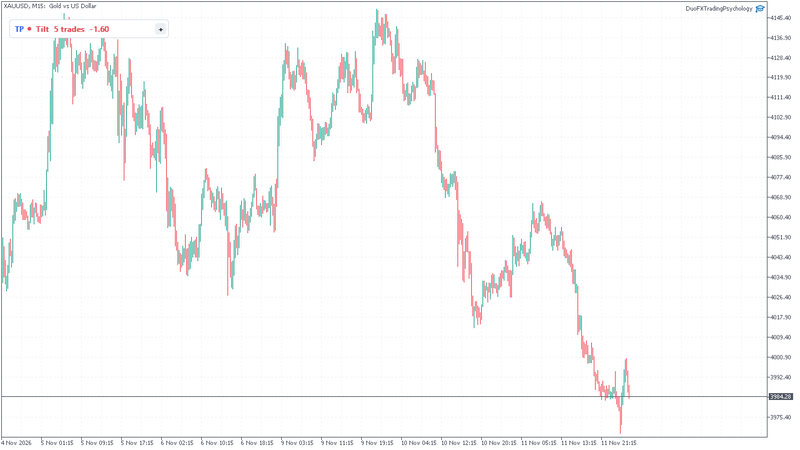
What it cannot do is tell how you feel. It reads trades, not people. Treat its flags as a prompt to check in with yourself, and keep the limits above whether you use a tool or not.
When to talk to someone
If stress from trading affects your sleep, your relationships or your work for more than a short while, or if you feel unable to stop trading when you want to, it is worth talking to someone you trust or a qualified professional. Many countries have free helplines for stress and for gambling-like behaviour around money. Asking for help early is a sensible decision, the same as cutting a losing trade early.
A simple weekly review
Once a week, answer four questions:
- 1. How many hours did I spend at the screen?
- 2. How many nights did I sleep well?
- 3. How many trades were outside my plan or my hours?
- 4. Did I stop when my limits said so?
Change one thing for the next week, and see what happens.
Try it free: DuoFX Trading Psychology for MT5 and DuoFX Trading Psychology for MT4. Free now and free for good, with a step by step user guide.
Note: this article is general information about trading habits. It is not medical, psychological or financial advice, and the tool it mentions does not promise results. Trading carries a high risk of loss.