
Product link:
https://www.mql5.com/en/ market/product/191385
Drawdown protection is often presented as a universal feature. Every copier should have it, every trader should configure it, and every account should be protected by it. That framing is reasonable, but incomplete. The feature matters far more to some traders than to others, and understanding which group you belong to helps determine how carefully it should be configured.
There are five groups of traders for whom drawdown protection deserves particular attention. If you belong to any of them, the question is not simply whether to configure it, but how to configure it in a way that reflects your actual risks.
Prop Firm Traders
The first group is prop firm traders. For them, drawdown protection can be especially important because exceeding a firm's daily or maximum loss threshold may result in failing a challenge or losing access to a funded account.
Prop firms define their own risk rules. These may include daily loss limits, maximum loss limits, equity-based calculations, balance-based calculations, and specific reset times. The exact rules vary between firms and account types, so traders must understand the relevant agreement rather than assume that every firm uses identical calculations.
A copier without suitable drawdown controls can expose the receiver account to the sender's full trading behavior. A difficult trading session, several correlated positions moving against the account, or a sequence of losses may bring the account close to a firm's limit before the trader has time to intervene.
Configuring COPYLATOR's drawdown thresholds below the firm's applicable limits can provide an additional control layer. The difference between the copier's threshold and the firm's threshold acts as a safety buffer.
However, this buffer must account for floating losses, execution delays, slippage, market gaps, and differences between the firm's measurement method and the copier's calculation method. A copier threshold cannot guarantee that a prop firm's loss limit will never be breached.
For prop firm traders, drawdown protection is an important part of a broader compliance and risk-management plan.
Traders Managing Client Capital
The second group includes traders who manage other people's money, operate signal services, or provide copy-trading arrangements to clients.
These traders face responsibilities that go beyond their own tolerance for losses. Clients may have expectations about acceptable drawdown levels, account behavior, and how risk will be managed.
A manager might consider a 20% drawdown acceptable because they understand the strategy's historical performance. A client with different financial circumstances may not share that view.
Drawdown protection can help managers establish predefined account-level boundaries. It can also support more transparent risk-management procedures when the limits and their implications have been clearly communicated.
Two considerations are particularly important:
- Practical risk control: Configure thresholds that reflect the agreed risk policy and the characteristics of each receiver account.
- Accountability: Document the selected limits, explain what happens when they are reached, and review whether the configuration remains appropriate.
Drawdown protection does not replace client agreements, regulatory obligations, or the manager's responsibility to monitor accounts. It is one technical tool within a much broader framework of responsible capital management.
Traders Using High Leverage
The third group consists of traders whose leverage and position sizes leave relatively little room for adverse market movements.
High leverage can magnify the effect of price movements on account equity. If positions consume a large portion of available margin, even a relatively modest adverse move may bring the account closer to a margin call or stop-out.
In such circumstances, the broker's margin rules may become more important than the strategy's historical drawdown.
The trader should calculate the distance between current account equity and the broker's margin or stop-out level. The copier's drawdown threshold should be configured with sufficient room for the intended protective action to take place before the account reaches a critical margin condition.
However, there is no universal percentage buffer that works for every broker, instrument, or account. A fixed recommendation such as 20–30% may be unsuitable when contract specifications, leverage, margin requirements, or market volatility differ.
For highly leveraged accounts, drawdown protection should be combined with conservative position sizing, adequate free margin, and a clear understanding of the broker's liquidation rules.
Traders Following Unproven Senders
The fourth group includes traders copying a sender whose behavior is not yet fully understood.
Every trading history describes what happened under previous market conditions. It cannot establish the maximum drawdown that the strategy may experience in the future.
A strategy that recorded a 15% maximum drawdown over two years could experience a substantially larger decline under different market conditions. A sender with only a short track record has also had less opportunity to demonstrate how the strategy behaves during prolonged losing periods.
For these receivers, drawdown protection helps establish a loss boundary while they evaluate the sender's performance.
During the evaluation period, pay attention to:
- The sender's historical drawdown and recovery behavior.
- Position sizes and changes in exposure.
- The number of simultaneous open positions.
- How the strategy behaves during high volatility.
- Whether the strategy's risk profile changes over time.
As more information becomes available, the receiver can review the thresholds. A longer track record may improve the quality of the assessment, but it never eliminates uncertainty or makes drawdown protection unnecessary.
Traders Who Cannot Monitor Their Accounts Continuously
The fifth group consists of traders whose daily circumstances prevent them from watching their accounts throughout the trading day.
This may include people with full-time jobs, traders in different time zones, frequent travelers, or anyone who does not want to monitor charts continuously.
When the receiver is unavailable, a sudden market movement or a series of copied losses may develop before they notice what is happening.
Drawdown protection can provide an automated response when a configured threshold is reached. Depending on the selected settings, COPYLATOR can block further copying and can also close positions and delete pending orders.
It is important to understand that a copying block alone does not necessarily close existing receiver positions. If automatic closing is not enabled, those positions may remain exposed to market movements.
Alerts and account monitoring can provide additional awareness, but no automated mechanism should be treated as a complete substitute for supervision. VPS availability, terminal connectivity, broker execution, and market conditions can all affect the result.
For traders who cannot monitor continuously, a tested configuration is particularly valuable because it defines what should happen when they are unavailable.
Who Needs It Less?
There is another group worth considering: traders who copy a well-established strategy, have substantial account capital relative to their position sizes, face no strict external loss rules, monitor their accounts regularly, and can tolerate meaningful drawdowns.
These traders may have more flexibility when choosing their thresholds. Their limits may be wider, depending on their strategy and financial circumstances, and the protection may trigger less frequently.
However, lower perceived risk does not mean that drawdown protection has no value.
A proven strategy can still encounter unexpected market conditions. A large account can still suffer losses, and a trader who monitors frequently can still miss a rapid market event.
The distinction is not between traders who need protection and traders who do not. It is between traders who face different levels and types of risk.
The Common Pattern Across These Groups
Although these five groups have different circumstances, they share an important characteristic: a trading loss can produce consequences beyond the immediate financial decline.
- Prop firm traders: A loss may result in failing a challenge or losing a funded account.
- Client-capital managers: A loss may affect client relationships, commitments, and professional responsibilities.
- Highly leveraged traders: A loss may bring the account close to broker-initiated liquidation.
- Traders following unproven senders: A loss may exceed what the limited historical record suggested was possible.
- Traders who cannot monitor continuously: Losses may accumulate before the trader becomes aware of the situation.
Drawdown protection helps address these risks by establishing predefined account-level boundaries and responses. It does not eliminate the underlying trading risk, but it can reduce dependence on last-minute manual intervention.
Configuring Drawdown Protection for Different Trading Situations
The configuration should reflect the receiver's account conditions rather than follow one universal set of values.
For Prop Firm Traders
- Understand the firm's daily and total loss rules.
- Confirm whether the firm measures losses using equity, balance, or another reference.
- Check the firm's reset time and compare it with the broker's server time.
- Set copier thresholds below the firm's limits with an appropriate safety buffer.
- Test the trigger response and confirm how open positions and pending orders are handled.
For Traders Managing Client Capital
- Define acceptable drawdown levels before trading begins.
- Ensure the configuration reflects the agreed risk policy.
- Document the thresholds and the reasons behind them.
- Review the settings when account size, strategy, or client requirements change.
For Highly Leveraged Traders
- Calculate the account's available margin and distance to stop-out.
- Use conservative lot sizing and appropriate maximum lot caps.
- Consider the combined exposure of simultaneous positions.
- Configure drawdown protection with sufficient room for execution delays and market volatility.
For Traders Following Unproven Senders
- Begin with an exposure level the receiver can afford to evaluate.
- Monitor actual drawdown rather than relying exclusively on historical statistics.
- Review position sizing and changes in trading behavior.
- Reassess the limits as the sender's performance becomes better understood.
For Traders Who Cannot Monitor Continuously
- Configure daily and total drawdown thresholds.
- Decide whether the trigger should block copying only or also close positions and delete pending orders.
- Check terminal and VPS reliability.
- Enable available notifications and test them.
- Establish a procedure for reviewing the account after protection is triggered.
Each situation requires different parameters because each has different constraints. The protection mechanism may be the same, but the appropriate configuration is not.
How COPYLATOR Supports Different Risk-Management Needs
COPYLATOR – MT5 Trade Copier provides several controls that can help receivers manage copied-trading exposure:
- Daily drawdown protection: Monitor losses against a configured daily threshold.
- Total drawdown protection: Define a broader account-level loss boundary.
- Blocking further copying: Prevent additional copied trades after the configured drawdown condition is reached.
- Optional position closing: Close positions when the relevant drawdown action is enabled.
- Pending-order deletion: Remove pending orders as part of the configured protective response.
- Manual and automatic reset: Use the available reset mechanisms according to the account's risk-management plan.
- Flexible lot management: Adjust copied position sizes using the available sizing methods and maximum lot controls.
These controls should be tested on a demo account before being relied upon with live capital. In particular, understand the difference between blocking copying and closing existing positions.
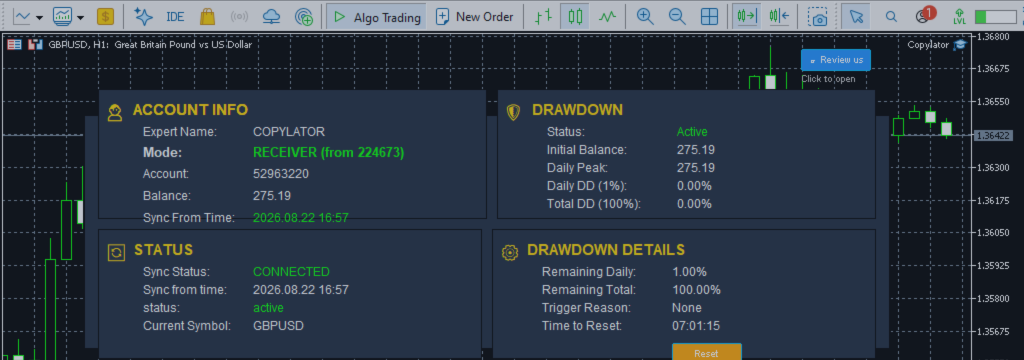
Also remember that a manual reset in COPYLATOR's Receiver Drawdown Details resets daily and total drawdown and sets the initial balance to the current account balance. The automatic daily reset does not reset the total drawdown baseline.
Summary
Drawdown protection is useful to every copy trader, but it deserves particular attention from traders whose circumstances make losses especially costly.
Prop firm traders use it as an additional layer of protection against account-rule breaches. Traders managing client capital use it to support predefined risk policies. Highly leveraged traders need to consider it alongside margin and stop-out conditions. Those following unproven senders use it to manage uncertainty, while traders who cannot monitor continuously benefit from predefined automated responses.
For traders outside these groups, drawdown protection remains valuable, although their configuration may be different.
The central principle is simple: the more serious the consequences of an uncontrolled drawdown, the more carefully the protection should be designed, configured, and tested.
Drawdown protection cannot make a risky strategy safe. It can help ensure that the receiver has a defined response when the strategy performs worse than expected.
Product link:
https://www.mql5.com/en/ market/product/191385