Automate Your Signal Service End to End — COPYLATOR – MT5 Trade Copier

Product link:
https://www.mql5.com/en/ market/product/191385
There is an important difference between using a trade copier and automating an entire signal service.
Using a copier means that trades are replicated automatically. Automating a service means building an operational process in which trade execution, position management, risk controls, monitoring, onboarding, and verification work together with as little repetitive manual effort as possible.
Many providers automate only the first part. They replicate orders automatically but continue to calculate volumes, contact clients, check terminal status, and verify copied trades manually.
Here are seven stages of a more complete automation process, including what a trade copier can handle and what the provider still needs to configure.
STAGE ONE: THE TRADE ITSELF
This is the stage most providers already understand.
You open a position on your trading account. COPYLATOR detects the trade and communicates the relevant order information to connected Receiver terminals, where the trade can be replicated according to each Receiver's configuration.
Each client can use an appropriate lot-sizing method, such as fixed volume, a multiplier, or balance-based sizing. Symbol mapping helps match the Sender's instrument with the corresponding symbol at the client's broker. The Receiver also operates within its own broker's trading conditions and volume requirements.
This removes the need to place the same order manually in every client account. One trading decision can be distributed to multiple connected accounts without repeating the entire order-entry process.
Execution is not necessarily simultaneous or identical across accounts. Communication delays, terminal performance, network conditions, broker execution, liquidity, spread, and slippage can all affect the final result.
STAGE TWO: POSITION MANAGEMENT
A trade is not finished when it opens. Its stop-loss may be moved, its take-profit may be adjusted, or part of the position may be closed as the market develops.
These management actions can also be replicated by COPYLATOR. When the Sender modifies supported order parameters, connected Receivers can apply the corresponding changes according to their configuration.
For example, a provider may move a stop-loss to break-even or tighten it as the trade progresses. Instead of manually updating every client account, the provider makes the change on the Sender account and lets the copier distribute the modification.
The objective is to reduce inconsistent manual updates. However, the resulting levels and execution may differ between accounts because of different entry prices, broker restrictions, minimum stop distances, and market conditions.
Partial Close is also supported. A provider can reduce a position, and the corresponding reduction can be replicated on connected Receivers. Actual closed volumes may vary where brokers impose different minimum lot sizes or volume steps.
STAGE THREE: TRADE EXITS
Closing positions is another repetitive task that becomes more difficult as the number of clients increases.
A trade may end because:
- The take-profit is reached.
- The stop-loss is reached.
- The provider closes the position manually.
- The provider closes part of the position and leaves the remainder open.
COPYLATOR supports the replication of trade-management actions, including supported closing and partial-closing operations.
This reduces the need for the provider to repeat closing instructions across multiple accounts. Nevertheless, the outcome on each Receiver depends on its own order status and execution conditions. A stop or target may be triggered at different prices, and execution delays or broker restrictions can produce differences.
Providers should therefore avoid assuming that every client account will always have exactly the same open positions, closing prices, or realized results as the Sender.
STAGE FOUR: THE RISK LAYER
This is one of the most important stages of a scalable signal service.
The provider manages the strategy, but each client should understand and configure the risk appropriate to their own account. Different balances, leverage settings, broker conditions, and personal risk tolerances mean that one configuration is not necessarily suitable for everyone.
Depending on the available features and the Receiver's configuration, COPYLATOR provides risk-management options such as:
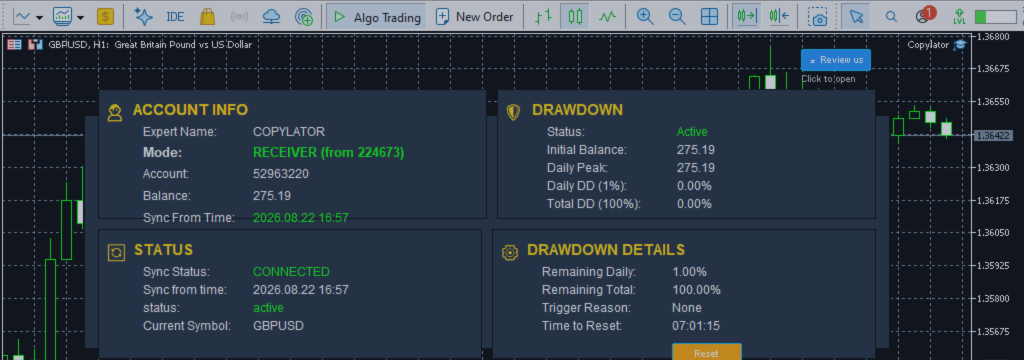
- Drawdown protection: Configure daily and total drawdown limits. When a configured limit is reached, the Receiver can block further copying. The option to close existing positions and delete pending orders can also be configured.
- Flexible lot management: Use fixed lots, a multiplier, or balance-based sizing, with a maximum lot cap where appropriate.
- Independent Receiver settings: Each client can configure their own supported risk parameters rather than relying on the provider to manage every account individually.
Drawdown protection is a risk-control mechanism, not a guarantee that realized losses will never exceed the configured threshold. Slippage, gaps, execution delays, and other market or broker conditions can affect the final result. Blocking new copying also does not automatically eliminate the risk of positions that remain open unless the relevant closing option is enabled.
Any additional controls, such as spread, direction, or time filters, should be treated as separate configuration requirements and verified before being included in a client's standard setup. They should not be assumed to be automatic COPYLATOR features unless the relevant functionality is available in the installed version.
STAGE FIVE: MONITORING
Automation is only useful when the infrastructure supporting it remains operational.
A Sender terminal may stop working because of a VPS restart, a Windows update, a terminal crash, or a network interruption. A Receiver may also disconnect or stop processing incoming information.
If the provider discovers the problem only after a client complains, the service has a monitoring gap.
A practical monitoring setup should include:
- Running the trading terminals on a reliable VPS or another suitable always-on computer.
- Configuring the operating system and terminal to restart after an unexpected failure where possible.
- Using available MT5 alerts or external monitoring tools to detect terminal disconnections.
- Monitoring the communication mechanism and checking whether the relevant data is being updated.
- Checking Receiver terminals periodically rather than assuming that every client remains connected.
These monitoring arrangements are part of the provider's operational setup. They should not be confused with a guarantee that the copier itself can detect and report every possible VPS, operating-system, network, or terminal failure.
A provider with five clients may be able to check each account manually. With fifty clients, a structured monitoring process becomes much more important.
STAGE SIX: CLIENT ONBOARDING
Every new client introduces another configuration that must be checked.
The Receiver needs to be installed and configured. The client must enter the appropriate Sender account number, select a lot-sizing method, review symbol mapping, and configure suitable risk limits.
A documented onboarding procedure can make this process considerably more consistent.
A practical approach is to prepare a standard configuration guide containing:
- Installation instructions for the Receiver.
- The correct Sender account number and connection settings.
- Recommended lot-sizing options, with an explanation of their differences.
- Instructions for checking symbol mapping and handling instruments that require manual mapping.
- Drawdown and other relevant risk settings.
- A checklist for confirming that the Receiver is connected and operating correctly.
Before using the configuration on a live account, the provider can test it on a separate demo or sandbox account. A controlled test trade can help confirm that the connection, symbol mapping, volume calculation, and basic order replication are working as expected.
The same documented procedure can then be reused for future clients. This reduces repeated explanations and makes onboarding easier to verify.
STAGE SEVEN: VERIFICATION
The final stage is checking whether the automation is actually producing the intended results.
A connected terminal or an apparently normal dashboard does not prove that every trade has been copied correctly. Providers should periodically compare Sender and Receiver activity.
A useful reconciliation procedure includes:
- Exporting or reviewing the Sender's trade history.
- Reviewing the corresponding Receiver histories.
- Matching trades using available identifiers and order details, such as symbol, direction, volume, opening time, and any relevant comments.
- Checking for missing trades, unexpected open positions, partial-close differences, and volume discrepancies.
- Investigating differences and documenting their causes.
Do not assume that Sender and Receiver ticket numbers will be identical. They are separate trading accounts, and their order identifiers can differ. Comments or other identifiers may help with matching where they are available and preserved, but the reconciliation process should not depend on a single identifier.
A weekly review is a reasonable starting point for many providers. The frequency should be increased when trading activity, client numbers, or operational risk justify it.
WHAT REMAINS MANUAL
It would be misleading to describe a signal service as completely autonomous simply because it uses a trade copier.
The trading decisions remain with the provider. The provider decides when to enter, where to place stops and targets, and when to close positions. COPYLATOR distributes supported trading actions; it does not independently create or validate the strategy.
The strategy remains the provider's responsibility. It must be designed, tested, monitored, and adjusted when necessary. A copier does not make an unprofitable strategy profitable.
The client relationship remains important. Clients may need explanations, technical support, risk disclosures, and updates. Automation reduces repetitive operational work, but it does not replace communication or responsible service management.
What automation primarily removes is duplication: repeatedly placing orders, calculating volumes, modifying positions, and manually distributing the same instructions to multiple accounts.
THE AUTOMATION CHECKLIST
A well-organized signal service should have the following arrangements in place:
- The Sender terminal runs on a reliable VPS or another suitable always-on system.
- Terminal and operating-system recovery procedures are configured where possible.
- Monitoring is in place for Sender and Receiver disconnections.
- The communication mechanism is checked for unexpected interruptions or stale data.
- Each Receiver has independently configured lot sizing and risk limits.
- A separate demo or sandbox Receiver is available for testing configuration changes.
- A documented onboarding procedure is maintained and updated.
- A reconciliation procedure is performed regularly.
- Clients understand that execution prices and results may differ from the Sender account.
Some of these arrangements are provided by the copier, while others depend on MT5, the VPS, external monitoring tools, and the provider's own operating procedures. A reliable service requires all of these elements to work together.
THE SCALE THRESHOLD
The reason to automate is not simply convenience. It is the ability to manage more client accounts without repeating every operational task manually.
With a small number of clients, a provider may be able to place orders, calculate volumes, and send updates individually. As the client base grows, the number of repeated actions grows as well.
A trade copier can reduce this duplication by distributing supported trading actions to multiple Receiver accounts. Client-side configuration also allows each account to apply its own lot-sizing and risk settings.
However, automation does not make the provider's workload completely constant. More clients can still mean more onboarding, support requests, account checks, and operational incidents. The benefit is that routine trade replication no longer needs to be repeated manually for every account.
That is an important step toward building a service that can grow in a more organized and manageable way.
THE HONEST ASSESSMENT
An automated service is not automatically better in every respect.
Some clients value personal communication and frequent updates from the provider. An automated service may feel less personal if the provider stops communicating simply because the technical process is automated.
The best approach is to separate operational automation from client communication. Let the copier handle supported trade replication and position-management tasks, while the provider remains available for explanations, support, and important service updates.
Automation should improve consistency and reduce repetitive work, not create the impression that clients no longer need attention.
SUMMARY
Automating a signal service involves more than copying the initial trade. It requires a coordinated process covering seven stages:
- Trade execution and replication.
- Position management.
- Trade exits.
- Client-side risk controls.
- Terminal and connection monitoring.
- Consistent client onboarding.
- Periodic verification and reconciliation.
COPYLATOR provides the trade-copying mechanism for distributing supported orders and management actions across connected MT5 accounts. The provider builds the surrounding process through suitable VPS configuration, monitoring, documentation, testing, and regular verification.
The trading strategy and client relationship remain human responsibilities. The repetitive operational work, however, can be reduced substantially through a properly configured automation process.
Product link:
https://www.mql5.com/en/ market/product/191385