If You Are a Signal Provider, This Copier Does the Work For You — COPYLATOR – MT5 Trade Copier

Product link:
https://www.mql5.com/en/ market/product/191385
Running a signal service is not one job. It is several jobs performed by the same person. You analyze, you trade, you distribute, you support, and you keep records. Only the first two are directly related to the trading service itself. The others can consume a significant amount of time and operational effort.
A trade copier is not a complete signal distribution business platform. It is not a marketing system, billing service, or client portal. What it can do, when configured correctly, is remove much of the manual duplication from your operation, allowing you to spend less time repeating trades across accounts.
Here is what that looks like in practice with COPYLATOR – MT5 Trade Copier.
The Problem: One Trade, Forty Accounts
A signal provider with forty followers faces an operational challenge that a solo trader does not have.
Every trade may need to be replicated across dozens of accounts. Every stop adjustment, partial close, break-even move, and exit must also reach the corresponding follower accounts.
Doing this manually is time-consuming and increases the chance of mistakes. A lot size can be entered incorrectly on one account. A stop adjustment can be missed on another. A follower may remain in a position after the provider has already closed it.
This is the duplication problem a trade copier is designed to reduce.
One Account Becomes the Source
The provider's trading account becomes the Sender. COPYLATOR is attached to a chart on that MT5 terminal and configured in Sender mode.
Once configured and running, the provider can continue trading normally. When a position is opened, modified, partially closed, or closed, the Sender publishes the relevant trading activity for the connected Receivers.
The provider does not need to manually repeat every trade on every follower account or calculate each follower's lot size individually.
The copier handles the distribution process, subject to the configured settings and the availability of the Sender terminal.
Each Follower Becomes a Receiver
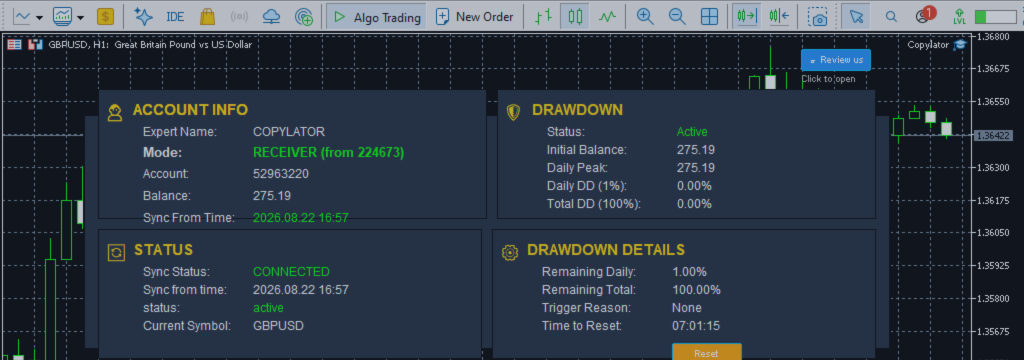
Each follower installs COPYLATOR on their own MT5 terminal and configures it in Receiver mode, using the provider's Sender account number.
The Receiver reads the published trading activity and replicates it according to its own configuration. This can include lot sizing, symbol mapping, and applicable risk controls and filters.
The provider does not need to operate the follower's trading terminal or manually enter the follower's trades. Each follower manages their own Receiver configuration and trading account.
Lot Sizing Handles Different Account Balances
One of the biggest practical challenges in signal distribution is the difference between account sizes.
A provider trading 1.00 lot should not necessarily send 1.00 lot to a follower whose account is much smaller. Each follower needs a volume appropriate to their own account and risk preferences.
COPYLATOR offers several lot-sizing methods, including fixed lot, multiplier, and balance-ratio sizing.
With balance-ratio sizing, the copied volume is calculated using the relationship between the Receiver's balance and the Sender's balance, subject to the platform's volume normalization and broker constraints.
For example, if a follower's balance is 10% of the Sender's balance, balance-ratio sizing can calculate a copied volume approximately equal to 10% of the Sender's volume. A follower with 250% of the Sender's balance may receive approximately 250%, subject to the configured maximum lot cap and the broker's permitted volume steps.
The important point is that each Receiver applies its own sizing configuration. The provider does not have to calculate every follower's volume manually.
Symbol Mapping Handles Different Brokers
Followers may use different brokers, and brokers do not always use identical symbol names for the same instrument.
For example, gold may appear as XAUUSD on one broker, XAUUSDm on another, and GOLD or XAUUSD.pro elsewhere.
COPYLATOR includes automatic symbol mapping to help match equivalent instruments between the Sender and Receiver. If automatic matching does not identify the correct symbol, the follower can configure a manual mapping on the Receiver side.
This reduces the need for the provider to manage symbol-name differences for every follower.
SL/TP Synchronization Handles Trade Management
A trade is not finished when it opens. The provider may move a stop-loss, change a take-profit, partially close a position, or close the entire trade.
COPYLATOR supports synchronization of stop-loss and take-profit changes between Sender and Receiver accounts. When the provider modifies trade protection, the Receiver can apply the corresponding update according to the copier's synchronization settings and execution conditions.
Partial Close is also supported, allowing a partial closing action on the Sender to be replicated on the Receiver.
These operations reduce the need for separate messages every time the provider manages an open position. However, differences in broker execution, volume steps, minimum stop distances, and market conditions can affect the exact result on individual Receiver accounts.
Investor Password Support Changes the Access Model
For providers who do not want to give trading access to their source account, investor-password support can be useful.
The Sender EA can operate on an MT5 terminal logged in with an investor, or read-only, password, provided the broker and terminal allow the required account information to be accessed.
In this arrangement, the Sender reads the account's trading activity but does not place trades on the source account. The provider retains control of the trading account, while the Receiver accounts use the published information to replicate trades.
This separates access to trading information from permission to execute trades on the provider's account.
Multi-Receiver Support Handles Growth
COPYLATOR supports a multi-sender and multi-receiver structure, including one-to-many distribution.
A provider with five followers and a provider with fifty can use the same basic Sender-to-Receiver approach. Each follower runs their own Receiver instance on their own MT5 terminal.
Adding a follower generally requires configuration on the new Receiver side rather than manually changing the provider's trading routine.
The provider's trading activity can therefore be distributed to multiple connected accounts without manually repeating each trade.
Risk Limits Stay on the Follower's Side
A common question is what happens when followers have different risk preferences.
Each Receiver can be configured independently. Followers can select their own lot-sizing method, maximum lot cap, and available drawdown protection settings.
COPYLATOR's drawdown protection can be configured to block further copying when a defined daily or total drawdown threshold is reached. Depending on the selected settings, the Receiver can also close positions and delete pending orders when the configured drawdown condition is triggered.
Other available filters can help followers control which trades they accept, including supported spread, time, day, and direction filters.
This allows followers to apply their own account-level rules rather than relying entirely on the provider's risk preferences.
However, a copier's drawdown protection is not a guarantee against losses or broker stop-out. Execution delays, slippage, gaps, and existing positions can affect the final account result. Each follower remains responsible for understanding their broker's rules and monitoring their own account.
What the Provider Still Has to Do
It would be misleading to claim that a copier removes every operational responsibility from a signal provider. It does not.
The provider still has to trade and manage the strategy. The copier distributes trading activity; it does not create a profitable strategy or make trading decisions on the provider's behalf.
The provider also needs to handle onboarding. New followers may need help installing the EA, configuring the Sender account number, selecting the appropriate lot-sizing method, and checking that their first test trade is copied correctly.
Monitoring is still important. The provider should confirm that the Sender terminal is running and that the copying setup is functioning as expected. Followers should also monitor their own Receiver terminals and accounts.
Finally, the provider remains responsible for communicating with followers about strategy performance, trading risks, and service conditions. The copier reduces mechanical repetition, not the need for a relationship with clients.
What the Provider No Longer Has to Do Manually
The main benefit is the reduction of repetitive trading operations.
- Manually opening the same trade on every follower account.
- Calculating every follower's lot size for each new position.
- Repeating stop-loss and take-profit adjustments account by account.
- Manually processing corresponding partial closes and exits.
- Sending separate instructions for every routine trade-management action.
Automating these repeated steps can reduce manual errors and save time. It does not eliminate every possible copying or execution issue, but it removes many tasks that would otherwise need to be performed separately on each account.
The Operational Setup
A typical one-to-many setup has a straightforward structure:
- One MT5 terminal running the Sender EA on the provider's account.
- The provider's Sender account configured with the appropriate account number.
- Each follower running a separate MT5 terminal with a Receiver instance.
- Each Receiver configured with its own lot sizing, symbol mapping, filters, and risk settings.
COPYLATOR uses the MT5 Common Folder for local communication between its Sender and Receiver components on the same computer. This architecture does not require an external cloud server or a separate API service for that local communication.
For deployments across different computers, the communication environment and required file access must be configured appropriately. The provider should test the complete setup before relying on it for live signal distribution.
Summary
A signal provider's operational workload is not limited to analyzing and executing trades. Distributing those trades across multiple follower accounts can create a substantial amount of repetitive work and introduce avoidable mistakes.
COPYLATOR helps automate that process. Lot-sizing options address differences in account balances. Symbol mapping helps handle different broker symbol names. SL/TP synchronization and Partial Close support ongoing trade management. Investor-password support provides a read-only option for the Sender account, while multi-receiver functionality supports distribution to multiple follower accounts.
Each follower can configure their own Receiver settings and risk controls, while the provider focuses on trading, onboarding, monitoring, and communication.
A trade copier does not replace a signal provider's responsibility for strategy quality, transparency, or risk communication. What it can do is make the operational side of distributing trades more organized and less dependent on manual repetition.
Product link:
https://www.mql5.com/en/ market/product/191385