When a provider and follower report different results, I compare one matched trade before comparing monthly returns. That keeps execution, sizing and account reporting in view. A monthly chart can flag a difference. It rarely explains where the difference entered the process.
Following a strategy does not make two accounts identical
Copy trading links trading activity, not every condition affecting an account. The provider and follower may have different fills, position sizes, costs, funding histories or observation periods. Two percentage figures can therefore differ without either figure explaining why.
The useful response is to compare like with like before deciding what went wrong. Start with matched trades and account records, not a headline return or a screenshot from another date. A difference deserves investigation; it is neither automatic proof of a technical fault nor something to dismiss without evidence.
This guide provides a practical comparison method. It does not describe proprietary SmiteFX execution rules, promise tracking accuracy or recommend a broker or allocation.
If the copied strategy uses an Expert Advisor, use the pre-live EA evaluation checklist to examine its underlying evidence as well. Checking whether trades were copied and deciding whether an EA is suitable are separate tasks.
Establish which copying service you are using
“Copy trading” describes more than one implementation. Broker-managed copying, MQL5 Signals and other services can use different sizing, synchronisation and operating arrangements. Find the documentation for the actual service and account type before applying a setting from someone else's guide.
The MetaTrader signal-subscription documentation, for example, describes MQL5 Signals-specific checks and controls. Those details should not be treated as rules for every broker's copying platform.
For SmiteFX, use the current links on the Copytrade page to identify the offering you are reviewing. Verify its terms directly. This article does not announce identical behaviour across those offerings or claim that they use MQL5 Signals.
Match the trade before comparing its result
Compare the same instrument, direction and entry/exit sequence over the same time window. Keep the account statement or supported service record that establishes which follower transaction corresponds to the provider's activity.
Then separate three questions:
- Was the intended activity copied?
- Was the copied exposure what the service's rules and chosen settings imply?
- Were the actual execution and account costs different?
These questions need different evidence. A missing transaction is not the same issue as a smaller transaction, and neither is established just because the account's return is lower.
If a trade match cannot be established, record that limitation rather than producing a precise comparison from assumed pairs.
Entry and exit prices can differ
A copied instruction and its executed deals are different records. Compare actual opening and closing prices rather than assuming a chart marker was the fill. MetaTrader's signal-selection guide includes copying/slippage information for its service; it is an input to investigation, not a guarantee about your next transaction.
For an original hypothetical example, assume the same unit exposure, instrument and account currency, with no costs. Account A buys at 100 and exits at 105; Account B buys at 101 and exits at 105. Their price changes are 5 and 4 units. That arithmetic shows why different entry prices matter. It is not a real instrument quote, a return calculation or a measured copying result.
In a real review, use the contract specification and recorded charges to translate price changes into account money. Do not add an assumed spread charge again if it is already reflected in the executed prices. The spread and slippage guide provides a checklist for distinguishing quoted prices, actual fills and separately recorded charges.
Similar lot labels do not establish similar exposure
Check the instrument and broker specifications before treating a quoted lot size as comparable. The official MQL5 symbol-property reference distinguishes contract size, tick size/value and permitted volume increments. These are separate inputs to interpreting a position.
For example, a symbol name containing “gold” is not a complete exposure specification. Record the exact symbol and its units. Also inspect the service's documented allocation rules and your selected settings rather than assuming every copier uses the same balance ratio.
MQL5 Signals documentation specifically warns about mismatched volume limits and unavailable symbols between accounts. Use that as a labelled example of a platform compatibility issue, not a universal formula for SmiteFX broker copying.
Higher leverage is not, by itself, proof that a particular trade has a different price-based profit or loss. Compare actual exposure and account conditions; do not confuse available margin with a matched trade's result.
Starting later can produce a different trade sample
Account comparisons need a common observation window. A follower who began later may not have the same set of transactions as the provider's lifetime record. Check what the actual service does with positions already open when copying starts.
MQL5 Signals has documented synchronization behavior. Other services may handle joining or interruptions differently. Do not assume that every follower enters at the provider's original historical price, or that a delayed start can be reconstructed from a headline chart.
Write down the copying start time, any recorded interruption and which positions are included. If the sample differs, compare the overlapping activity separately before interpreting the whole-account totals.
Separate trade outcomes from account reporting
Cash profit, percentage return and changes in account balance are different comparisons. Deposits, withdrawals, account currency and the report's treatment of open positions can change what a summary means. Use the same dates and disclose whether you are examining closed activity or current equity.
Record any commissions, financing and service fees shown by the actual records and terms. Do not assume that a provider's public statistic and a follower's cash balance include the same items. If a fee has not yet been charged, label it as an expected cost rather than inventing a deduction in the statement.
Our Myfxbook reading guide helps distinguish the evidence behind a public record. The drawdown guide explains why the path of equity also matters; a return comparison alone is not a complete risk assessment.
Use a small discrepancy worksheet
For one matched trade or an agreed date range, keep:
- Provider and follower record identifiers, without credentials.
- The service/account type and copying start time.
- Exact symbol specifications and exposure.
- Recorded entry/exit times and executed prices.
- Charges and the reporting currency.
- Relevant allocation/synchronization settings and documented warnings.
- What is established, what is missing and the next question for support.
This is an editorial comparison aid, not a proprietary SmiteFX diagnostic method. Share only necessary redacted records with the appropriate service provider. Do not change a live risk setting merely to make two charts look closer.
Judge the explanation, not only the gap
A useful explanation connects the difference to specific records: an unmatched trade, a different exposure, a recorded fill or a clearly defined cost. “It is normal” is not enough if those records do not support it. Equally, a percentage gap alone cannot identify the mechanism.
Review the current SmiteFX copy-trading information alongside the actual provider terms and your own account evidence. Ask for clarification where the comparison remains incomplete. No example here establishes that a particular service will suit your circumstances.
Copy trading can lose money, and losses or outcomes can differ between accounts. Past provider results are not a promise of follower returns. This is trading education, not personalised investment advice.
Compare two accounts without mixing causes
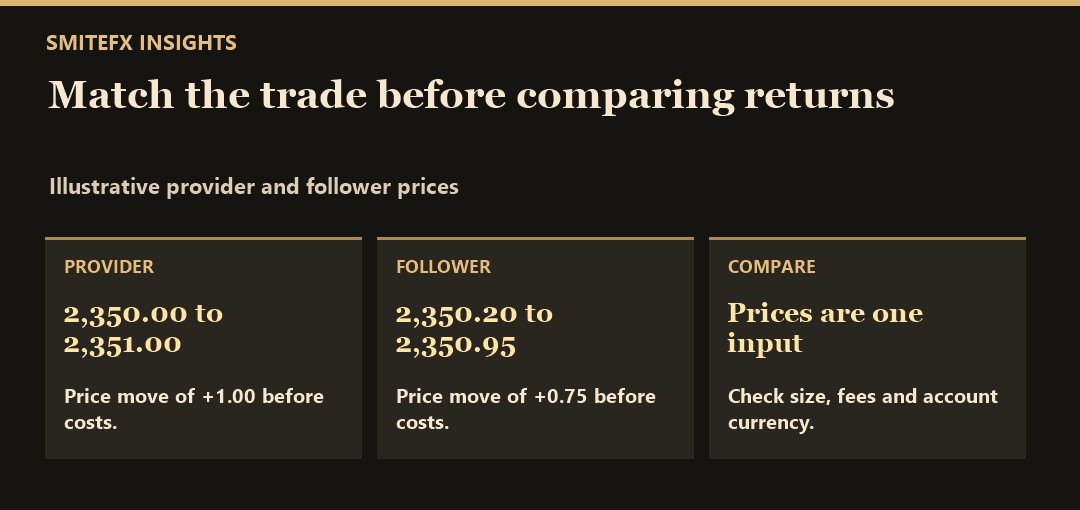
Imagine a provider buys at 2,350.00 and closes at 2,351.00. A follower buys at 2,350.20 and closes at 2,350.95. Their price moves are +1.00 and +0.75 respectively, before conversion to account currency and before fees. If position sizes also differ, the cash difference cannot be attributed to fills alone. These prices are hypothetical.
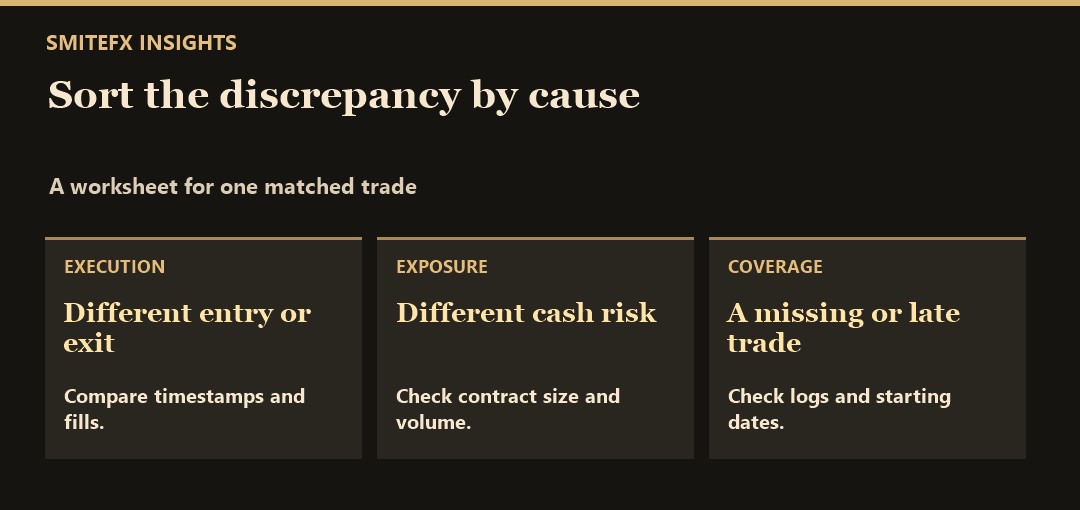
Match the side and open and close timestamps, then compare the actual broker symbol, contract size and position volume. Record copying skips separately. If the follower did not receive the order at all, the result is a missing trade, not a bad fill. A broker report can help you tell fees apart from execution differences, while the copying log can explain skipped or delayed orders.
For a SmiteFX product reference, see Frontier MT5. The listing describes the EA software itself. It is useful context for what the provider may be running, but copying is a separate arrangement. Check the actual provider and follower records and their terms before treating any product or signal figure as comparable to yours.