
The right lot size for US30 depends on your broker more than on the index, because brokers set different contract sizes for the same Dow Jones CFD.
You can try the All In One Trade Management Panel free on a demo account.
One Index, Three Contract Sizes
On forex, 1 lot is almost always 100,000 units. On indices there is no standard. Depending on the broker, 1 lot of US30 (or NAS100 / USTEC) may be worth:
| Broker setting | Money per 1-point move, 1 lot | Lot for $100 risk, 100-point stop |
|---|---|---|
| $1 per point | $1 | 1.00 |
| $10 per point | $10 | 0.10 |
| $0.10 per point | $0.10 | 10.00 |
Same trade, same $100 risk - and lot sizes from 0.10 to 10.00. Copying a lot size from a video or a signal on indices is how traders end up risking 10 times what they meant to.
Find Your Index Point Value
In MT5: right-click the symbol in Market Watch > Specification. Look at contract size, tick size and tick value. Tick value ÷ tick size = money per point for 1 lot.
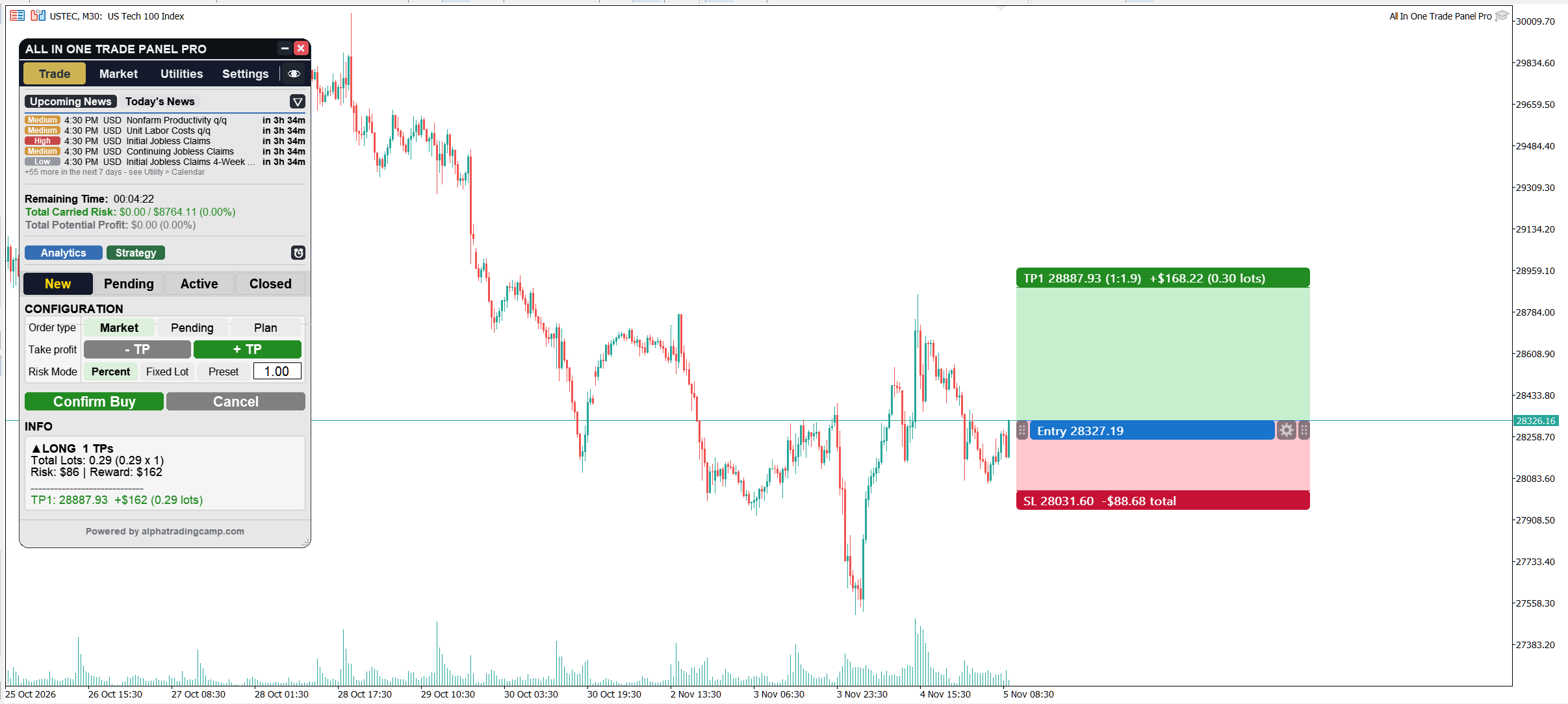
Or skip the math: the ATC Position Tool and Trade Manager MT5 reads these values from your broker. Place the trade, drag the stop 100 points away, and it shows the lot size for your risk, already rounded to the broker's lot step.
Quick Tip
After switching brokers or symbols (US30 vs US30.cash, NAS100 vs USTEC), always place one trade plan on the chart before trading. If the lot looks very different from what you are used to, the contract size changed - not the market.
FAQ
How much is 1 point on US30?
It depends on the broker: commonly $1, $10 or $0.10 per lot. Check the symbol's specification.
What is the best lot size for Nasdaq (NAS100)?
The one that makes your stop loss cost your chosen risk, e.g. 1% of balance. Work it out from the stop distance and your broker's point value.
Are index lots the same as forex lots?
No. Forex lots are standardized at 100,000 units; index lots are set by each broker.
Read next
- This week's guide: lot size calculator
- Gold version: lot size for gold
- Next week: Risk Reward Ratio - The Complete Guide
- Try the panel free on a demo account: free trial