

Introduction
One of the challenges beginners face when learning technical analysis is recognizing candlestick patterns on a live price chart. Knowing the definition of a Hammer, Doji, or Bullish Engulfing pattern is one thing. Identifying these formations among other candles, especially when the chart is moving, requires practice. Trading psychology presents another challenge. Beginners may struggle with impatience, impulsive decisions, fear of making mistakes, and difficulty following a set of rules. Although these challenges cannot be solved by learning candlestick patterns alone, structured practice can help develop some of the habits needed for better decision-making.
This is where gamification can make learning more engaging.
Algoyin Candle Snake Game brings a familiar Snake-style game directly onto the MetaTrader 5 chart. Instead of collecting ordinary food, players guide the snake toward candles representing specific candlestick patterns. Other patterns serve as decoys, requiring the player to recognize the correct formation before making a move. The result is an interactive way to practise pattern recognition while experiencing the importance of concentration, patience, and consistency.
1. Making Candlestick Recognition More Practical
Beginners often start by studying candlestick patterns in books, articles, and tutorials. They learn what individual formations look like and what they may indicate about price action. However, recognizing a pattern in an isolated illustration is different from finding it among many candles on a chart. The game addresses this learning gap by turning pattern recognition into an active task. A target appears on the screen, such as FIND: Hammer. The player must locate the corresponding candle and guide the snake toward it while avoiding decoys. Because only closed candles are used, players practise recognizing completed formations rather than relying on a candle that is still developing.
Repeated sessions can help beginners become more familiar with the visual characteristics of different patterns. The scoring system also gives them immediate feedback when they select the correct or incorrect target. This approach does not replace studying candlestick theory or analysing real market conditions. Instead, it provides an additional way to practise identifying formations.

Figure 1. Algoyin Candle Snake Game
2. Training Concentration and Attention to Detail
Successful pattern recognition requires attention to detail. A Hammer, for example, has a different structure from a Doji, even though both may appear within a similar price range. Beginners who focus only on the general shape of a candle may confuse one formation with another. During gameplay, players must observe the chart, identify the requested pattern, locate its position, and steer the snake toward the correct candle. Similar-looking patterns act as decoys, making careful observation important.
The countdown introduces a time constraint, while increasing levels make the game progressively more demanding. These mechanics encourage players to balance speed with accuracy instead of rushing toward the first available target. Over time, repeated practice may help players become more attentive to candle structure. The broader lesson is relevant to chart analysis: quick decisions are not necessarily good decisions, and taking a moment to examine the available information can prevent avoidable mistakes.
3. Understanding Patience and Impulse Control
Impatience can affect beginners in several ways. A trader may enter a position before a setup is complete, act on an unclear pattern, or abandon a trading plan after a small loss. Although a game cannot reproduce the emotional pressure of risking real money, it can provide a simple environment for practising controlled responses. Algoyin Candle Snake Game requires players to identify the requested pattern rather than collect every available target. Choosing a decoy costs a life and points, while waiting too long can interrupt a combo or cause the countdown to expire. These rules create a clear distinction between acting with a purpose and acting without sufficient attention.
Players can use this experience to reflect on their decisions. Did they select the first candle they noticed? Did they rush because the countdown was running low? Did they become careless after gaining points? Such questions can help beginners recognize habits that may also appear during chart analysis. The objective is not to eliminate hesitation or encourage faster trading. It is to practise making deliberate choices instead of reacting automatically.
4. Learning to Handle Mistakes and Recover
Mistakes are part of the learning process. Beginners may confuse a Shooting Star with another candle formation or overlook the characteristics that distinguish an Engulfing pattern from an ordinary candle. In the game, an incorrect selection has an immediate consequence. The player loses a life and points, and the combo multiplier resets. The game therefore makes the cost of an error visible without involving financial risk.
This provides an opportunity to practise responding to mistakes constructively. Rather than becoming frustrated and making another careless move, a player can pause, review what happened, and concentrate on the next target. The same principle is useful when learning technical analysis. One incorrect interpretation should encourage a review of the evidence, not an attempt to compensate for the mistake with another impulsive decision. The game cannot reproduce the emotional impact of a losing trade, but it can introduce the idea that mistakes should be examined rather than ignored.
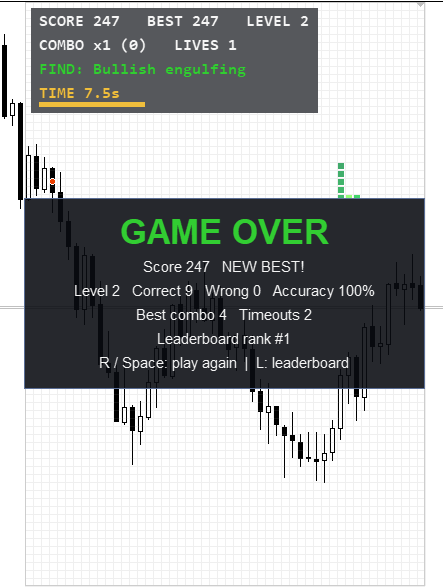
Figure 2. Game Over
5. Building Consistency Through Combos and Levels
Consistency is an important part of learning any skill. Recognizing one pattern correctly does not necessarily mean that a beginner can identify it reliably across different chart conditions. The combo system rewards consecutive correct selections by increasing the multiplier. Incorrect choices, timeouts, and excessive delays between targets interrupt that progression. As players advance through levels, the snake moves faster, the countdown becomes shorter, and additional decoys appear.
These mechanics reward sustained accuracy rather than a single successful decision. They also make the task progressively more difficult, requiring players to maintain attention as the conditions change. Beginners can use their scores and combo performance to observe whether they are becoming more consistent. However, a high game score should be treated as a measure of performance within the game, not proof of trading skill or profitability. The practical lesson is that consistent decisions matter more than occasional success.
6. Making Practice Engaging Through Competition
Learning can become repetitive when it consists only of reading explanations and examining static chart examples. Adding a game structure can make practice more engaging by introducing clear objectives, immediate feedback, progression, and competition. Algoyin Candle Snake Game includes a leaderboard that stores the top ten scores for each symbol, timeframe, and mode. Its Daily Challenge gives players using the same symbol and timeframe the same random sequence for that day, with a separate leaderboard.
These features provide opportunities to compare performance and repeat the exercise. Players can challenge themselves to improve their scores, maintain longer combos, and avoid unnecessary mistakes. Competition should remain secondary to learning. A player who rushes to achieve a high score may make more errors, while someone who focuses on accuracy may develop a more useful practice routine. The best approach is to use competition as motivation without allowing it to replace the educational objective.
7. from Game Practice to Real Chart Analysis
Candlestick patterns are only one part of technical analysis. Their meaning depends on market context, price structure, volatility, and the surrounding price action. A Hammer does not guarantee a bullish reversal, just as a Bearish Engulfing pattern does not guarantee that price will fall. The game focuses on identifying patterns, not evaluating whether they provide valid trading opportunities. It does not open, close, or modify trades, and it does not generate trading signals.
After a practice session, beginners can apply what they have learned by examining historical charts. They can identify completed patterns, study where they appeared, compare them with the surrounding market structure, and use back-testing to evaluate different interpretations. Combining game-based practice with chart study helps maintain a clear distinction between recognizing a candle formation and deciding what to do with that information.
Conclusion
Learning to trade involves developing both technical knowledge and habits that support careful decision-making. Beginners need opportunities to recognize patterns, maintain concentration, respond constructively to mistakes, and practise consistency. Algoyin Candle Snake Game offers an alternative way to work on these skills by combining candlestick recognition with interactive gameplay directly on a MetaTrader 5 chart. Its scoring, combos, countdown, levels, and Daily Challenge make practice more engaging while providing immediate feedback. Although the game cannot reproduce the psychological pressure of live trading or guarantee improvements in trading discipline, it can serve as a useful educational supplement alongside structured chart analysis and back-testing. The goal is simple: make learning candlestick patterns more interactive, encourage deliberate observation, and help beginners build a stronger foundation before applying their knowledge to real market analysis.