COPYLATOR – MT5 Trade Copier: Why a Drawdown Block Needs a Cooldown, Not Just a Block

Product link:
https://www.mql5.com/en/ market/product/191385
When drawdown protection activates, copying can be blocked to prevent additional trades from being replicated. Depending on the configuration, existing positions may also be closed and pending orders deleted. The objective is to limit further exposure after a drawdown threshold has been breached.
But blocking trades addresses only part of the problem. What happens when the block is lifted matters, too.
Consider what happens when a trader resets the protection or the scheduled daily reset occurs. If copying is allowed to resume immediately, the sender may still be trading under the same market conditions that contributed to the drawdown. The next signal may arrive within minutes, and the receiver may begin copying again before the trader has reviewed what happened.
The protection has interrupted trading, but the underlying circumstances may not have changed. This is where a cooldown can be useful.
A cooldown is a deliberate period of inactivity after a drawdown event. During this period, copying remains suspended until the chosen waiting period has elapsed and the trader has had an opportunity to review the situation. It is a risk-management policy rather than an inherent requirement of every copier, and it can help prevent premature decisions after a loss.
What a Cooldown Actually Is
A cooldown is a waiting period that begins after a defined event, such as a daily or total drawdown trigger. It may last for several hours or days, depending on the trader's policy.
The distinction between a block and a cooldown is important. A block describes a state in which copying is not permitted. A cooldown describes a time-based restriction that determines when copying may resume.
These mechanisms are not automatically separate in every copier. If the software does not provide a dedicated cooldown feature, the trader may need to manage the waiting period manually or use another supported control.
The purpose is to create time for review. During the pause, the trader can investigate the trigger, assess the strategy's recent performance, and decide whether the existing configuration remains appropriate.
Why Immediate Resumption Can Be a Mistake
After a drawdown trigger, some traders focus on restoring normal operation as quickly as possible. They reset the protection, wait for the block to clear, and resume copying at the next available signal.
This response can overlook the reason the protection activated. A trigger is not merely an interruption; it is also a signal that the account has reached a predefined risk threshold.
If the trader resumes without reviewing the situation, the account may be exposed to similar conditions again. Repeated drawdown events can occur if the underlying risk factors remain unchanged.
A cooldown creates an opportunity to interrupt this pattern. It does not guarantee that the next drawdown will be avoided, but it encourages the trader to make a considered decision rather than automatically restarting after a loss.
How Long Should a Cooldown Be?
The appropriate cooldown depends on the reason for the trigger, the strategy's trading frequency, and the review needed before copying resumes.
- A few hours: May be appropriate when the trigger follows a short-lived market event and the trader needs time to review the account and current conditions.
- One day or longer: May be appropriate after a series of losses when the trader needs to compare the current drawdown with the strategy's historical performance.
- Several days: May be appropriate after a substantial total drawdown, particularly when continuing the strategy requires a more detailed review of risk, position sizing, and recent performance.
These are illustrative ranges, not universal rules. A short pause may be insufficient for a complex problem, while a long pause may be unnecessary when the cause is already understood and adequately addressed.
The cooldown should be long enough to support a meaningful review, rather than simply satisfy a timer.
What to Do During the Cooldown
A cooldown is most useful when the trader uses the time productively. Three steps can help structure the review.
- Examine the trigger. Determine which limit was breached, how far the drawdown exceeded it, and what market conditions were present. Check whether the loss came from a single trade, a sequence of trades, or floating losses on open positions.
- Compare the event with historical performance. Determine whether the drawdown falls within the strategy's previously observed range or is unusually severe. Historical results cannot predict future performance, but they can help identify meaningful differences.
- Choose the next action. Options may include resuming with the same configuration, reducing lot sizes, reviewing the drawdown limits, investigating technical problems, or discontinuing copying from the sender.
The right decision depends on the evidence. Resuming unchanged may be reasonable after a well-understood event, while a substantial or unexplained drawdown may justify further investigation before trading resumes.
The Relationship to the Confirmation Period
A cooldown and a confirmation period serve different purposes.
A confirmation period is a short interval used by some protection systems to determine whether a drawdown breach persists before triggering the configured response. Its purpose may be to reduce reactions to brief fluctuations, depending on the implementation.
A cooldown is a longer waiting period after a confirmed event. Its purpose is to give the trader time to review the account and decide whether copying should resume.
The confirmation period operates as part of the trigger logic. The cooldown operates as part of the post-trigger risk-management policy.
Not every copier supports both mechanisms. Traders should verify the available settings instead of assuming that a confirmation period or a configurable cooldown is included.
The Cooldown and the Automatic Daily Reset
A cooldown policy can interact with the copier's scheduled daily drawdown reset.
Suppose a drawdown event occurs late in the trading day and the cooldown extends beyond the next scheduled reset. The daily drawdown state may reset when the configured reset time arrives, but that event should not automatically be assumed to cancel a separately managed cooldown.
Whether copying remains suspended depends on how the cooldown is implemented and how it interacts with the copier's blocking and reset mechanisms.
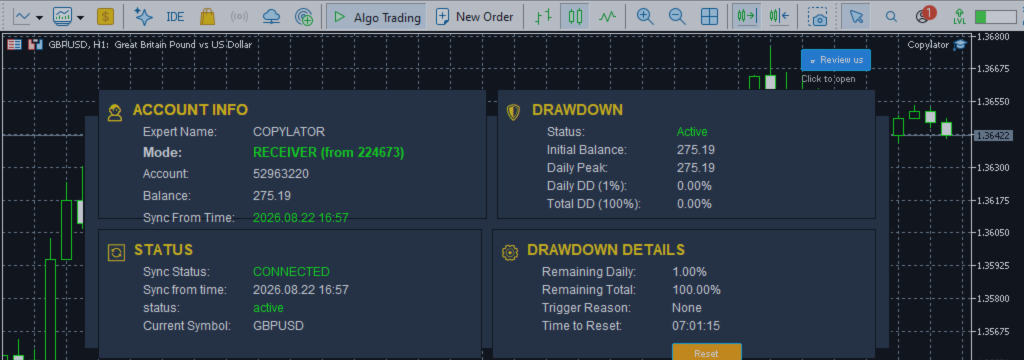
For COPYLATOR, the automatic daily reset uses the configured ResetHour and ResetMinute based on broker server time. It resets the daily drawdown state but does not reset the total-drawdown baseline.
If a trader wants a cooldown to remain active beyond the daily reset, that behavior must be enforced by a supported configuration or a separate manual procedure. The daily reset alone should not be treated as a guaranteed cooldown mechanism.
The Cooldown and the Manual Reset
The same distinction applies to manual resets.
COPYLATOR's manual Reset button in Drawdown Details resets the daily and total drawdown state and sets initialBalance to the current account balance.
This operation changes the drawdown protection state and baseline. It does not, by itself, establish a separate waiting period unless an additional mechanism or procedure enforces one.
If the trader wants to require a review before resuming, the cooldown policy must be handled independently of the drawdown reset. This helps avoid confusing the act of resetting the protection with a decision that the strategy is ready to resume.
When a Cooldown Can Be Counterproductive
A cooldown is not necessarily appropriate after every trigger.
- Technical problems: If the event resulted from a symbol-mapping issue, broker rejection, or configuration error rather than a market loss, a lengthy waiting period may delay the resolution without addressing the cause.
- A completed review: If the trader has already investigated the event and determined that the configuration remains suitable, an additional long cooldown may provide little benefit.
- Infrequent strategies: If the sender produces signals only occasionally, the cooldown may overlap a period when no trades would have occurred anyway.
- Time-sensitive strategies: A prolonged pause can cause the receiver to miss signals. Whether this is acceptable depends on the strategy and the trader's risk policy.
The goal is not to impose inactivity for its own sake. It is to prevent premature resumption when further review could materially improve the decision.
The Cooldown as a Risk-Management Principle
A drawdown limit primarily addresses account risk by defining when protective action should begin. A cooldown adds a behavioral component by encouraging the trader to pause before resuming.
This distinction matters because automated trading decisions are often followed by manual decisions about whether to continue. A trader who immediately resets after every trigger may repeatedly expose the account to the same unresolved risks.
A planned waiting period can create a more structured process: review the event, evaluate the available evidence, and decide whether the original configuration remains appropriate.
A cooldown does not guarantee better judgment or prevent losses. Its value depends on how the trader uses the time and whether the review leads to a reasoned decision.
A Practical Cooldown Policy
The following examples can serve as starting points for a personal risk-management policy:
- Daily drawdown trigger: Consider a pause of 12 to 24 hours to allow time to review the trading session before resuming.
- Total drawdown trigger: Consider a pause of several days when the accumulated loss requires a more detailed assessment of strategy performance and risk settings.
- Technical trigger: Investigate and correct the technical problem before resuming. The appropriate delay depends on the cause and the verification required.
These periods are suggestions for evaluation, not proven optimal settings. A trader should adjust them to the strategy, trading schedule, and seriousness of the event.
If the copier does not support a configurable cooldown, the trader can implement the policy manually by leaving copying blocked after the trigger and resuming only after the selected period and review are complete. The exact procedure should be tested to ensure that resetting the protection does not unintentionally restart copying earlier than intended.
What the Cooldown Reveals
A cooldown can reveal whether the trader has a clear plan for responding to a drawdown.
A trader with predefined rules can use the pause to review the trigger, compare it with historical performance, and decide what conditions must be satisfied before copying resumes.
Without such a plan, the trader may simply wait for the cooldown to end and restart copying without changing anything or understanding what happened.
The timer itself does not create a sound risk-management process. Its value comes from the preparation, analysis, and decisions that take place during the pause.
Summary
A drawdown block stops or restricts copying when the configured protection conditions are met. A cooldown adds a deliberate waiting period before copying resumes, giving the trader time to understand why the block occurred.
The two concepts are different: a block is a restriction on trading activity, while a cooldown is a time-based policy. Resetting drawdown protection does not automatically create or enforce a cooldown unless the system has been configured to do so.
Choose the waiting period according to the type and severity of the trigger. Use the time to examine the event, compare it with historical performance, and decide whether the original strategy and risk settings remain appropriate.
A cooldown is not a substitute for effective drawdown protection, nor is it a guarantee against future losses. It is an additional risk-management measure that can help make the decision to resume copying more deliberate.
Product link:
https://www.mql5.com/en/ market/product/191385