MT5 Trade Copier: The Psychology of Copy Trading and Why Discipline Matters More Than Strategy

Product link:
https://www.mql5.com/en/ market/product/191385
Many traders assume that successful copy trading is mainly about finding the right signal provider, selecting a profitable strategy, or choosing the correct lot-sizing method. While strategy selection is important, another factor is often underestimated: trading discipline.
Copy trading can remove many repetitive manual tasks, but it does not automatically remove emotional decision-making. In fact, watching another trader's positions being replicated on your own MT5 account can create a different psychological challenge. A losing streak, a temporary drawdown, a delayed execution, or a series of winning trades can all create pressure to interfere with the system.
This is why a well-configured MT5 Trade Copier should not only replicate trades. It should also help traders implement rules that were decided before emotions become involved.
1. Strategy Is Only One Part of Copy Trading
A signal provider can have a clearly defined strategy, consistent entry rules, and a documented risk model. However, the Receiver account can still produce a different result if the user constantly changes the configuration or manually interferes with copied positions.
For example, imagine that a Sender experiences a sequence of losing trades. The Receiver owner becomes uncomfortable and disables copying. A few hours later, the Sender's strategy begins recovering.
The original strategy was allowed to complete its process, but the Receiver was not.
This illustrates an important principle:
Sender strategy + Receiver configuration + Trader discipline = Actual copy-trading result
The copier itself does not determine whether a strategy is profitable. It provides the infrastructure for reproducing trades according to configured rules.
2. The First Psychological Challenge: Trust
When you copy a Sender, you are allowing another strategy to generate trading decisions that affect your own account. Even when the system is fully automated, the psychological reaction remains human.
A losing trade can immediately create questions:
- Should I stop copying?
- Should I close the position manually?
- Should I reduce the lot size?
- Was the Sender's strategy broken?
- Should I wait for recovery?
These questions are understandable, but making random configuration changes during a losing period can fundamentally change the statistical behavior of the system.
If the strategy was evaluated using a particular set of rules, changing those rules after losses means you are no longer following the same system.
3. Why Manual Intervention Can Change the Strategy
Consider a Sender strategy that historically allows losing trades to reach their predefined Stop Loss while allowing profitable trades to reach their Take Profit.
If the Receiver owner manually closes losing positions early, the Receiver is no longer following the Sender's original exit model.
The same problem can occur in the opposite direction. After several profitable trades, a trader may increase the lot size because confidence has increased.
Both behaviors can create inconsistency:
- Reducing exposure after losses.
- Increasing exposure after winning streaks.
- Closing copied trades manually.
- Disabling the copier during drawdown.
- Changing lot settings without a predefined rule.
Each decision may feel reasonable individually, but repeated intervention can make the actual Receiver performance very different from the tested strategy.
4. The Second Challenge: Patience During Drawdown
No trading strategy produces profits on every trade or every month. Losing periods are part of the statistical distribution of any strategy.
The psychological difference between reading about a 10% drawdown in historical data and watching your own account experience it can be significant.
When the account balance is falling, the natural reaction is often to do something.
However, the correct response should ideally have been defined before the drawdown occurred.
This is where automated risk controls can become useful.
5. Drawdown Protection as a Predefined Decision
A drawdown protection system can convert an emotional decision into a predefined rule.
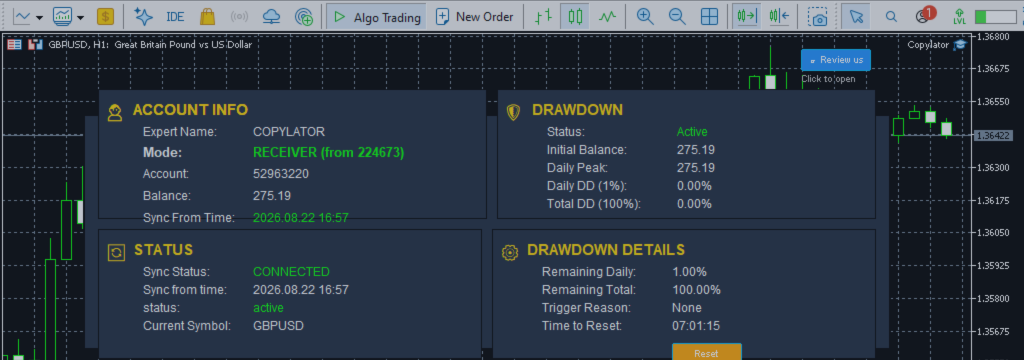
For example, a Receiver can be configured with a maximum daily drawdown and a maximum total drawdown. When a configured limit is reached, COPYLATOR can block new copying. Depending on the configuration, it can also close positions opened by COPYLATOR and delete its pending orders.
The important psychological benefit is that the decision was made before the stressful situation occurred.
Instead of asking:
"Should I stop copying now?"
the system follows the rule that was already configured.
COPYLATOR also provides daily and total drawdown controls, with configurable reset behavior. Traders should understand the difference between a daily reset and a manual reset because resetting the protection baseline can materially change how future drawdown is measured.
6. Filters as Psychological Contracts
Filters are often viewed only as technical features. They can also serve as a form of pre-commitment.
When you configure a filter before trading begins, you are effectively deciding:
"These are the conditions under which I want copying to occur."
That reduces the need to make a new decision every time a trade arrives.
Spread Filter
A spread filter can prevent copying when the Receiver's spread exceeds the configured threshold.
This can be particularly relevant during volatile market conditions or periods of reduced liquidity, when transaction costs can change quickly.
Time Filter
A time filter can restrict copying to a predefined trading window.
Instead of deciding manually whether to accept a trade at a particular time, the Receiver follows the configured schedule.
Day Filter
Day-based restrictions can be used when the trading plan excludes specific days. The important point is that the decision is established in advance rather than made emotionally after a trade appears.
Direction Filter
Buy-only or Sell-only restrictions can be useful when the Receiver's intended exposure differs from the Sender's complete trading activity.
For example, a Receiver can be configured to copy only long trades or only short trades.
7. The Third Challenge: Attribution
Another psychological problem is determining who deserves credit or blame for the result.
After a winning trade, the Receiver owner may think:
"I chose the right Sender."
After a losing trade, the same trader may immediately conclude:
"The Sender is wrong."
Neither conclusion can be reliably established from one or a few trades.
Trading strategies must generally be evaluated over a meaningful sample. Short-term results can contain substantial randomness, and a small number of trades may not represent the long-term behavior of a strategy.
8. Copy Trading Requires a Defined Evaluation Period
One of the most common mistakes is changing the system after a very small number of trades.
For example:
| Observation | Possible Problem |
|---|---|
| 3 losing trades | Insufficient information to judge a strategy |
| 1 profitable week | May not represent long-term performance |
| One large winning trade | Can distort short-term statistics |
| Temporary drawdown | May be normal for the strategy |
Instead of changing the configuration after every short-term result, traders should define an evaluation period and specific metrics in advance.
9. Discipline Is Easier When the System Enforces It
Willpower is unreliable under financial stress.
A better approach is to design the trading environment so that fewer emotional decisions are required.
An MT5 Trade Copier can help implement this structure through features such as:
- Drawdown protection.
- Spread filtering.
- Day and time restrictions.
- Buy-only or Sell-only filtering.
- Fixed lot sizing.
- Balance-ratio lot scaling.
- Lot multiplier controls.
- Maximum lot caps.
- Automatic symbol mapping.
- Real-time SL/TP synchronization.
- Partial close synchronization.
These features do not make a trading strategy profitable by themselves. Their purpose is to make the execution of predefined rules more consistent.
10. Lot Management and Emotional Risk
Lot size has a direct psychological effect on trading.
If the copied volume is larger than the Receiver account can comfortably tolerate, even a normal losing streak can create emotional pressure.
COPYLATOR provides several approaches to lot management, including:
- Fixed lot size.
- Lot multiplier.
- Balance-ratio scaling.
- Maximum lot cap.
A maximum lot cap can prevent the calculated copied volume from exceeding a predefined maximum.
Balance-ratio scaling can adjust volume according to the relationship between Sender and Receiver balances. However, traders should remember that equal balance ratios do not guarantee identical monetary risk because leverage, contract specifications, symbol characteristics, Stop Loss distance, and broker conditions can differ.
11. Why Increasing Lot Size After Winning Streaks Is Dangerous
Winning streaks can create overconfidence.
A trader may see several profitable copied trades and decide to increase exposure manually.
That introduces a new variable into the strategy.
If the next trade loses, the financial impact may be significantly larger than the previous trades—not because the Sender changed the strategy, but because the Receiver changed the risk model.
Predefined lot management is therefore not only a technical configuration. It can also help prevent emotional position sizing.
12. Real-Time SL/TP Synchronization and Discipline
Another source of manual intervention is changing Stop Loss or Take Profit levels independently on the Receiver.
If the Sender modifies its Stop Loss or Take Profit and the Receiver is configured to synchronize those changes, the Receiver can update the corresponding position automatically.
This is particularly important when the strategy actively manages open positions.
Manually overriding every change can create a divergence between the Sender's strategy and the Receiver's actual position management.
13. Partial Closes and Emotional Decision-Making
Partial closing can also create psychological inconsistency.
Suppose a Sender closes part of a position while leaving the remaining volume open. If the Receiver manually closes the entire position instead, the Receiver's exposure becomes different from the Sender's.
With Partial Close Support, COPYLATOR can replicate supported partial volume changes while maintaining the remaining position.
This allows the Receiver to follow the intended position-management structure more closely.
14. Multi-Sender Environments Require Even More Discipline
When multiple Senders are connected to one Receiver, psychological complexity can increase.
Different strategies may produce conflicting signals on the same symbol.
For example:
- Sender A may open a Buy.
- Sender B may open a Sell.
- One strategy may be short-term.
- Another may be designed for longer holding periods.
In such an environment, the Receiver configuration should be deliberately designed rather than changed after individual trades.
Separate accounts, direction filters, symbol selection, lot limits, and clear Sender-to-Receiver relationships can help maintain a predictable structure.
15. Hedging and Netting Considerations
Account type can also influence how copied trades behave.
On Hedging accounts, multiple positions can exist independently on the same symbol, making individual ticket-based trade management possible.
On Netting accounts, positions are aggregated by symbol. As a result, conflicting trades or multiple strategies trading the same instrument can interact differently than they would on a Hedging account.
This is another reason to understand the Receiver account structure before going live.
16. Reverse Mode Requires a Clear Psychological Rule
Reverse Mode changes the direction of copied trades. A Buy can become a Sell and a Sell can become a Buy, with corresponding Stop Loss and Take Profit adjustments according to the configured behavior.
Reverse Mode should therefore be treated as part of the trading plan, not as an emotional reaction to recent performance.
Turning Reverse Mode on after a losing streak because "the strategy is going the wrong way" creates a completely different system from one that was tested with Reverse Mode enabled from the beginning.
17. The Difference Between Automation and Blind Trust
Discipline does not mean blindly trusting an automated system.
A disciplined approach still requires monitoring:
- Connection status.
- Sender and Receiver configuration.
- Symbol mapping.
- Account margin and free margin.
- Drawdown levels.
- Execution conditions.
- Logs and error messages.
The difference is that monitoring should follow a predefined process rather than becoming constant emotional intervention.
18. A Practical Discipline Framework
A structured approach can be divided into four stages.
Stage 1 — Define
- Choose the strategy and Sender.
- Define acceptable drawdown.
- Define lot-sizing rules.
- Define instruments.
- Define trading sessions.
- Define whether Buy or Sell filtering is required.
Stage 2 — Configure
- Set Sender and Receiver modes.
- Configure SenderAccountNumber correctly.
- Configure symbol mapping if necessary.
- Set lot management.
- Set maximum lot limits.
- Configure drawdown protection.
- Configure applicable filters.
- Configure SL/TP synchronization.
Stage 3 — Test
- Run the configuration on a demo account.
- Verify market-order copying.
- Verify pending-order behavior where applicable.
- Test SL/TP synchronization.
- Test partial closes.
- Check symbol mapping.
- Observe drawdown protection behavior.
Stage 4 — Follow the Rules
Once the system is live, evaluate it according to the predefined criteria rather than reacting to individual trades.
If the configuration needs to change, make the change deliberately, document it, and evaluate the new configuration separately.
19. Common Psychological Mistakes in Copy Trading
| Mistake | Why It Can Be a Problem |
|---|---|
| Stopping after a few losses | May interrupt the strategy before a meaningful sample is available |
| Increasing lots after wins | Changes the predefined risk model |
| Closing copied trades manually | Can create divergence from Sender management |
| Changing filters constantly | Makes performance difficult to evaluate |
| Ignoring drawdown limits | Removes an important predefined risk boundary |
| Judging from a few trades | Short samples can be statistically misleading |
| Changing Reverse Mode emotionally | Creates a different trading system |
20. What a Disciplined MT5 Trade Copier Setup Looks Like
A disciplined setup does not necessarily mean using every available feature.
It means using only the features that correspond to clearly defined rules.
For example:
Sender
   ↓
COPYLATOR Receiver
   ↓
Symbol Mapping
   ↓
Spread / Direction / Time Rules
   ↓
Lot Management
   ↓
Drawdown Protection
   ↓
MT5 Execution
Each layer has a defined purpose. The objective is to reduce unnecessary decisions during live trading.
21. Discipline Does Not Guarantee Profitability
This distinction is essential.
A disciplined trader can consistently execute an unprofitable strategy. Automation can make the execution more consistent, but it cannot turn a poor strategy into a profitable one.
Likewise, a strong strategy can produce poor results if the Receiver repeatedly changes its configuration or manually interferes with positions.
Therefore, strategy selection and disciplined execution should be treated as separate components of the overall process.
22. Final Checklist Before Going Live
- Have you defined the maximum acceptable drawdown?
- Have you selected a lot-sizing method?
- Have you set a maximum lot cap where appropriate?
- Have you decided which instruments will be copied?
- Have you configured the correct SenderAccountNumber?
- Have you verified symbol mapping?
- Have you tested SL/TP synchronization?
- Have you tested partial close behavior?
- Have you configured relevant filters?
- Have you tested the complete setup on demo?
- Have you decided how performance will be evaluated?
- Have you defined when configuration changes are allowed?
Conclusion
The psychology of copy trading is often underestimated.
Finding a strategy is only the beginning. The more difficult challenge can be following that strategy consistently without allowing short-term results to trigger emotional decisions.
An MT5 Trade Copier such as COPYLATOR can provide tools that support disciplined execution: drawdown protection, filters, lot management, SL/TP synchronization, partial close support, symbol mapping, and multi-account copying.
These features do not replace strategy evaluation or risk management. Their value is that they can help transform decisions made in advance into repeatable rules during live execution.
The central idea is simple:
Do not build a system that requires perfect discipline. Build a system that helps enforce discipline.
When strategy selection, risk limits, copier configuration, and evaluation rules are defined before trading begins, the trader has fewer decisions to make under pressure—and that can make the entire copy-trading process more structured and consistent.
Product link:
https://www.mql5.com/en/ market/product/191385