Two Of The Three Pairs My EA Trades Lost Money. Here Is The Full 46-Day Report Anyway.

Two of the three symbols my EA trades lost money over the last 46 days.
EURUSD finished down $12.76. EURJPY finished down $28.07. If you only looked at those two lines you would conclude the system does not work and you would close this page.
I am going to show you the entire report anyway — every metric, including the ones I would rather not publish — because the third symbol tells a different story, and because I think the way most EA results get presented is the reason nobody believes any of them any more.
Here is what actually happened.
The setup, with nothing hidden
On 17 July 2026 I funded a live RoboForex account with $500 and attached Apex Drawdown Zero V9. Account number 37376132. Real money, not a demo. No bonus, no credit, no second deposit, no withdrawals.
Then I did the only thing that makes a live test worth anything: I left it alone.
The report breaks every trade down by origin. It reads 46 robot, 0 manual, 0 signals. I did not close a losing trade early to protect the screenshot. I did not add a winner by hand. Forty-six trades over forty-six days, all of them placed by the EA, none of them by me.
That is the part most published results quietly omit, and it is the part that determines whether any of the numbers below mean anything.
The numbers
| Balance | $868.55 |
| Equity | $863.78 |
| Net profit | +$368.55 |
| Gain | +73.71% |
| Gross profit | $594.33 |
| Gross loss | -$225.78 |
| Profit factor | 2.63 |
| Recovery factor | 4.83 |
| Sharpe ratio | 0.224 |
| Maximum drawdown | 9.79% |
| Deposit load | 3.58% |
| Total trades | 46 |
| Winning trades | 24 (52.2%) |
| Trades per week | 6 |
| Average hold time | 14h 12m |
| Largest win | +$153.84 |
| Largest loss | -$53.10 |
| Longest win streak | 5 trades (+$81.34) |
| Longest loss streak | 5 trades (-$31.78) |
| July | +$3.44 |
| August | +$365.11 |
That July figure is real and I want to explain it rather than bury it. The EA takes a maximum of one qualified trade per day, and through the back half of July it did not find much that met its conditions. Two weeks of near-nothing, then a month that produced $365.
If you need an EA that trades every day so you can feel like you are getting your money's worth, this is the wrong EA. Sitting out is a position.
Now the uncomfortable part
| Symbol | Net P/L | Trades | Profit Factor |
|---|---|---|---|
| XAUUSD | +$409.38 | 14 | 4.37 |
| EURUSD | -$12.76 | 20 | 0.78 |
| EURJPY | -$28.07 | 12 | 0.39 |
Gold made $409.38. The account netted $368.55.
Gold did not contribute most of the profit. Gold contributed more than all of it, and the two currency pairs handed a portion back.
Fourteen gold trades at a profit factor of 4.37 is a serious number. Twelve EURJPY trades at 0.39 is not — that is losing an average of $2.34 every time it opens a position, across a sample large enough to take seriously.
I could have cropped the symbol table out of this post. Most people would have. Every screenshot you have ever seen of an EA result had a crop decision behind it, and you were not shown what got cut.
Here is why I am not cropping it: the symbol breakdown is the single most useful thing in this entire report, and it is more valuable to you than the headline gain.
What the losing pairs actually prove
The strategy is a daily session-range model. It maps the session's range, then evaluates how price behaves at the boundary — trend alignment, candle quality, timing window, volatility, spread — and takes at most one qualified breakout per day.
That logic depends on a market that respects session structure and then commits to a direction. Gold is doing that right now. EURUSD and EURJPY are chopping through their boundaries and reversing, which is precisely the environment that produces a string of small structural losses.
So the data is not telling me the system is broken. It is telling me which instrument is currently in the regime the system was built for.
That distinction is the whole job. An EA that cannot tell you why it lost is a black box, and a black box is worth nothing when conditions change — because you will not know whether to keep running it or switch it off.
Acting on it:
- EURJPY comes off the default symbol set in V11.
- EURUSD gets one more month to justify itself, then goes the same way.
- Gold gets more granular session handling, because that is where the edge lives.
V11 is targeted for release this month. Every existing licence holder gets it free, the same as every update before it.
The win rate is 52%, and that is fine
Twenty-four wins from forty-six trades. Barely better than a coin flip.
I am telling you that directly because win rate is the number EA marketing loves and it is close to meaningless on its own. A martingale grid can show you 95% and then remove your account in a single afternoon. Win rate tells you how often, never how much.
What actually built this account is the shape of the wins and losses:
- Largest win: $153.84
- Largest loss: $53.10
- Best streak: 5 wins, +$81.34
- Worst streak: 5 losses, -$31.78
Read those last two lines again. The worst run this account had was five consecutive losses — and it cost $31.78. The best run was also five trades, and it made two and a half times as much.
That asymmetry is the strategy. Small structural stop attached at entry. Percent-based sizing. No averaging down, no grid, no recovery mode, no adding to a loser hoping it comes back. You lose small and reasonably often. You win larger.
Profit factor 2.63 is what that asymmetry looks like as a single number: every dollar this account lost bought back $2.63.
About the name
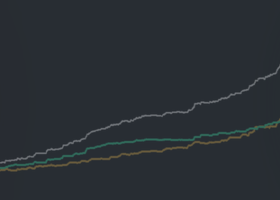
The EA is called Apex Drawdown Zero. This account ran a maximum drawdown of 9.79%, and the deepest dip on the growth curve touched 13.48%.
That is not zero. I am not going to pretend it is.
The name refers to the hard drawdown controls built into the EA: a configurable daily loss halt and an overall equity stop, each of which flattens every open position the moment its limit is reached. It is a protection system. It was never a claim that the equity curve only travels upward.
Any EA advertising genuinely zero drawdown is either not trading or not being straight with you. Every real strategy gives money back sometimes. What separates a survivable one from an account-killer is whether the giving-back is bounded by design or bounded by luck.
For context: 9.79% drawdown against 73.71% gain is a recovery factor of 4.83. That ratio — how much you made per unit of pain — is the number I actually watch, and 4.83 is healthy.
Who should not buy this
I would rather lose the sale than deal with the refund request, so:
- Do not buy this if you need daily action. It trades roughly six times a week across three symbols and it will sit out days at a time. Two weeks of July produced almost nothing.
- Do not buy this if you are looking to turn $100 into $10,000. This is a $500 account that made $368 in six weeks at a 3.58% deposit load. It is deliberately conservative and it will feel slow if you have been watching martingale backtests.
- Do not buy this if a 9.79% drawdown would make you switch it off. Because it will happen again, and switching an EA off at the bottom of a drawdown is how most people convert a temporary loss into a permanent one.
- Do not buy this if you will not run a VPS. An EA that misses its session window because your laptop slept is not being given a fair test.
Buy it if you want one qualified trade a day, a hard stop attached from entry, no martingale anywhere in the code, and a developer who publishes the losing symbols alongside the winning one.
The honest limitations
Forty-six days and forty-six trades is a small sample. It is enough to establish that gold is currently working and EURJPY is not. It is not enough to make confident claims about long-run expectancy, and you should be suspicious of anyone presenting six weeks as proof of a durable edge — including me.
This is also a small account. $500 at a 3.58% deposit load behaves differently from size, and results do not scale linearly.
The Sharpe ratio is 0.224, which is modest. Over a longer sample I would want to see that climb.
I am publishing this account weekly, in both directions, until at least January. If it turns, you will read about it here in the same detail.
See it live
I walk through this exact account on video — the open position, the full trade history, the exposure, the report:
Get the EA
Apex Drawdown Zero MT5 runs on H1. Maximum one qualified trade per day. Risk-percentage sizing with a structural stop attached at entry. Automatic break-even management, spread validation, daily entry cutoff, and a prop-firm Guardian edition with daily-loss and maximum-drawdown halts.
No martingale. No grid. No averaging. No recovery mode.
It is $849 direct, down from $999. That price includes lifetime updates — V11 lands this month and every licence holder gets it at no cost, which is how every previous version has been handled. There is a 14-day fault-resolution promise: if something is technically broken, I fix it.
- MQL5: https://www.mql5.com/en/market/product/163054
- Direct: https://apexdrawdownzero.com/products/apex-drawdown-zero-mt5
If you want to ask me something before you spend $849, message me on WhatsApp: https://wa.me/27601542672
I answer these myself.
Disclaimer. Trading forex and CFDs carries a high risk of loss and is not suitable for every investor. The figures above come from a single live account over 46 days and are not indicative of future results. Nothing in this article is financial or investment advice. Never trade money you cannot afford to lose.