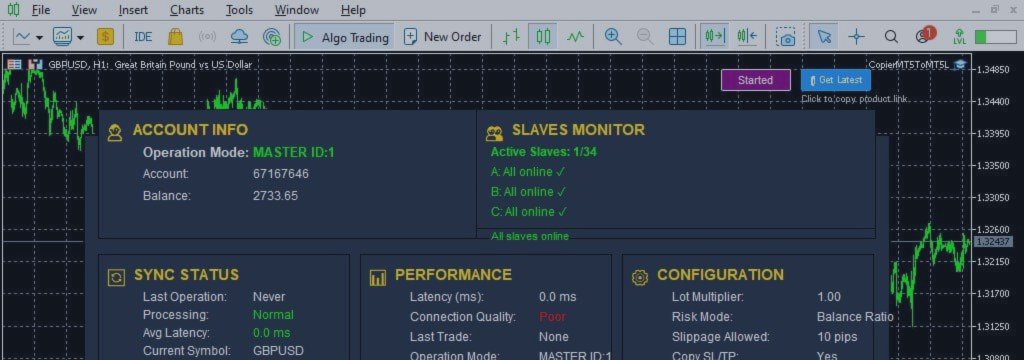

PRODUCT ACCESS LINK ON MQL5 MARKET:
Copier MT5 To MT5
https://www.mql5.com/en/ market/product/191385
Copier MT4 To MT4
https://www.mql5.com/en/market/product/150647
Multi‑broker trade replication is frequently mistaken for a simple extension of conventional copy trading. On the surface, the premise appears almost trivial: a trade opens on a Master account, and the very same order is automatically mirrored across multiple Slave accounts. At first glance, this seems like little more than transmitting signals from point A to point B—and many traders assume that a copier needs to do nothing else.
In practice, however, professional multi‑broker trade replication involves profound complexity that extends far beyond signal forwarding.
Each broker operates within its own distinct ecosystem—complete with proprietary servers, independent pricing feeds, divergent execution technologies, unique contract specifications, and bespoke trading rules. Even when two brokers list seemingly identical instruments—such as EURUSD, XAUUSD, or NASDAQ CFDs—those products often behave very differently under the hood. As the number of linked brokers grows, the challenge of preserving consistent synchronization escalates exponentially.
Consequently, professional trade copiers are not built to merely duplicate orders; they are engineered to continuously adapt every trade to the specific environment of each connected broker, all while faithfully upholding the originating strategy's intent.
Why Multi‑Broker Replication Is Deceptively Difficult
Many newcomers instinctively believe that if a Buy order is placed on the Master, every Slave account should instantly open the exact same position at the very same price.
Financial markets, however, do not operate in such a uniform manner.
Even when multiple brokers grant access to the same asset classes, they rarely function under identical conditions. Divergences in execution speed, spread structures, liquidity sources, contract sizes, leverage offerings, margin policies, and even physical server locations all exert tangible influence over how orders are filled.
Professional replication thus focuses on preserving trading logic and strategic coherence—rather than chasing the illusion of identical execution prices. The ultimate goal is to ensure that every linked account faithfully follows the same overall strategy, while intelligently accommodating each broker's unique operational quirks.
Symbol Mapping: A Primary Source of Synchronization Failures
One of the most pervasive headaches in multi‑broker environments is inconsistent symbol nomenclature.
Although the underlying financial instrument is fundamentally the same, brokers habitually impose their own proprietary naming conventions. Consider these common variations for EURUSD:
- EURUSD
- EURUSDm
- EURUSD.a
- EURUSD-Pro
- EURUSD.cash
This same fragmentation applies equally to metals, indices, cryptocurrencies, and energy products. For instance, one broker may list spot gold as XAUUSD , while another uses GOLD , a third opts for XAUUSDm , and yet another employs GOLDmicro .
Without a robust symbol‑translation layer, the copier cannot reliably determine which instrument corresponds to the Master's trade—leading to multiple adverse outcomes:
- The trade may be outright rejected due to an unrecognized symbol.
- The order could silently fail without any execution.
- The copier might skip synchronization entirely.
- In poorly architected systems, an entirely wrong instrument could be erroneously selected.
Professional copiers resolve this through flexible, user‑configurable symbol mapping. Instead of blindly assuming identical naming, they translate every Master symbol into the appropriate counterpart for each Slave broker. This translation layer is not an optional extra—it is an absolute prerequisite for reliable synchronization across heterogeneous broker landscapes.
Price Discrepancies: A Normal Market Reality
Another widespread misconception is the expectation that all brokers should execute the same trade at precisely the same price.
In truth, price variations are not merely common—they are entirely unavoidable.
Every broker sources pricing from one or more liquidity providers, and the composition of these liquidity pools differs markedly between firms. Consequently:
- Bid prices diverge marginally.
- Ask prices diverge marginally.
- Spread sizes fluctuate independently.
- Market depth profiles differ.
- Tick arrival timestamps rarely align.
Even if two brokers display nearly identical chart patterns, actual ticks almost never arrive at the same millisecond. During volatile market conditions—such as high‑impact news releases—these disparities become even more pronounced. A trade executed on Broker A may be filled several pips earlier or later than the identical order on Broker B.
Crucially, this does not signal faulty synchronization; it simply reflects normal infrastructural variations across the financial ecosystem. Professional copiers, therefore, prioritize logical consistency over futile attempts to eliminate natural execution differences that no software can fully control.
The Role of Liquidity Providers in Execution Quality
Behind every retail broker lies at least one—and often several—liquidity providers (LPs). Some brokers aggregate feeds from numerous institutional sources, while others rely on a narrower pool.
Because liquidity availability fluctuates continuously throughout each trading session, execution quality inherently varies from one broker to the next. Large market orders may encounter:
- Different final execution prices.
- Partial fills.
- Divergent slippage amounts.
- Varying fill speeds.
These discrepancies become especially conspicuous during:
- Major economic announcements and NFP releases.
- Central bank policy statements.
- Daily and weekly market openings.
- Holiday‑reduced liquidity sessions.
- Off‑hours trading with thin order books.
A professional trade copier cannot force uniform execution across such divergent conditions. Instead, it must gracefully accommodate these differences, ensuring that the overarching strategy remains coherently synchronized across the entire account network.
Execution Latency: The Silent Synchronization Killer
Latency constitutes another hidden but formidable obstacle.
Every trading instruction must traverse a multi‑stage journey before reaching the broker's execution engine—typically comprising:
- The Master terminal.
- The local machine or VPS.
- Internet routing infrastructure.
- The broker's trading server.
- The internal execution engine.
- The liquidity provider's system.
- Confirmation routing back to the terminal.
When multiple brokers participate in a single replication network, each follows a distinct routing path. One broker may execute within mere milliseconds, while another—owing to geographical distance, network congestion, or server load—may take substantially longer.
During calm, low‑volatility periods, these timing discrepancies are often imperceptible. However, during fast‑moving markets, even a delay of a few milliseconds can yield meaningfully different execution prices. Professional copiers are architected with this reality in mind: they do not promise identical timings, but rather strive to preserve overall synchronization quality despite inevitable differences in infrastructure and broker response times.
Divergent Order Execution Rules Across Brokers
Execution rules represent yet another factor that newcomers frequently overlook.
Although MetaTrader offers a standardized front‑end interface, each broker retains full autonomy to define its own trading conditions and execution policies. For example:
- One broker may allow Stop Loss and Take Profit levels to be placed extremely close to the current market price, whereas another enforces a mandatory minimum stop distance.
- Freeze levels, pending‑order distance requirements, minimum and maximum lot sizes, and order‑execution policies can all differ materially.
These variations can produce frustrating scenarios where a trade accepted instantly by one broker is summarily rejected by another. Pending orders are especially vulnerable—a Buy Stop, Sell Stop, Buy Limit, or Sell Limit that satisfies the Master's broker may blatantly violate the Slave's trading rules.
Without rigorous pre‑transmission validation, the copier may repeatedly attempt to submit an order that will never be approved. Professional systems therefore perform thorough compatibility checks before dispatching any order. They evaluate whether the requested trade complies with the target broker's specific parameters, and—where necessary—adjust order attributes according to predefined synchronization rules prior to submission.
Margin, Leverage, and Risk Asymmetries
Margin management grows increasingly critical as more brokers join the replication network.
A common fallacy is the belief that identical lot sizes automatically produce identical risk profiles. In reality, this assumption is seldom valid.
Each broker defines its own leverage model, margin formulas, contract specifications, and account conditions. For instance:
- One account might offer 1:500 leverage, while another is capped at 1:100.
- Some brokers apply dynamic leverage that scales with position size.
- Others temporarily reduce leverage ahead of major economic events or during periods of heightened volatility.
Consequently, deploying the same absolute lot size across all accounts can expose traders to substantially divergent levels of financial risk. A position that comfortably fits within one account's available margin might trigger a margin warning—or even a forced liquidation—on another.
Professional trade copiers counter this by supporting flexible lot‑sizing methodologies that extend far beyond fixed lot replication:
- Balance‑based calculations.
- Equity‑scaling algorithms.
- Proportional multipliers.
- Fully customizable risk settings.
These intelligent approaches enable each account to maintain a similar relative exposure—even when broker conditions diverge significantly—thus preserving the strategic risk profile while adapting to individual account characteristics.
Why Event‑Based Copying Falls Short
Many rudimentary trade copiers rely exclusively on event‑based synchronization. Under this model, whenever the Master account opens, modifies, or closes a trade, the identical instruction is immediately dispatched to every Slave.
Although superficially efficient, this paradigm suffers from serious vulnerabilities.
Temporary internet dropouts, VPS reboots, broker‑side server delays, or transient communication failures can all cause individual synchronization events to be lost. If the copier depends solely on discrete events, even a single missed update can gradually cause accounts to drift out of alignment. Over time, one account may accumulate orphaned trades, obsolete Stop Loss values, incorrect Take Profit levels, or stale pending orders that no longer exist on the Master. These inconsistencies can remain undetected for extended periods—silently eroding portfolio coherence.
State‑Based Synchronization: The Professional Standard
Advanced trade replication systems overcome these limitations by adopting state‑based synchronization.
Rather than relying exclusively on incoming trade events, the synchronization engine continuously compares the complete trading state of every connected account. This comprehensive comparison encompasses:
- All open positions.
- All pending orders.
- Trade direction.
- Position sizes.
- Stop Loss and Take Profit levels.
- Symbol mappings.
- Historical synchronization records.
Instead of assuming that every prior instruction was correctly executed, the system actively verifies the actual status at regular, predefined intervals. If any inconsistency is detected, the copier determines and applies the appropriate corrective action according to its synchronization rules.
This verification loop dramatically improves long‑term stability and minimizes the accumulation of hidden errors.
Continuous Verification: Reliability Beyond the Initial Copy
Professional synchronization does not stop once an order has been successfully copied. Every trade remains under continuous surveillance throughout its entire lifecycle.
Whenever the Master account modifies a Stop Loss, adjusts a Take Profit, partially closes a position, or fully exits a trade, the synchronization engine instantly verifies that the corresponding change has also been applied to every Slave account. Should discrepancies arise—due to transient communication glitches, broker‑specific execution behavior, or unusual market conditions—they can be detected and rectified promptly, long before they metastasize into major portfolio inconsistencies.
This commitment to continuous validation is a hallmark of truly professional trade replication systems.
Dedicated Multi‑Broker Synchronization in This Copier
Both the MetaTrader 4 and MetaTrader 5 iterations of this trade copier incorporate a purpose‑built multi‑broker synchronization engine, explicitly designed to handle heterogeneous broker environments.
Each connected broker can maintain its own fully independent configuration, encompassing:
- Symbol mapping.
- Lot scaling rules.
- Execution parameters.
- Synchronization behavior.
- Risk management settings.
Prior to transmitting any order, the copier rigorously validates compatibility between the Master's signal and the destination broker's specifications. Following execution, an additional verification step confirms that the trade has been replicated correctly. Whenever broker‑specific limitations prevent immediate synchronization, the system intelligently detects the discrepancy and applies the appropriate logic as soon as conditions permit.
This sophisticated, adaptive architecture enables brokers with entirely disparate trading environments to coexist seamlessly within a single, unified synchronization network.
Conclusion
Successful multi‑broker trade replication demands far more than the mere relay of trading signals from one account to another.
Each broker contributes its own unique combination of pricing models, execution speeds, liquidity sources, symbol formats, leverage frameworks, margin policies, and regulatory constraints. These differences give rise to hidden challenges that often remain invisible—until they begin to degrade synchronization quality and compromise performance.
Professional trade copiers address these challenges head‑on through intelligent normalization, flexible symbol mapping, dynamic risk management, broker‑specific execution logic, and relentless state‑based verification. Rather than obsessing over raw execution speed, they prioritize preserving consistent trading structures and strategic integrity throughout the entire lifecycle of every position.
For professional portfolio managers, proprietary trading firm operators, signal providers, and any trader operating across multiple brokers, long‑term consistency is ultimately far more valuable than instantaneous copy‑execution. A dependable trade copier must continuously adapt to diverse broker environments, minimize hidden divergence, preserve intended risk exposure, and ensure that every connected account remains as accurately synchronized as possible—even under the most demanding and volatile market conditions.
PRODUCT ACCESS LINK ON MQL5 MARKET:
- Copier MT5 To MT5
https://www.mql5.com/en/ market/product/191385 - Copier MT4 To MT4
https://www.mql5.com/en/market/product/150647


