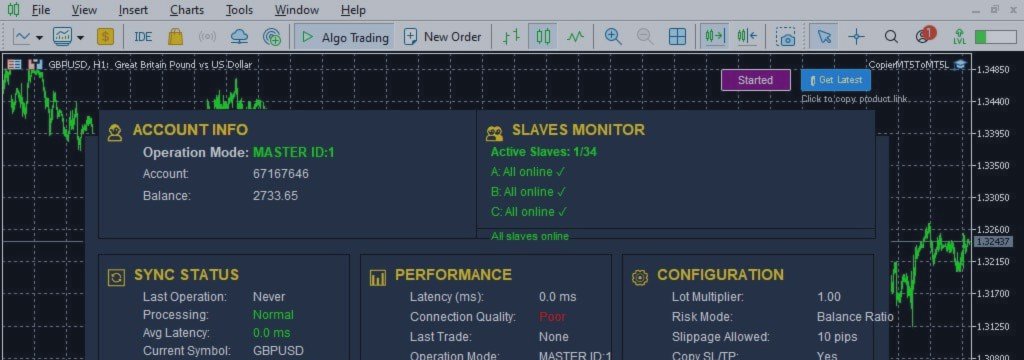
How a Professional Trade Copier Preserves Integrity During High Market Volatility

PRODUCT ACCESS LINK ON MQL5 MARKET:
- Copier MT5 To MT5
https://www.mql5.com/en/ market/product/191385 - Copier MT4 To MT4
https://www.mql5.com/en/market/product/150647
Financial markets rarely remain static for long. While routine trading sessions feature moderate fluctuations, there are moments when volatility surges within seconds. Rapid price gaps, widening spreads, execution delays, and dwindling liquidity transform the trading environment into one of the most demanding operational challenges for automated execution systems.
A professional trade copier must continue functioning reliably under these turbulent conditions. Its responsibility extends far beyond merely cloning trades from one account to another. Its core mission is to preserve the complete structural integrity of each strategy across every connected account—including trade direction, volume, stop-loss/take-profit levels, and risk ratios—even when execution conditions vary unpredictably between brokers.
Many traders expect every copied position to open at precisely the same price as the master trade. While understandable, this expectation does not align with the dynamic nature of financial markets. Even when two accounts use the same broker, identical servers, and a shared VPS, execution prices will inevitably differ due to continuous price fluctuations during order routing. Professional trade replication therefore focuses on preserving strategic uniformity rather than chasing identical execution ticks.
The Anatomy of Market Volatility and Its Impact on Replication
Volatility spikes typically stem from fundamental catalysts: central bank interest rate decisions, inflation and employment reports, geopolitical tensions, natural disasters, or sudden institutional order flow during market openings.
In such high-velocity environments, a price can move several pips before a trade request reaches the broker's execution engine. Each slave account may therefore receive slightly different execution prices, which is normal behavior and not a synchronization failure.
For every replicated trade, the copier executes a complex chain of operations: detecting a new position, reading parameters, mapping symbols, calculating lot sizes, sending execution requests, receiving confirmations, and recording synchronization data. During volatility, every step is affected by server congestion and liquidity changes.
Trade Integrity vs. Perfect Price Matching
Professional systems do not define synchronization through identical entry prices. Instead, they prioritize trade integrity, which includes:
- Correct trade direction (Buy/Sell)
- Proportional position sizing
- Accurate Stop Loss and Take Profit levels
- Consistent risk exposure
- Reliable synchronization records
Small execution differences do not affect the logic of the strategy. The trading behavior remains identical across all accounts.
Slippage, Latency, and Broker Diversity
Slippage is a natural market phenomenon where orders are executed at the nearest available price when the requested price is no longer valid. It cannot be eliminated by any copier.
Network latency also plays a role, as every trade passes through multiple layers: terminal, VPS, network infrastructure, broker server, and liquidity providers. Even milliseconds can matter during volatile markets.
Broker differences add further complexity. Execution speed, spreads, contract specifications, and pricing formats vary between brokers. A professional system adapts to these differences rather than enforcing identical conditions.
State-Based Synchronization and Continuous Monitoring
Instead of relying only on trade events, advanced systems use state-based synchronization. The copier continuously compares the master and slave accounts, including:
- Open positions
- Pending orders
- Trade volumes
- Stop Loss and Take Profit
- Trade direction
Only real differences trigger synchronization actions. This reduces errors during volatile conditions.
Monitoring continues throughout the entire trade lifecycle, ensuring consistency even during prolonged market instability.
Stop Loss, Take Profit, and Partial Close Precision
During volatility, Stop Loss and Take Profit levels may be skipped due to price gaps. The copier ensures all modifications are applied consistently across accounts.
Partial closes require proportional calculation based on original position size and executed volume. This maintains consistent exposure ratios across all accounts.
Pending orders must also be carefully synchronized to avoid duplicate triggers or incorrect execution timing.
Margin and Equity Management
One of the most important challenges in multi-account replication is divergence in equity and margin levels. Due to slippage and execution differences, slave accounts may behave differently over time.
Professional systems address this using:
- Dynamic lot sizing based on equity
- Risk-based scaling models
- Maximum exposure limits
- Risk alerts for margin imbalance
Without these mechanisms, synchronized accounts may experience inconsistent risk behavior.
Post-Disconnection Recovery and Auditing
After reconnection, the system performs a full state audit instead of replaying missed events. It checks open positions, pending orders, and synchronization logs.
Only missing or inconsistent data is corrected. This prevents duplicate trades and ensures accurate recovery.
Conclusion
High market volatility represents one of the most challenging environments for trade replication systems. Execution delays, slippage, and broker differences make perfect synchronization impossible.
However, the goal of a professional trade copier is not perfect price matching. It is preserving trade integrity across all connected accounts.
Through state-based synchronization, continuous monitoring, and intelligent recovery systems, modern trade copiers maintain consistent trading logic even under extreme market conditions.
A well-designed system adapts to volatility instead of fighting it—ensuring that every strategy remains structurally identical across all accounts.
PRODUCT ACCESS LINK ON MQL5 MARKET:
- Copier MT5 To MT5
https://www.mql5.com/en/ market/product/191385 - Copier MT4 To MT4
https://www.mql5.com/en/market/product/150647


