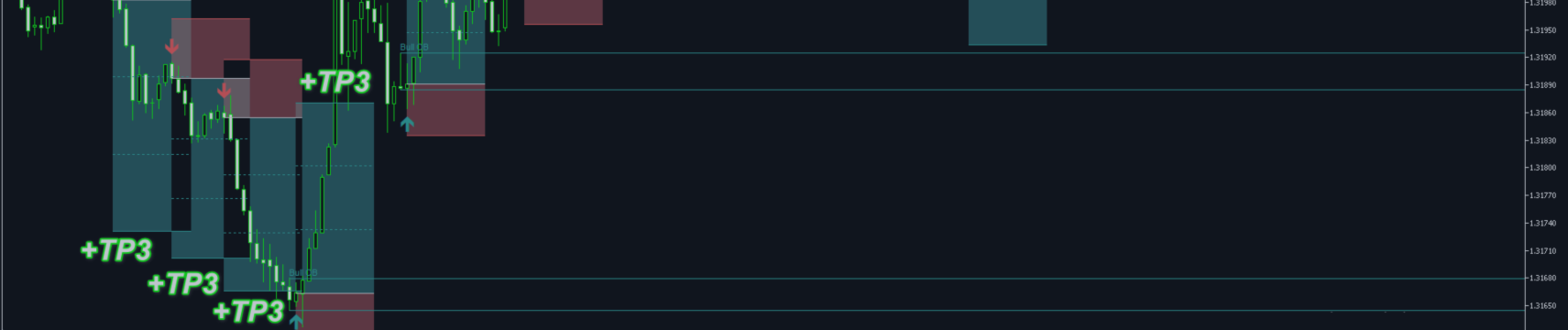

If you've spent any time studying ICT (Inner Circle Trader) or Smart Money Concepts (SMC), you've probably noticed one recurring idea: institutional traders leave footprints on the chart.
Among all Smart Money concepts, Order Blocks remain one of the most widely used tools for identifying potential reversal and continuation zones. They represent areas where large market participants are believed to have accumulated or distributed positions before initiating strong directional moves.
The challenge, however, isn't understanding what an Order Block is.
The real challenge is identifying valid Order Blocks consistently.
Many traders manually draw dozens of zones on every chart. Two traders looking at the same market often end up with completely different Order Blocks because there is no objective process behind their analysis.
This subjectivity creates inconsistency, which eventually affects trading performance.
In this article we'll explore what makes an Order Block significant, why many indicators fail to deliver reliable signals, and how a systematic approach can improve trading decisions.
Understanding the Logic Behind Order BlocksAn Order Block is generally defined as the final opposing candle before price makes a strong impulsive movement that breaks market structure.
Instead of viewing the market as random price fluctuations, Smart Money traders assume that institutional participants require significant liquidity to execute large positions.
Before a major bullish move, institutions may absorb selling pressure, creating what later becomes a bullish Order Block.
Before a strong bearish move, the opposite process occurs, forming a bearish Order Block.
When price later revisits these zones, market participants expect remaining institutional orders to continue influencing price.
Of course, not every Order Block works.
This is where filtering becomes essential.
Why Most Traders Struggle With Order Blocks
The concept itself is relatively simple.
Execution is not.
Several common problems appear repeatedly:
-
Too many potential Order Blocks
-
Different drawing methods
-
Weak impulsive moves
-
Ignoring market structure
-
Entering before confirmation
-
Repainting indicators
These issues often result in charts filled with overlapping rectangles and conflicting trading decisions.
Instead of simplifying analysis, Order Blocks sometimes create even more confusion.
The Importance of Market Structure
One characteristic separates high-quality Order Blocks from weaker ones:
They are connected to a genuine Break of Structure (BOS).
A bullish Order Block becomes much more meaningful when it forms immediately before price breaks above the previous swing high.
Likewise, a bearish Order Block gains importance when it precedes a decisive break below the previous swing low.
Without structure confirmation, many Order Blocks become nothing more than ordinary consolidation areas.
Professional traders therefore focus on the relationship between:
-
Swing highs and lows
-
Market structure
-
Momentum
-
Liquidity
-
Institutional participation
rather than candle patterns alone.
Strength Matters More Than Quantity
Another common mistake is treating every Order Block equally.
Markets constantly produce small pullbacks and minor consolidations.
Most of these are insignificant.
A high-quality Order Block should normally be followed by a strong impulsive movement.
This impulse demonstrates that buyers or sellers were capable of overwhelming the opposing side.
One practical way to evaluate this strength is by measuring:
-
ATR multiples
-
Fixed pip movement
-
Volatility expansion
Filtering weak impulses significantly reduces market noise and helps traders concentrate on areas where institutional activity is more likely.
Sometimes receiving fewer trading opportunities actually leads to better overall performance.
Fresh Order Blocks vs Mitigated Order Blocks
Not every Order Block remains valid forever.
Once price has fully traded through an Order Block, the imbalance that originally existed may no longer be present.
Many Smart Money traders classify Order Blocks into two categories.
Fresh Order Blocks
Price has never closed through the zone.
These often provide the highest probability opportunities because institutional orders may still remain unfilled.
Mitigated Order Blocks
Price has already traded through the zone and absorbed much of the available liquidity.
Repeated retests generally become weaker over time.
Distinguishing between fresh and mitigated Order Blocks helps reduce unnecessary trades and keeps chart analysis focused only on active institutional levels.
Confirmation Is Better Than Prediction
One temptation among traders is entering immediately when price touches an Order Block.
While this occasionally works, it also exposes traders to many false reactions.
A more disciplined approach is waiting for confirmation.
For example:
-
Bullish rejection candles inside bullish Order Blocks
-
Bearish rejection candles inside bearish Order Blocks
-
Strong closes in the expected direction
-
Market structure confirmation on lower timeframes
Waiting for confirmation naturally reduces the number of trades.
However, it often improves overall trade quality.
Professional trading is rarely about entering first.
It is about entering with evidence.
Why Non-Repainting Indicators Matter
Perhaps one of the biggest frustrations among traders is discovering that yesterday's perfect signal disappears today.
This happens because many indicators continuously redraw historical signals using future price information.
Such repainting creates unrealistic backtests and misleading expectations.
A non-repainting indicator behaves differently.
Signals appear only after all required confirmation has been completed.
Once displayed, they never move or disappear.
Although this approach may generate signals slightly later, it provides something much more valuable:
Confidence that historical performance reflects what actually happened in live market conditions.
Building a Complete Trading Plan
Finding an Order Block is only the beginning.
Every trade also requires:
-
Entry
-
Stop Loss
-
Profit targets
-
Risk management
Professional traders typically define these levels before entering a position rather than making decisions emotionally after the trade begins.
Many experienced traders scale out gradually.
For example:
-
Take partial profit at TP1.
-
Move the Stop Loss to breakeven.
-
Hold the remaining position toward larger targets.
This structured approach reduces emotional decision-making while allowing winning trades additional room to develop.
Multi-Timeframe Analysis Improves Context
Higher timeframe Order Blocks often carry more weight than those on lower timeframes.
A bullish Order Block on H4 or Daily may influence price even while lower timeframes appear temporarily bearish.
Many traders therefore combine:
-
Daily trend
-
H4 Order Blocks
-
H1 execution
-
M15 entry confirmation
This top-down analysis aligns trades with broader institutional flow rather than isolated short-term movements.
Automation Doesn't Replace Judgment
Modern trading tools can automate much of the technical analysis.
Order Block detection, market structure recognition, dashboard statistics, alerts, and multi-timeframe overlays all reduce manual workload.
However, no indicator can replace trading discipline.
Successful traders still need to evaluate:
-
Overall market conditions
-
Economic news
-
Risk exposure
-
Position sizing
-
Trading psychology
Indicators should support decision-making rather than replace it.
A Practical Solution for MT5 & MT4 Traders
To make the entire Order Block workflow more objective, I developed Order Block Pro for MetaTrader 5 and MetaTrader 4.
Instead of manually drawing zones, the indicator automatically identifies institutional Order Blocks based on market structure and impulse strength. Fresh Order Blocks remain visible while mitigated zones are removed automatically, helping keep charts clean and focused.
Each confirmed setup includes a complete trading plan with Entry, Stop Loss, and three Take Profit levels. A built-in dashboard summarizes current market conditions, while optional multi-timeframe overlays and alert notifications help traders monitor opportunities without constantly watching every chart.
The indicator is designed around one important principle: non-repainting signals. Every Order Block and trading setup is confirmed only after the candle has closed, ensuring that historical charts accurately reflect what traders would have seen in real market conditions.
Rather than attempting to predict every market movement, the goal is to provide an objective framework that helps traders apply ICT and Smart Money Concepts with greater consistency.
Final Thoughts
Order Blocks remain one of the most valuable concepts in modern price action trading.
Yet the concept itself is only part of the equation.
Consistency comes from applying objective rules, filtering weak setups, respecting market structure, waiting for confirmation, and managing risk with discipline.
Whether you prefer manual analysis or use specialized trading tools, the objective should always remain the same:
Make better decisions based on repeatable processes rather than subjective chart interpretation.
The market will always be uncertain.
Your analysis doesn't have to be.