Why Every EA Developer Should Track Institutional Money Flows and Market Events

Introduction
You have built a solid Expert Advisor. Backtests look good. Forward testing is positive. You put it live — and then the US Federal Reserve makes an announcement, and your EA eats a 200-pip loss in 90 seconds.
This scenario is familiar to almost every EA developer on MQL5. The problem is not the strategy logic. The problem is context blindness.
Most algorithmic traders spend enormous time optimising entry signals, risk parameters, and trailing stop logic. Very few invest the same effort in understanding the macro environment their EA operates in. This article explains why that asymmetry is dangerous, and how monitoring institutional money flows, economic calendars, and market intelligence can meaningfully improve your EA's live performance — regardless of the strategy type.
How the problem is solved: By monitoring daily market intelligence — economic calendar events, institutional COT positioning, ETF flow data, and macro developments — traders can give their EAs the environmental context they lack. The article explains which events cause the most EA damage, how to read institutional positioning as a macro filter, and introduces a free daily market briefing designed specifically for algorithmic traders
The Context Problem in Algorithmic Trading
An Expert Advisor does not know it is Non-Farm Payrolls day. It does not know the Federal Reserve is meeting in two hours. It does not know that crude oil just spiked 6% because a geopolitical conflict closed a major shipping lane. It only knows the price data in its lookback window.
This creates a fundamental gap between backtested performance and live results. Most historical data does not cleanly capture the regime changes that high-impact events create. A breakout system that works beautifully in normal trending conditions can be destroyed by a single CPI release that produces a 150-pip spike and immediate reversal — a move no technical model was designed for.
The practical solution is not to avoid running EAs entirely. It is to give your EA the environmental awareness it lacks by providing context externally — through monitoring market events, economic data releases, and institutional positioning before each trading session.
High-Impact Events That Directly Affect EA Performance
From years of developing and selling EAs on the MQL5 Market, I have identified the events that most consistently damage algorithmic strategy performance when not accounted for:
Tier 1 — Immediate spike risk (consider pausing EA or widening stops):
- Non-Farm Payrolls (NFP) — first Friday of every month, 12:30 UTC
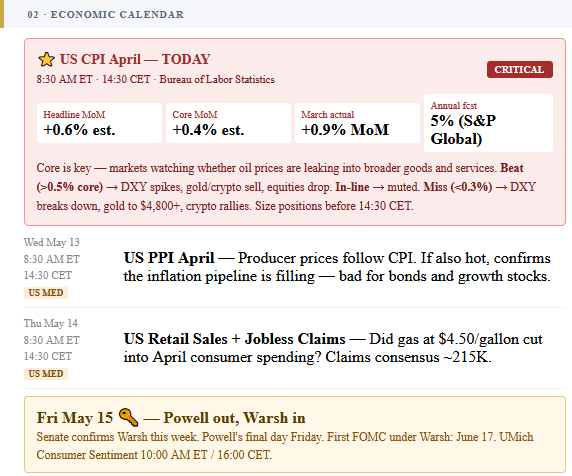
- US CPI and PPI releases — monthly, 12:30 UTC
- Federal Reserve rate decisions and press conferences
- ECB, Bank of England, Bank of Japan rate decisions
- US GDP advance estimate
Tier 2 — Elevated volatility (monitor closely, consider reduced position sizes):
- FOMC Minutes releases
- Fed Chair speeches and testimony
- G7/G20 summit communiqués
- Major geopolitical developments (war escalation, ceasefire announcements, trade deal breakthroughs)
- Options expiry dates — particularly monthly SPX options expiry, which creates mechanical dealer hedging flows that produce sharp intraday reversals disconnected from news
Tier 3 — Secondary effects (relevant for specific pairs):
- China CPI/PPI for AUD/USD and commodity-linked pairs
- UK GDP and CPI for GBP pairs
- Japanese wage data for USD/JPY and yen carry trade dynamics
- CFTC Commitment of Traders (COT) report for understanding speculative positioning
The Institutional Money Flow Edge
Technical analysis tells you what price has done. The COT report and institutional flow data tell you what large players are positioned to do.
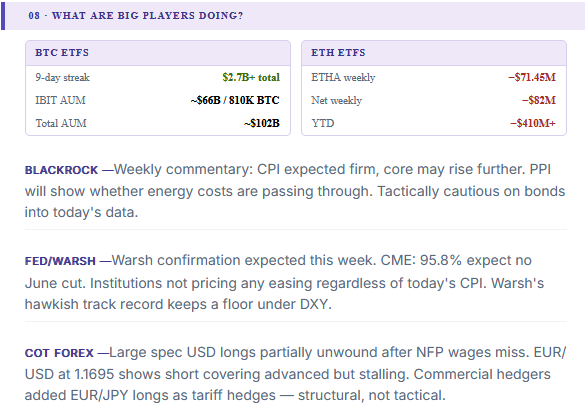
The CFTC Commitment of Traders report, released every Friday, shows the net long/short positioning of three categories of market participants across major currency futures, gold, oil, and commodity markets:
- Commercial hedgers — importers and exporters using futures to hedge real economic exposures
- Large speculators — hedge funds and professional money managers making directional bets
- Small speculators — retail traders
When large speculator positioning reaches extreme levels in one direction — particularly when it diverges sharply from commercial hedger positioning — it often precedes a significant reversal. This is not a trading signal in isolation, but it provides critical context for evaluating whether a trend has institutional support or is running out of fuel.
For EA developers trading forex, gold, or crude oil, monitoring COT data weekly takes 5 minutes and can prevent trading against a positioning extreme that is about to unwind violently.
Beyond COT, tracking cryptocurrency ETF flows has become essential for traders with crypto exposure. When BlackRock's iShares Bitcoin ETF records multiple consecutive days of institutional inflows, it signals that large institutional money is accumulating — a structural bullish floor. When those flows reverse, it can precede significant price moves. This data is publicly reported daily by ETF providers and financial news services.
Introducing The Money Flow Journal
Tracking all of these data sources manually takes significant time every morning. I built The Money Flow Journal specifically for this purpose — a free daily newsletter that consolidates market intelligence relevant to forex, crypto, and equity traders into one morning briefing.
Each weekday issue covers:
Market Snapshot — Spot prices across all major forex pairs, cryptocurrency, equity indices, gold (XAUUSD), silver, and crude oil. Updated before the European open.
Economic Calendar — High-impact events for the US, EU, UK, Japan, and China. Each event includes the scheduled time in both New York (ET) and Central European Time (CET), the consensus forecast, the previous reading, and a practical note on which trading pairs to watch.
Macro and Geopolitical Moves — Developments that directly affect market conditions: central bank communications, trade policy changes, geopolitical escalations or de-escalations, and corporate news that moves indices.
Forex Focus — Pair-by-pair session analysis covering key levels, active drivers, and practical notes for forex traders. Includes specific guidance on when to consider pausing EAs or widening stops ahead of high-impact releases.
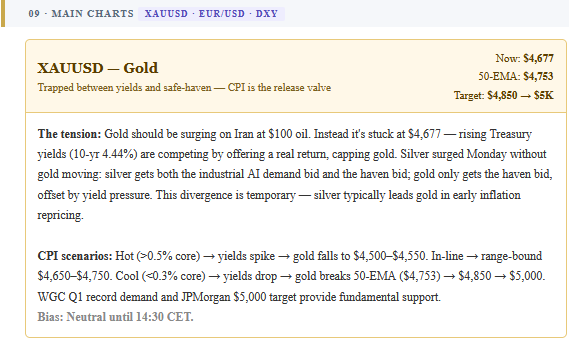
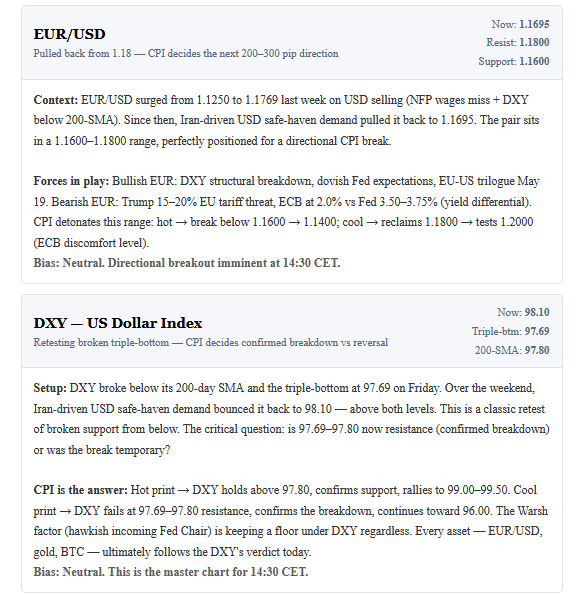
Main Charts — Written technical analysis of the most relevant charts for that day, selected from BTC/USD, XAUUSD, EUR/USD, SPX500, DXY, GBP/USD, USD/JPY, and Nasdaq 100. No TradingView embeds — clean written analysis you can act on.
What Are Big Players Doing? — The institutional intelligence section. Covers BTC and ETH ETF daily inflow/outflow data, COT report highlights for forex pairs, Federal Reserve transition news, sovereign wealth fund moves, and institutional earnings commentary.
Stock Market View — Earnings calendar for the week with release times in both ET and CET timezones, plus analysis of major earnings reports and how they affect related instruments.
Quote of the Day — A single trading psychology or market wisdom quote relevant to that day's conditions.
The Friday issue includes a Week Ahead Preview as the first section — a structured preview of next week's high-impact calendar events, key earnings, and risk factors to plan positions around.
How to Use The Money Flow Journal With Your Expert Advisors
Here are specific practical ways EA developers can use daily market intelligence to improve live performance:
1. Build a pre-session checklist Before each trading session, review the economic calendar from the morning issue. If a Tier 1 event is scheduled for that session, decide in advance whether you will: (a) pause the EA, (b) widen stop losses by a defined multiplier, or (c) reduce position sizing. This decision should be made before the event, not in the moment.
2. Use the Forex Focus section for session context The daily pair analysis tells you whether a pair is in a trending or ranging regime, what the key support and resistance levels are, and what news drivers are active. This context helps you set appropriate parameters for the session rather than running at default settings regardless of conditions.
3. Monitor the XAUUSD and DXY analysis for correlated instruments Gold (XAUUSD) and the Dollar Index (DXY) drive correlated moves across EUR/USD, USD/JPY, USD/CHF, and commodity-linked pairs. A single paragraph of analysis on DXY each morning provides a macro filter for every USD-denominated pair your EA trades.
4. Use COT data to validate or question trend signals If your EA generates a buy signal on EUR/USD but the COT report shows large speculative short positioning at a multi-year extreme in EUR futures, that context does not invalidate the signal — but it suggests tighter risk management is appropriate. Extreme positioning does not mean immediate reversal, but it does mean the risk/reward of fighting the positioning is elevated.
5. Set calendar-based EA filters Most EA platforms including MetaTrader 4 and 5 support news filters that can pause trading around specified times. Using the MFJ calendar alongside a news filter EA (I publish one at MQL5 — TelegramNotifyEA with built-in news event notification) allows you to build a semi-automated system where market intelligence feeds directly into trading decisions.
Why This Matters More in 2026
The macro environment of 2026 — with an active geopolitical conflict affecting energy prices, a Federal Reserve leadership transition, and AI-driven earnings acceleration — has created unusually high correlations between macro events and intraday price action. Strategies that ran profitably in the calmer 2023–2024 environment have experienced drawdown in 2026 specifically because context-blind EA operation is more dangerous in high-macro-sensitivity regimes.
When oil moves 6% in a session because of a ceasefire announcement or breakdown, every USD pair, every gold position, and every equity index is affected simultaneously. No technical model built on normal market conditions is designed for this. Context awareness is the only mitigation.
Subscribe to The Money Flow Journal
The Money Flow Journal is published every weekday morning before the European session open. It is free to subscribe.
Subscribe: https://themoneyflowjournal.beehiiv.com
MQL5 Market (products by the author): https://www.mql5.com/en/users/ortiniusIf you find the daily issues useful, consider sharing with other EA developers in your network. The newsletter is designed specifically for the algorithmic trading community — the same community that builds and uses products on the MQL5 Market.
Conclusion — what the reader gets: A practical framework for integrating market intelligence into EA workflows: a tiered high-impact event list, guidance on using COT data and ETF inflow/outflow as directional filters, and a free daily newsletter that consolidates all relevant macro data before each European session open
Building a profitable Expert Advisor is a technical challenge. Keeping it profitable in live conditions is a contextual one. The EA cannot read the news, monitor institutional positioning, or anticipate the Fed Chair's press conference. You can — and doing so with a consistent daily briefing takes less than 10 minutes of morning reading.
Market intelligence is not a substitute for a good strategy. It is the environment in which your strategy operates. Understanding that environment is as important as understanding the strategy itself.