

More about Pass or Breakeven EA
This page covers the full technical detail, background, lifecycle mechanics, live test results, notes, and disclaimers for the Pass or Breakeven (POBE) Expert Advisor listed on the MQL5 Marketplace.
View/Back to the product listing | Backtest/Simulator Guide
The Idea Behind POBE
Published industry data covering over 300,000 prop firm accounts shows that approximately 1 to 2% of all challenge buyers ever receive a funded account payout. For the remaining 98 to 99%, the challenge fee produces no return when the challenge fails.
POBE changes this structure. Because the broker account holds the opposing position throughout the challenge, every possible lifecycle ending produces a defined result. There are six possible endings across three phases. Based on observed challenge cycles, the three terminal outcomes have distributed as follows:
- Approximately 50% of observed challenges ended near breakeven — either failing Phase 1 or failing the Funded phase. The broker account recovered an amount close to the challenge cost.
- Approximately 25% of observed challenges ended with a net positive result from failing — passing Phase 1 but failing Phase 2. The broker account accumulated gains across both phases.
- Approximately 25% of observed challenges ended with the funded payout outcome — passing all phases and receiving a funded account profit share.
These figures are based on observed challenge cycles and will vary by trader, strategy, and market conditions. They are presented as a reference, not a guarantee of future results.
A trader running POBE does not need to pass the challenge to produce a result. The challenge fee becomes a capital deployment with a defined expected outcome across all possible paths, rather than a binary fee at risk.
Background
Published industry data covering over 300,000 prop firm accounts across multiple firms shows that approximately 14% of traders pass a two-step Phase 1 evaluation, and roughly 1 to 2% of all challenge buyers ever receive a funded account payout. Multiple independent sources cite the overall evaluation pass rate at 5 to 10%.
Researchers and trading psychology professionals consistently identify emotional factors — fear, impulsive recovery trades after losses, and pressure to hit targets before fee renewal — as the primary reasons traders fail evaluations rather than strategy failures. A trader operating under evaluation pressure behaves differently from a trader on a demo account, even when using the same setup.
POBE addresses this by removing manual decision-making from the process. The EA executes trades according to its configured parameters without responding to equity fluctuations, drawdown proximity, or target proximity.
How the Hedge Lifecycle Works
POBE tracks three phases that correspond to a standard two-phase prop firm structure: Phase 1 (Challenge), Phase 2 (Verification), and the Funded phase. At each phase the prop firm account and broker account hold opposing positions. When one account gains, the other loses a proportional amount determined by the hedge ratio.
The four possible lifecycle endings are:
- Fail Phase 1 — prop firm hits maximum drawdown. Broker collects the opposing gain, targeting recovery of the challenge fee.
- Fail Phase 2 — prop firm passes Phase 1 but hits maximum drawdown during verification. Broker has accumulated gains across both phases, producing a net positive result in observed testing.
- Fail the Funded phase — prop firm passes both phases but hits maximum drawdown after being funded. Broker gains from both evaluation phases offset the funded phase loss, targeting breakeven.
- Pass the Funded phase — prop firm hits the funded profit target. Broker losses across all three phases are offset by the funded payout and fee refund. This is the maximum outcome in the lifecycle.
Many traders assume POBE's job is done once Phase 1 and Phase 2 are passed and a funded account is obtained. This is a common misconception. Passing Phase 1 and Phase 2 means the broker account has been carrying opposing positions throughout both evaluation phases and has accumulated a sunk cost. The funded phase is where that sunk cost is recovered — either through a funded profit that offsets it entirely, or through a funded breakeven that closes the lifecycle at no net loss. Running the funded phase through POBE is not optional — it is the final leg that completes the hedge. Without it, the broker sunk cost from both evaluation phases remains unrecovered.
POBE Index
The POBE Index measures how the challenge fee compares to the maximum amount the funded phase could theoretically return after the payout split. The smaller the fee relative to the potential funded payout, the higher the index. A larger account size or a lower challenge fee both improve the index. It displays a rating on-chart:
- VERY GOOD — fee is very small relative to potential funded return
- GOOD — configuration is well-suited to hedging
- AVERAGE — hedging is viable but the margin is moderate
- WEAK — fee is relatively high, outcomes will be tighter
- NOT SUITABLE — fee consumes too much of the potential funded return, the EA will not recommend proceeding
Run the backtest simulator before committing to any live challenge. Check the POBE Index and Equity Needed figures for your specific account size and challenge cost before starting.
Built-In Backtest Simulator
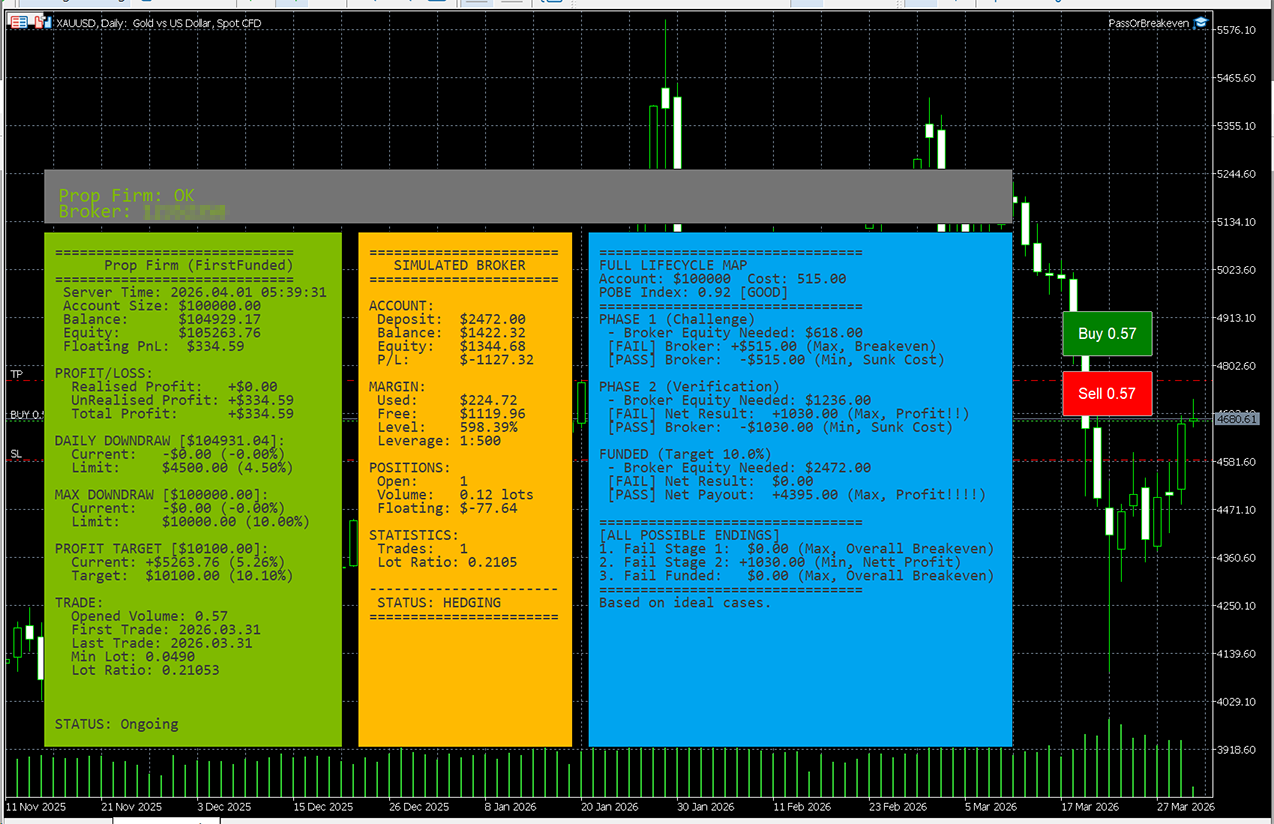
The demo version runs in the MT5 Strategy Tester with the simulated broker mode enabled. The EA runs a full challenge simulation — either reaching the configured profit target or breaching the drawdown limit, exactly as it would on a live challenge. The simulated broker tracks the opposing position throughout and displays its balance, equity, and running result on-chart alongside the prop firm account. The lifecycle map display and POBE Index are visible throughout the test.
Run the test multiple times across different date ranges to observe both the pass and fail outcomes and verify the lifecycle map calculations against your own prop firm's parameters.
The simulator panels explained:
- Green panel — prop firm account. Shows balance, equity, drawdown, profit target progress, and current trade statistics.
- Yellow panel — simulated broker account. Tracks the internal hedge calculation including deposit, balance, equity, open positions, lot ratio, and margin. No real second account is required during backtesting.
- Blue panel — full lifecycle map. Displays the POBE Index, equity needed per phase, expected result at each possible ending, and a summary of all possible lifecycle outcomes.
Live Testing Results
All six lifecycle paths were observed in live testing on a $100,000 FTMO account. Results are presented as net figures after all broker costs, challenge fees, spread, slippage, and where applicable the funded account payout and fee refund. Most outcomes landed within 97 to 99% of the calculated theoretical values shown in the lifecycle map display.
Pass Challenge (Phase 1)
Fail Challenge (Phase 1)
Pass Verification (Phase 2)
Fail Verification (Phase 2)
Pass Funded (Phase 3) — run 1
Pass Funded (Phase 3) — run 2
Fail Funded (Phase 3)
Results may vary due to real-world hedging friction from spread, slippage, and swap fees. In trending market conditions where fewer trades are required to reach the phase target, hedging fidelity is tighter and outcomes sit closer to the lifecycle map values. Ranging or choppy conditions introduce more friction over a longer period, and a drawn-out challenge with more trades accumulates more friction across both accounts.
Notes
- Broker selection matters. Use a low-cost broker with tight spreads and fast execution. High spread or slow execution widens the gap between the two accounts and reduces how closely actual results match the lifecycle map values.
- Two-phase challenges only. POBE is not configured for one-step or three-step evaluation structures without parameter adjustment.
- Both terminals must remain active. If one terminal closes or loses connection, trade copying pauses until the connection is restored.
- One instance per machine. POBE is designed to run one instance per VPS or PC, ensuring no two challenges share the same IP address at the same time.
- Broker account funding. If the broker account balance falls below the Equity Needed figure for the current phase, the EA displays a warning and pauses trade opening. The Equity Needed figure is shown in the lifecycle map display and includes a safety buffer.
- Prop firm rule compliance. The user is solely responsible for verifying that this approach is permitted by their chosen prop firm before use. Prop firm rules vary and may change at any time.
- Manual and third-party EA trades. POBE hedges all open positions on the prop firm account, including those opened manually or by other EAs. Trades not opened by POBE use a less precise lot ratio and will hedge with lower fidelity than POBE-opened trades.
- MT4 version coming soon. The current version is MT5 only. Cross-platform pairing between POBE MT4 and POBE MT5 will be supported when the MT4 version is released.
Disclaimers
No guarantee of results. Past performance, live test results, and theoretical lifecycle calculations shown in this product do not guarantee future results. Trading involves substantial risk. The outcomes shown in the lifecycle map display are based on ideal conditions and may differ from actual results due to spread, slippage, swap fees, execution delays, broker rejections, connection interruptions, and other real-world factors. Actual results may vary significantly from the theoretical values displayed.
Prop firm payments. The developer has no control over and accepts no responsibility for any prop firm's decision to pay out, withhold, delay, or refuse funded account profits. Prop firms are independent third-party businesses. Their payment policies, withdrawal terms, account conditions, and continued operation are entirely outside the developer's control. The user assumes full responsibility for selecting a reputable prop firm and for any financial outcome arising from the prop firm's actions or inactions.
No financial advice. This EA is a software tool. Nothing in this product, its documentation, or any associated communications constitutes financial advice, investment advice, or a recommendation to trade. The user is solely responsible for all trading decisions and for ensuring this tool is appropriate for their individual circumstances and risk tolerance.
Risk of loss. Trading foreign exchange and related instruments carries a high level of risk and may not be suitable for all investors. The use of automated trading software does not reduce or eliminate this risk. You may lose some or all of your invested capital. Do not trade with money you cannot afford to lose.
Software limitations. This EA is provided as-is. While every effort has been made to ensure reliable operation, the developer does not warrant that the software is free from errors, bugs, or interruptions. The developer accepts no liability for losses arising from software malfunction, incorrect configuration, or unexpected broker or platform behaviour.
Third-party platforms. This product is listed and distributed through MQL5.com. MQL5.com is a third-party marketplace and is not affiliated with or responsible for the function of this EA, the actions of any prop firm, or any financial outcome arising from the use of this product.
Two-terminal hedge EA for two-phase prop firm challenges. Opposing positions on a broker account produce a calculated result across all four possible lifecycle outcomes.
Back to the product description | Backtest/Simulation Guide


![[EURUSD]: Weekly Liquidity Activation Points (LAP), October 12-16, 2026](https://c.mql5.com/6/1035/splash-preview-777305.png "[EURUSD]: Weekly Liquidity Activation Points (LAP), October 12-16, 2026")
![[Nasdaq]: Weekly Liquidity Activation Points (LAP), October 12-16, 2026](https://c.mql5.com/6/1035/splash-preview-777311.png "[Nasdaq]: Weekly Liquidity Activation Points (LAP), October 12-16, 2026")
![[XAGUSD]: Weekly Liquidity Activation Points (LAP), October 12-16, 2026](https://c.mql5.com/6/1035/splash-preview-777308.png "[XAGUSD]: Weekly Liquidity Activation Points (LAP), October 12-16, 2026")