

This week I’m publishing my wildest forecasts for 2026. Please take them with a grain of humor and healthy skepticism—don’t treat them as gospel. These predictions might be absurd… but that’s the whole point of the genre. The probability they come true approaches zero—but it’s not zero.
If you read my last piece about gold hitting $12,000 per ounce, you know I’ve been thinking a lot about what happens when money stops behaving like money. But here’s the twist: gold isn’t the only metal about to go berserk.
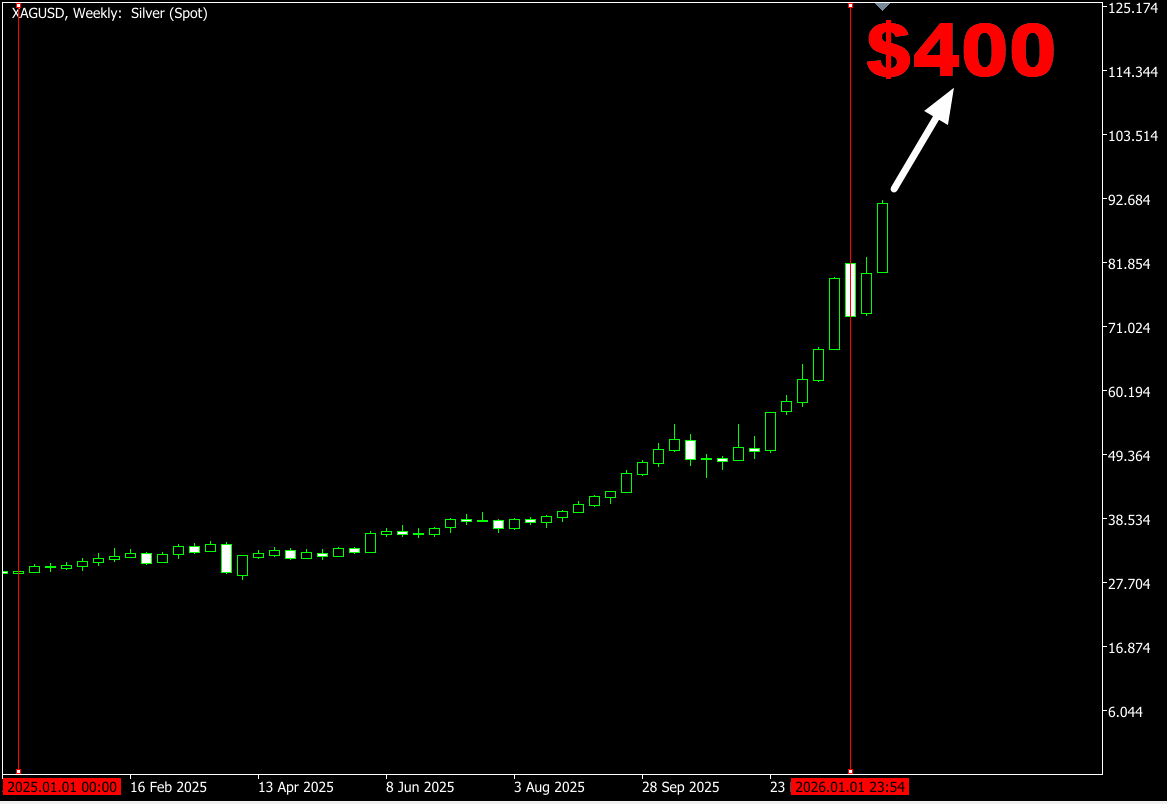
Right now, silver is trading at $91.20 per ounce.
Yes—ninety-one dollars. Not per kilogram. Per ounce. The same tiny ounce that weighs less than 30 grams.
And unlike gold, which is mostly hoarded or speculated on, silver is being devoured by real-world demand. Solar panels, EVs, AI data centers, defense tech—every major industrial trend of the decade runs on silver. The U.S. Geological Survey just confirmed: global silver reserves are depleting faster than any other critical mineral. We’re not just facing a supply crunch—we’re already in it.
Imagine this: a single solar farm now uses more silver than an entire country consumed in the 1990s. Meanwhile, mining output hasn’t kept pace. Recycling can’t fill the gap. And then—just like with gold—trust evaporates. Currencies wobble. Supply chains fracture. Suddenly, everyone realizes: you can’t print silver.
So here’s my shocking 2026 forecast:
My solutions on MQL5 Market: Evgeny Belyaev’s products for traders
Silver could surge past $400 per ounce.
Not $40. Four hundred.
Why? Because when physical scarcity meets financial panic, silver doesn’t act like a commodity—it acts like a lifeline. It’s both an industrial necessity and a monetary relic. In a world where chips are more valuable than cash and energy grids depend on photovoltaics, silver becomes irreplaceable.
Is this realistic? Probably not.
But remember: just a few months ago, $4,300 gold sounded insane too.
I love digging into how markets really work—beyond the headlines, beyond the hype. If you believe there are real people behind the numbers and real crises behind the charts, you’re in the right place.



![[iVISTscalp5]: EURUSD. Forecast First. Market Reaction Afterwards//October 12-16, 2026](https://c.mql5.com/6/1038/splash-preview-777972.png "[iVISTscalp5]: EURUSD. Forecast First. Market Reaction Afterwards//October 12-16, 2026")