The main purpose of the " Elliott Wave Helper " panel is to simplify and speed up wave analysis. The panel is available for versions 4 and 5 of the trading terminal:
Before using it, we recommend downloading and installing a special wave font with circles. You can download it from this link . To activate the font, set the gear icon next to " Circles " to " On ."
Building a pattern
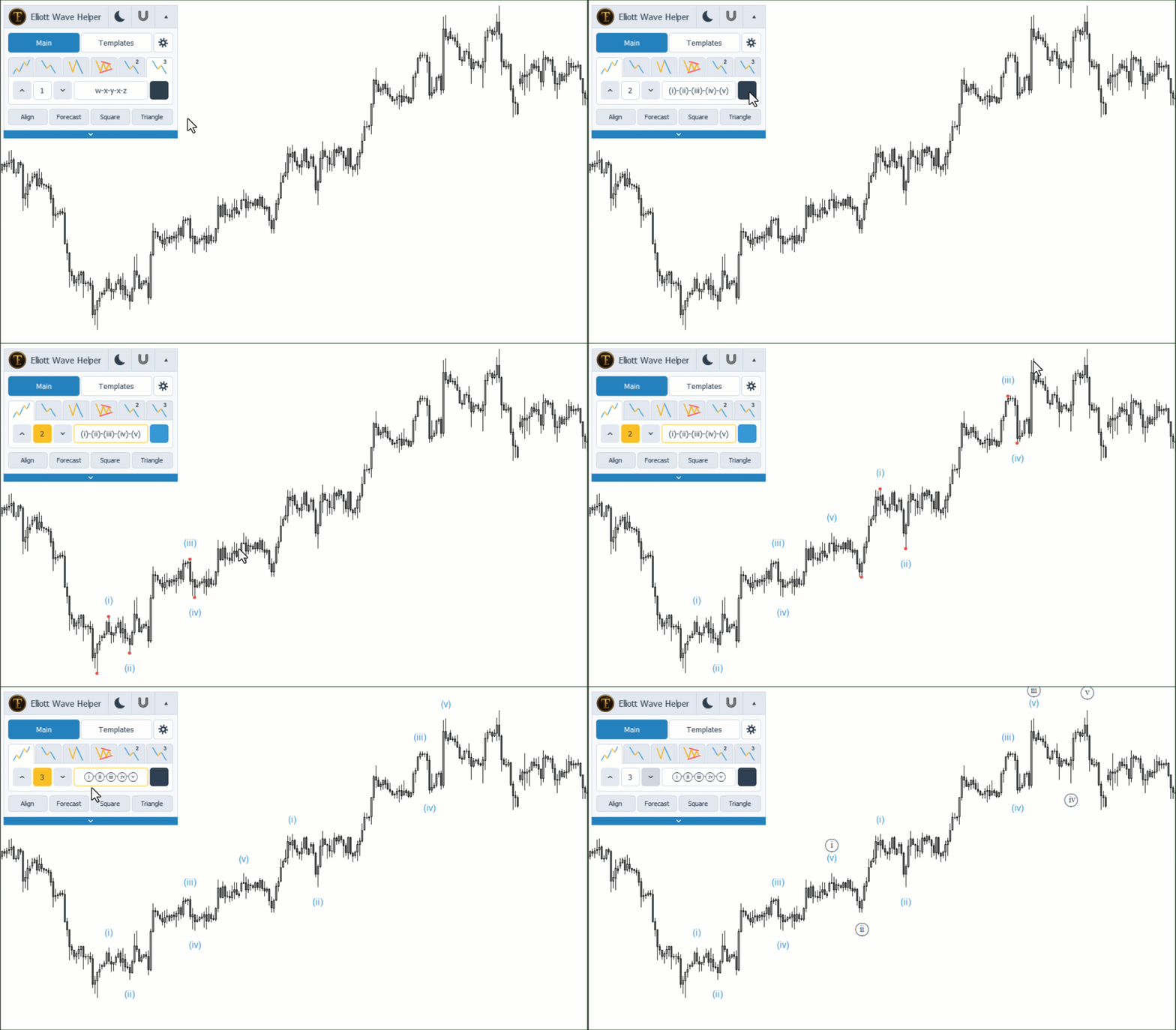
To build a pattern you need to do the following:
- Select the pattern itself. This is done by clicking on the pattern icons.
- Select a pattern level in the hierarchy. This is done using the up and down arrows to the left of the pattern name.
- Select the pattern color. This is done by clicking on the color cell to the right of the pattern.
- Click on the pattern field, then on the chart in the required places
Connecting lines
To make your wave structure more complete and understandable, you can build a pattern with connecting lines. To do this, click the " Lines " button before building. Remember that you can also change the style, thickness, and color of the connecting lines through the panel interface.

Triangle and rectangle
To fill triangles and diagonals, use the " Triangle " button, as shown in the video below. Rectangular areas are filled using the " Square " button.

Changing styles using the mini-panel
If you've built a pattern but want to change something after it's been built, you can double-click on it with the left mouse button and change it through the mini-panel: - hierarchy/font size/color for letters or pattern numbers
- style/thickness for pattern lines (or remove them completely)
- style/thickness/line color/fill color for triangles
- fill color for rectangles

Changing styles using hotkeys
You can use hotkeys to change styles, as well as to delete and redo a deleted pattern. This method is much more convenient and faster if you use a keyboard.
- W and S are the pattern font size
- B — bold font for pattern
- A and D are the wave order of the selected pattern
- Shift together with these arrows - line thickness and type
- F — hide or show the lines of the selected pattern
- Q — delete the selected pattern or shape
- R — return a deleted pattern or shape
- E — deselect the selected pattern or shape
- C — select a color for a pattern or shape line (does not affect pattern connecting lines)
Forecast line
If you want to forecast your markup, you can do so using the " Forecast " tool. Click the button, then enter your forecast, and then click the button again to deactivate the function. You can also generate a forecast using the " Shift " hotkey. Simply hold it down and click the chart several times. Releasing it deactivates the function.

Working with templates
The panel allows you to create multiple markup templates on a single chart. To work with templates, go to the " Templates " tab. By default, a template takes the name of the instrument you're marking, but you can change the name by double-clicking it and entering your own text. You can also create a template, copy a template, and delete a template. The maximum number of templates per chart is 5.
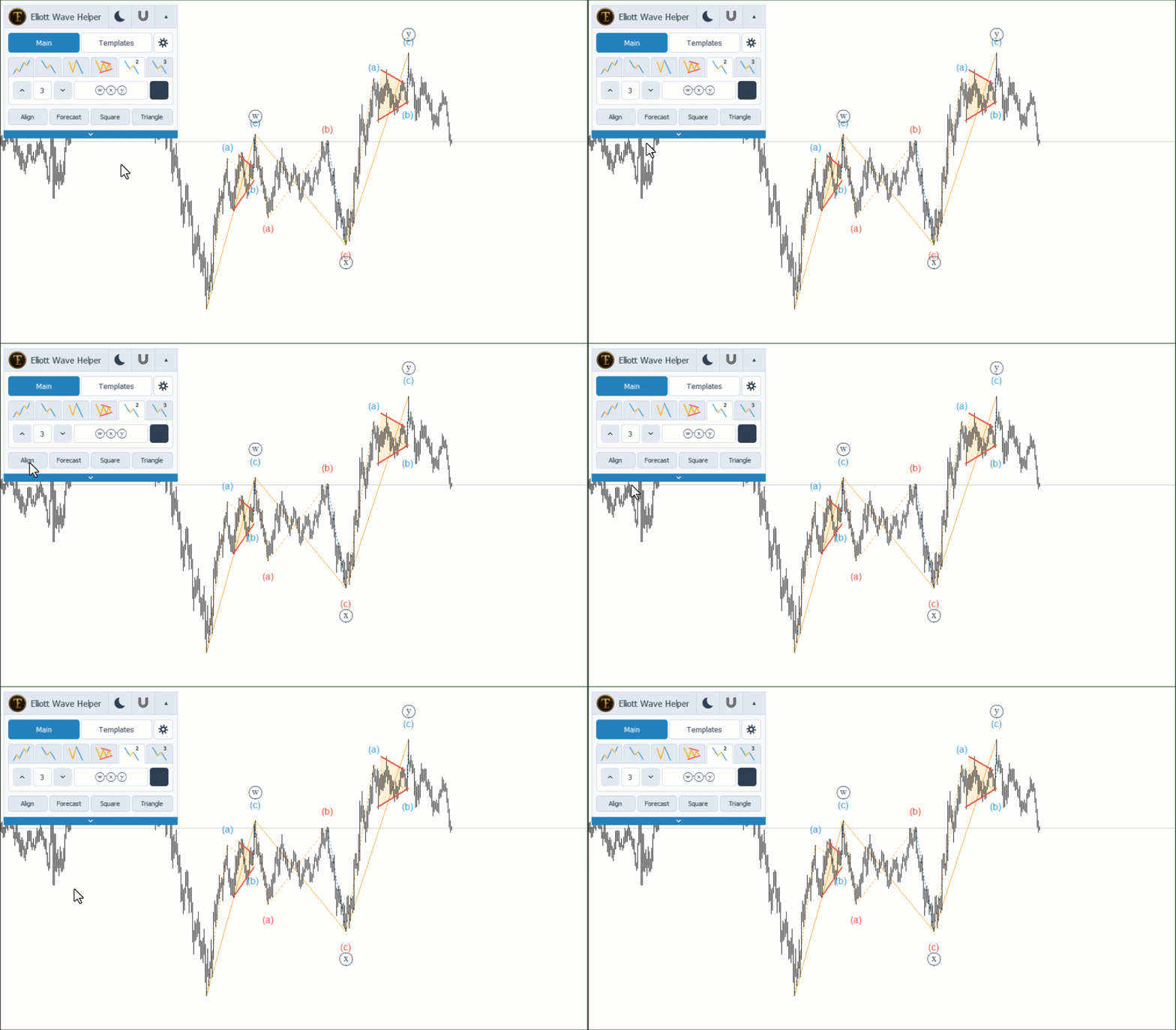
Alignment
When plotted, waves are aligned and adapted to the scale of your current chart. Since the appearance may vary when zooming in or out, the markup may look unsightly. I've added an alignment feature that allows you to align your markup based on the current chart scale. To activate, use the " Align " button or the " X " hotkey.
Working with timeframes
By default, all wave analysis elements are displayed only on the timeframe you're working on. For example, if you're performing analysis on a daily chart, all letters, numbers, and lines will also be displayed only on the daily chart. If you want your markup to be displayed on multiple timeframes, select these timeframes in the panel settings before starting. This is done by pressing the " TF " key, as shown below:

2 types of program interface
For convenience, we've created two interfaces. The first is shorter (to save space), but requires an additional click on the panel to select patterns before plotting. The second is classic, but larger. You can switch between interfaces using the gear icon.

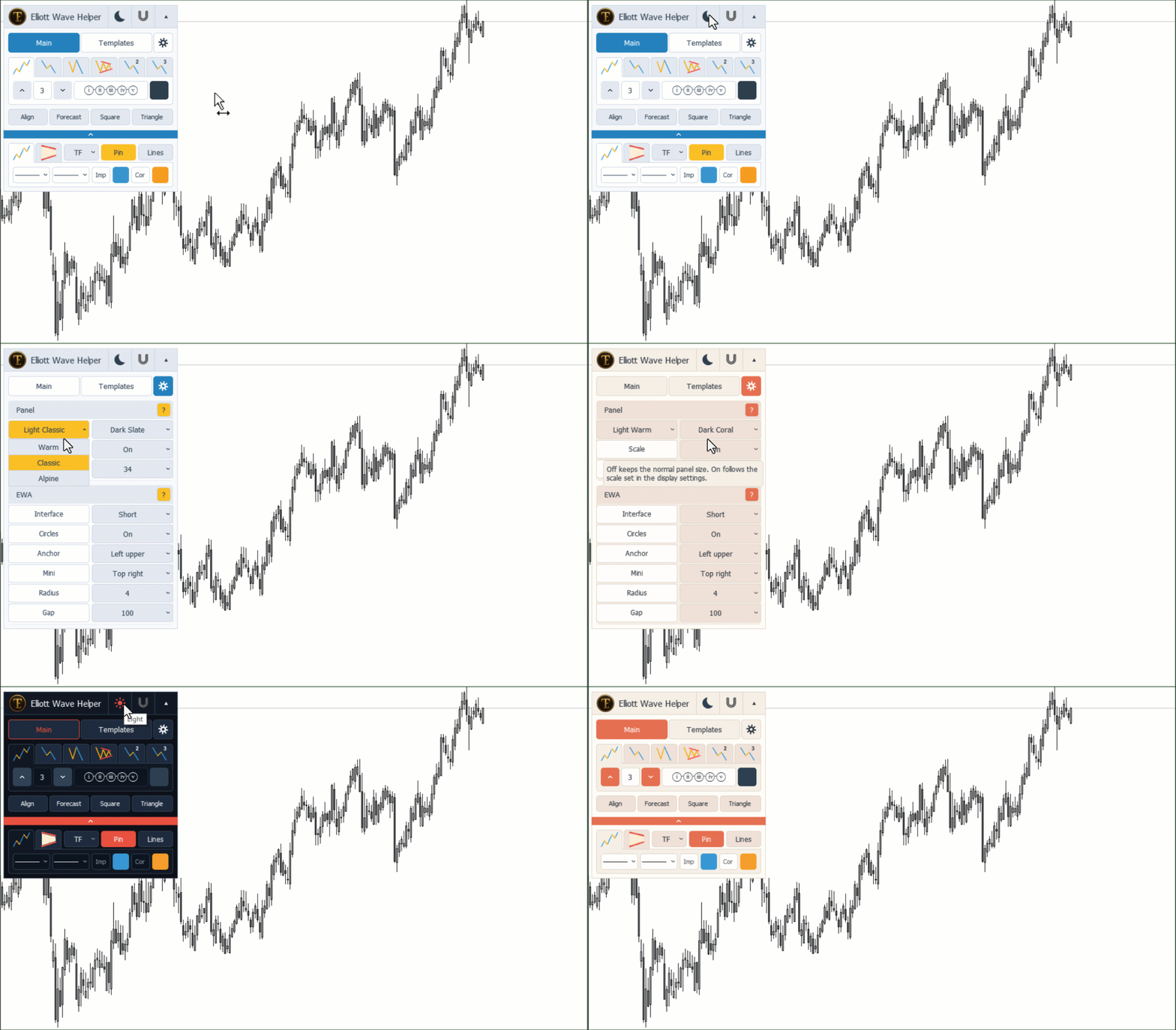
Light and dark themes
We've implemented a switch between dark and light interface themes in the program. You can switch between them by pressing the sun/moon key. You can also find other color schemes in the gear icon.
Appearance
Gear Card Panel
- Light — Warm, Classic, or Alpine. Dark — Slate or Coral. The sun and moon button in the header switches between the light and dark schemes.
- Scale: Off leaves the panel compact, On increases it along with the Windows scale.
- Tabs — tab height: 28, 34, or 40.
EWA card on the same gear:
- Interface - select the panel interface type
- Circles - turn on/off the circle font
- Anchor - the anchor point for dragging letters and numbers
- Mini - the default position of the mini panel
- Radius - the radius of attraction of letters and numbers to the shadows for "Pin"
- Gap - alignment range for "Align"
The ? symbol on the card plate briefly explains the lines. Gold indicates that explanations are included.
Important: The gear settings are saved across all tabs in the program.
Author : Siarhei Vashchylka . For any questions, please contact me via private message. I also recommend subscribing to my updates. To do this, follow the link to my profile and click " Add as friend ."