Pyramiding Entry Master MT5
- Göstergeler
- Sürüm: 1.10
- Güncellendi: 29 Temmuz 2026

Product Overview
Pyramiding Entry Master is a main‑chart moving‑average trend‑following and pyramiding‑entry indicator designed for both the MT4 and MT5 platforms. It draws a four‑period moving‑average system (MA5, MA10, MA20, MA60) on the main chart and, based on a 55‑period trend‑momentum model, volume‑expansion confirmation, and multiple oversold conditions, automatically generates three types of buy signals: Chase (halfway momentum entry), Add (next‑day pyramiding), and Dip Buy (deep‑oversold bottom fishing), covering three typical entry scenarios of trend‑acceleration chasing, next‑day dip adding, and deep‑oversold reversal. With rigorous signal logic, clear visual hierarchy, and an independent cooldown filter plus multi‑channel alert mechanism, it is an ideal main‑chart tool for building a pyramiding trading system.
Core Features
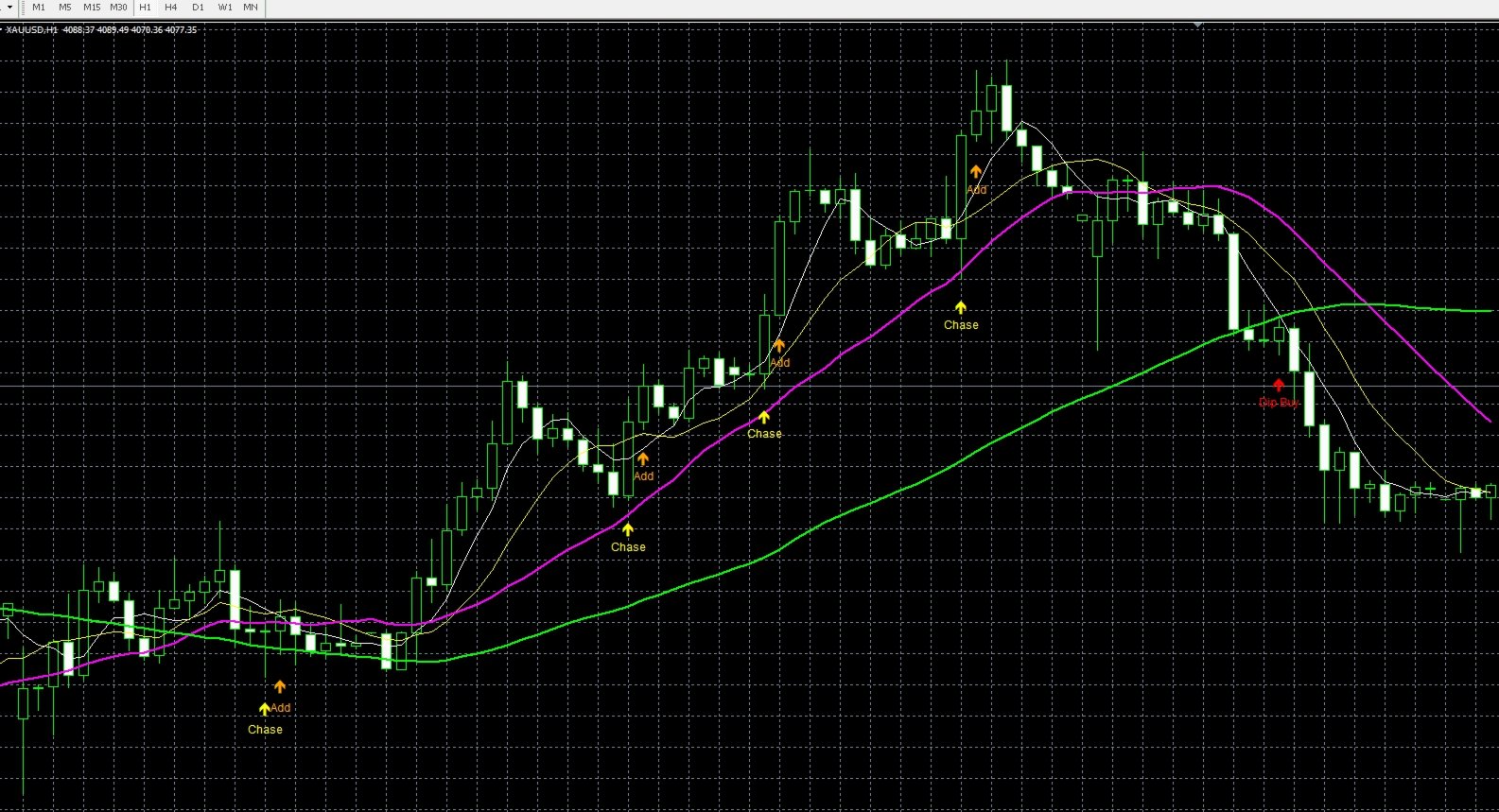
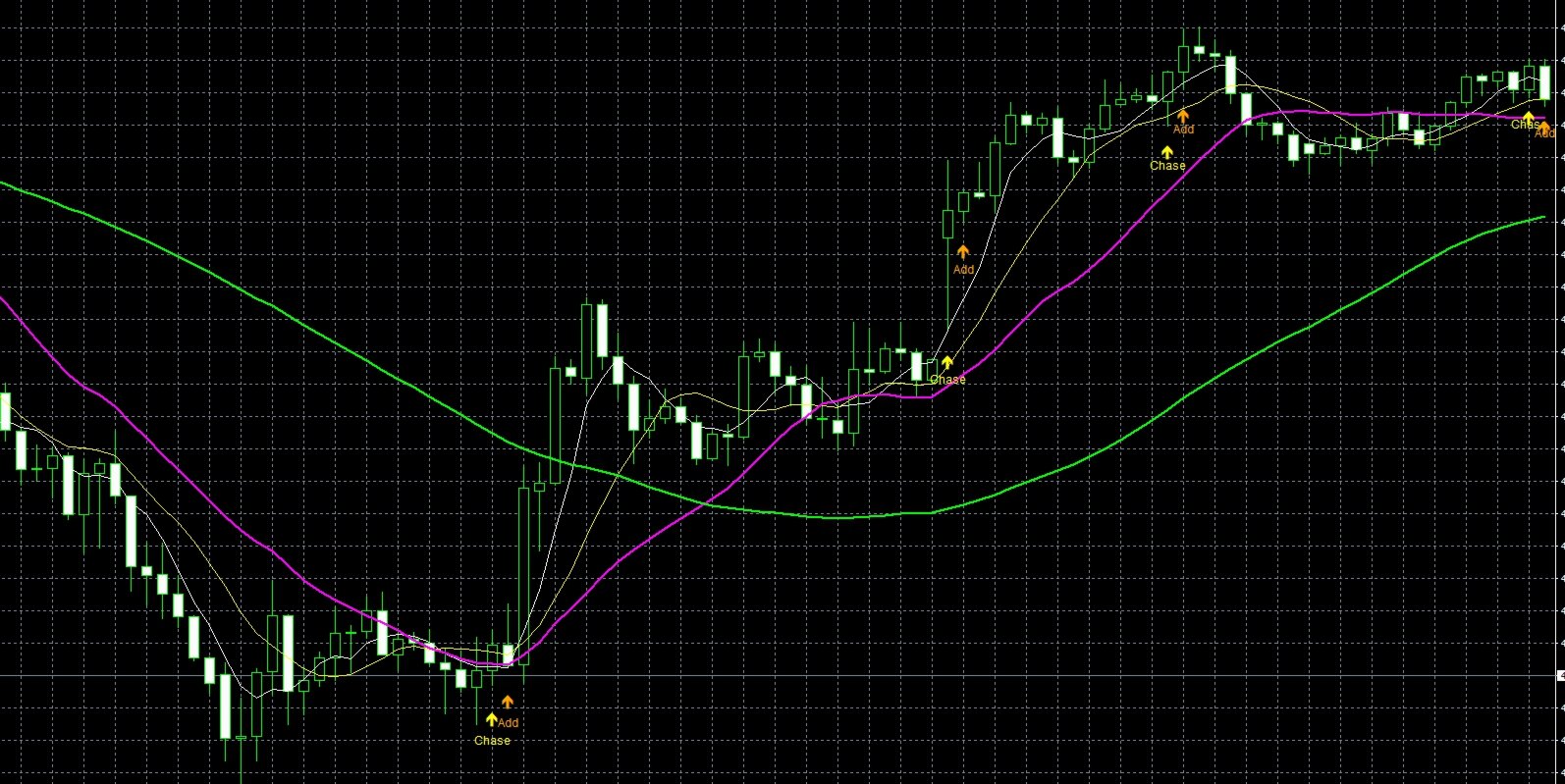
Four‑Period Moving Average System and Right‑Side Labels The system draws four moving averages on the main chart: the MA5 white line reflects the ultra‑short‑term price center of gravity, the MA10 yellow line reflects the short‑term trend direction, the MA20 magenta thick line serves as the short‑to‑medium‑term trend watershed, and the MA60 green thick line serves as the medium‑to‑long‑term trend benchmark. Each moving average has a same‑colored text label on its right side for quick identification. When the moving averages are in bullish alignment (MA5 > MA10 > MA20 > MA60), it indicates a healthy uptrend, which is the optimal background condition for Chase and Add signals to perform. The MT5 version additionally supports signal candle color‑coding, coloring candles that trigger Chase signals yellow, Add signals orange, and Dip Buy signals red, so that entry timing is shown intuitively through candle color.
Buy Signals
- Chase (Halfway Momentum Entry): Triggered when the 55‑period trend‑momentum indicator V3 crosses above the previous candle's V4 value (indicating that closing‑price momentum has surpassed opening‑price momentum, confirming trend acceleration), the current candle's volume exceeds the 20‑period average volume by a specified multiple (default 1.1x, confirming volume expansion), and the current candle closes bullish, displaying a yellow upward arrow with the text "Chase" below the candle. This means price has shown a resonance of momentum acceleration and capital inflow during a trend run, making it a classic trend‑continuation momentum‑entry signal suitable for adding to an existing position or opening a new one with the trend.
- Add (Pyramiding): Triggered automatically on the current candle when the previous candle has already triggered a Chase signal, displaying an orange upward arrow with the text "Add" below the candle. This means the next‑day dip window after a momentum‑entry signal has appeared; if price pulls back slightly, it represents the optimal timing for pyramiding, serving as a continuation‑add prompt for the Chase signal.
- Dip Buy (Bottom Fishing): Triggered when any three of the following five oversold conditions are met: short‑term momentum ratio below 30 (declining momentum exhaustion), price position relative to the 60‑period high‑low range deeply negative (far from the high), lowest price near the 10‑period low (touching recent support), close below MA20 but the current candle is bullish (a stabilization bullish candle below the moving average), and 20‑period bias below -5% (severe oversold deviation). When triggered, a red upward arrow with the text "Dip Buy" is displayed below the candle. This means price has moved deep into the oversold zone and multiple technical conditions resonate to confirm bottoming signs, making it an aggressive left‑side bottom‑fishing entry signal.
Practical Application
In day‑to‑day pyramiding trading, the three signals form a complete entry hierarchy. The Chase signal is the core entry signal, representing the resonance of trend acceleration and volume expansion, suitable as the primary basis for initial position building or adding in a bullish moving‑average alignment; the Add signal is the next‑day continuation of Chase, suitable for executing a second add when price pulls back slightly after the momentum entry, achieving step‑by‑step pyramiding; the Dip Buy signal is independent of the trend‑chasing logic, belonging to oversold‑rebound left‑side entry, suitable for capturing bottom‑reversal opportunities when price has severely deviated from moving averages and multiple oversold indicators resonate.
It is recommended to use Chase and Add signals for with‑trend operations in an uptrend, where reliability is highest when MA5 > MA10 > MA20 > MA60 are in bullish alignment; the Dip Buy signal is more suitable for use at the end of a downtrend or at the lower boundary of a consolidation range, and combining it with volume expansion or key support confirmation can significantly improve bottom‑fishing success rate. All three signals should be combined with stop‑loss management: stops for Chase and Add can be placed below the signal candle's low, while stops for Dip Buy should be stricter, recommended below the recent lowest point.
Parameter Settings
Core algorithm parameters: Signal cooldown defaults to 5 candles, shared by Chase and Dip Buy signals, effectively preventing repeated signals in extreme conditions and preserving signal scarcity and practical value. Volume Ratio defaults to 1.1, controlling the volume‑expansion confirmation threshold for the Chase signal, meaning the current volume must exceed the 20‑period average volume by 1.1 times to trigger; a higher value makes the signal stricter but less frequent. Max Lookback Bars defaults to 2000, controlling the maximum number of historical candles marked with signals, balancing chart cleanliness with backtesting needs.
Alert settings: Alert On Bar Close is enabled by default and is strongly recommended to stay enabled, so alerts fire only after a candle closes and confirms the signal, avoiding false signals caused by intrabar price swings. Popup and Sound are enabled by default, while Push and Email are disabled by default; traders can adjust them flexibly according to their screen‑watching habits.
Per‑signal alert switches: The system lets you independently enable or disable alerts for each of the three signals, Chase, Add, and Dip Buy; all three are enabled by default, allowing you to receive only the signals relevant to your current strategy and filter out unnecessary noise.
Usage Recommendations
This indicator applies to mainstream instruments such as forex, precious metals, indices, and cryptocurrencies, and is fully compatible with the MT4 and MT5 terminals. It is recommended for use on the H1 timeframe and above; trend‑momentum signals on larger timeframes are more stable and practically valuable than on smaller ones, effectively reducing false‑signal interference in ranging markets.
It is recommended to combine this indicator with trend‑direction judgment tools. The Chase signal has the highest reliability when moving averages are in bullish alignment and price is above MA20; the Dip Buy signal has significantly improved success rate when price touches a long‑term support line or a prior high‑volume consolidation zone. No indicator can guarantee a 100% win rate, so please always set strict stop losses and control position risk, using this indicator as a decision aid rather than the sole basis. The core of pyramiding is "with‑trend, staged, stop‑loss"; never chase blindly when the trend is unclear or go heavy on bottom fishing before oversold signals are confirmed.
Summary
Pyramiding Entry Master perfectly fuses four mechanisms: four‑period moving‑average trend identification, 55‑period momentum‑acceleration model, volume‑expansion confirmation, and multiple‑oversold resonance filtering. It is not only a visually clear, hierarchically layered main‑chart moving‑average trend tool but also a practical pyramiding system with three‑tier entry logic of chasing, adding, and bottom fishing plus all‑round filtering, suitable for traders at every level to build robust with‑trend pyramiding and oversold‑capture rules and achieve step‑by‑step profit growth while controlling risk.