Twingfang
- Experts
-
Alex Amuyunzu Raymond
 I’m an experienced MQL5 developer and software engineer specializing in building robust, high-performance algorithmic trading systems for MetaTrader 5. My work goes beyond standard EA development — I design intelligent, scalable solutions that combine market logic, automation, and external
 - Versão: 1.4
- Ativações: 5
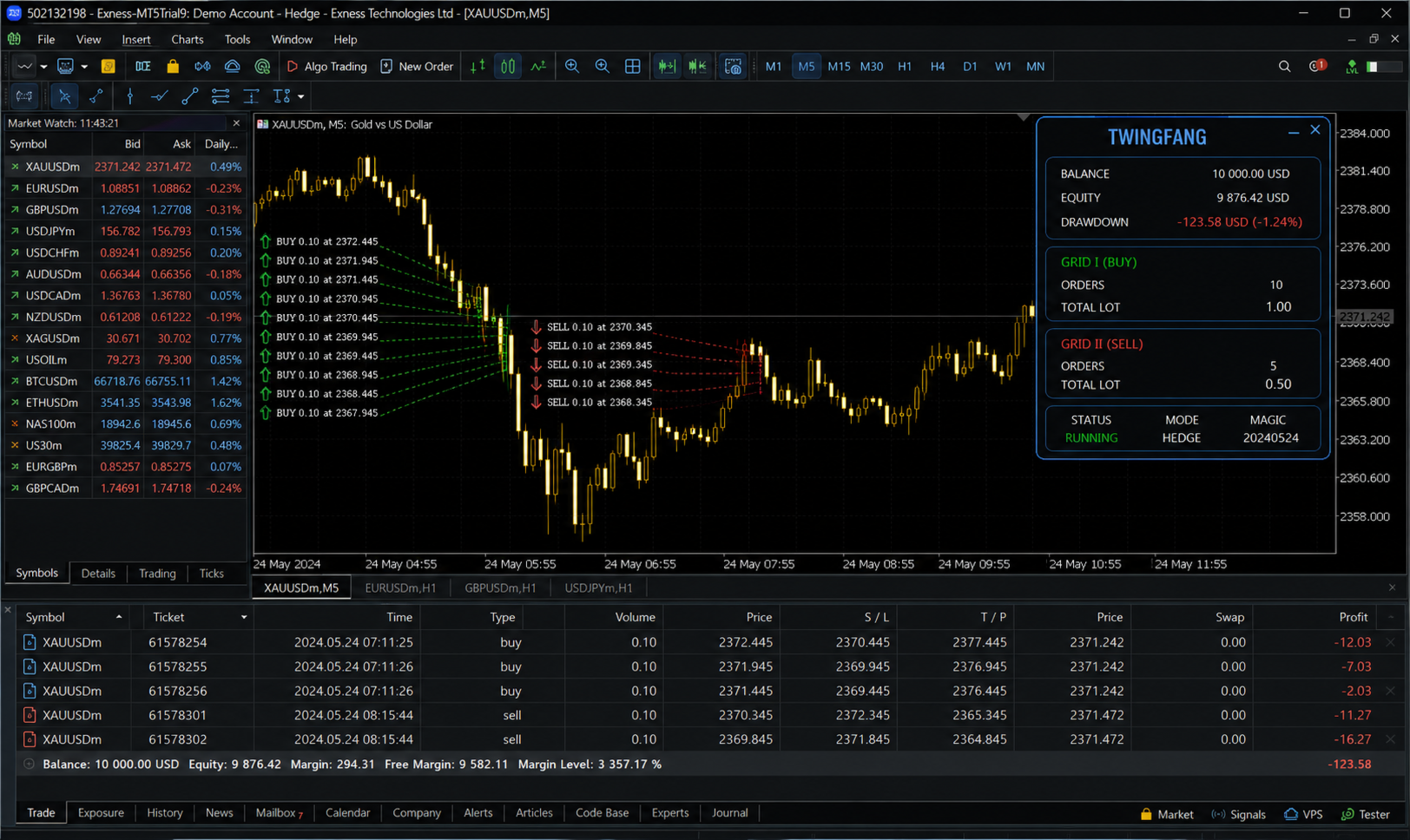
Most grid systems fail for one reason: they only know how to attack. TwingFang was built around a different idea — that a grid trader survives not by being right more often, but by having a second mechanism ready the moment the first one is wrong. TwingFang runs two independent order grids on every pair it trades. The first grid is the hunter: it opens on a five-indicator confluence read on the M5 timeframe and expands in the direction of that signal. The second grid is the guardian: it stays completely dormant until the first grid proves it is under real pressure, then locks in against it, opening in the opposite direction to absorb further adverse movement. This is not a simple "martingale plus stop loss" system. It is a coordinated two-basket structure where each basket is tracked, closed, and recalculated independently, under one shared risk umbrella.
Entry logic. TwingFang does not fire on a single indicator crossing a line. Every potential entry on the M5 chart is filtered through ATR (volatility gate), Williams %R, CCI, RSI, and Stochastic (overbought/oversold confluence), and a dual moving-average separation filter, with an optional trend-direction lock and a configurable number of confirming candles. This layered filter exists to keep the EA out of dead, choppy markets where grid systems typically bleed out — it only opens the first order of a sequence when several independent measures agree.
The first grid — block/complex progression. Once triggered, the first grid expands using a block-based lot progression: a configurable number of steps per block, a lot multiplier within each block, and a hard ceiling on both blocks and total order count. Lot sizing is fully deposit-aware — it reads from your applied settings file rather than a hard-coded value, so the same logic scales correctly whether you are running a $500 account or a $50,000 one.
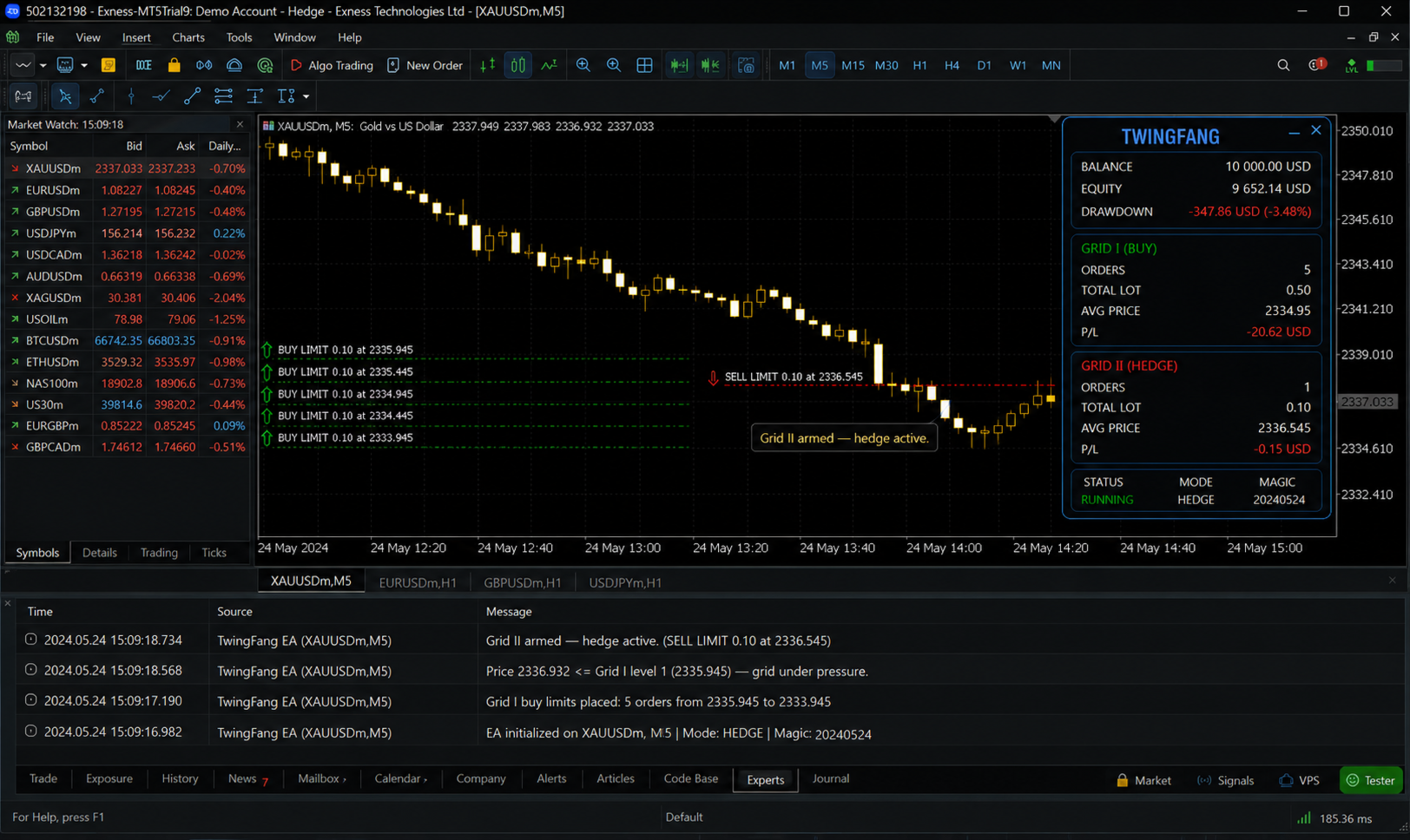
The second grid — the lock mechanism. This is what separates TwingFang from a standard grid EA. You define exactly how much pressure the first grid has to take — for example, five open orders deep — before the second, opposite-direction grid arms itself. From that point, the second grid manages its own basket, its own lot progression, and its own exit logic, entirely independent of the first. It is not a blanket hedge placed at the start of every trade; it is a conditional insurance policy that only activates once the market has actually proven the original read wrong.
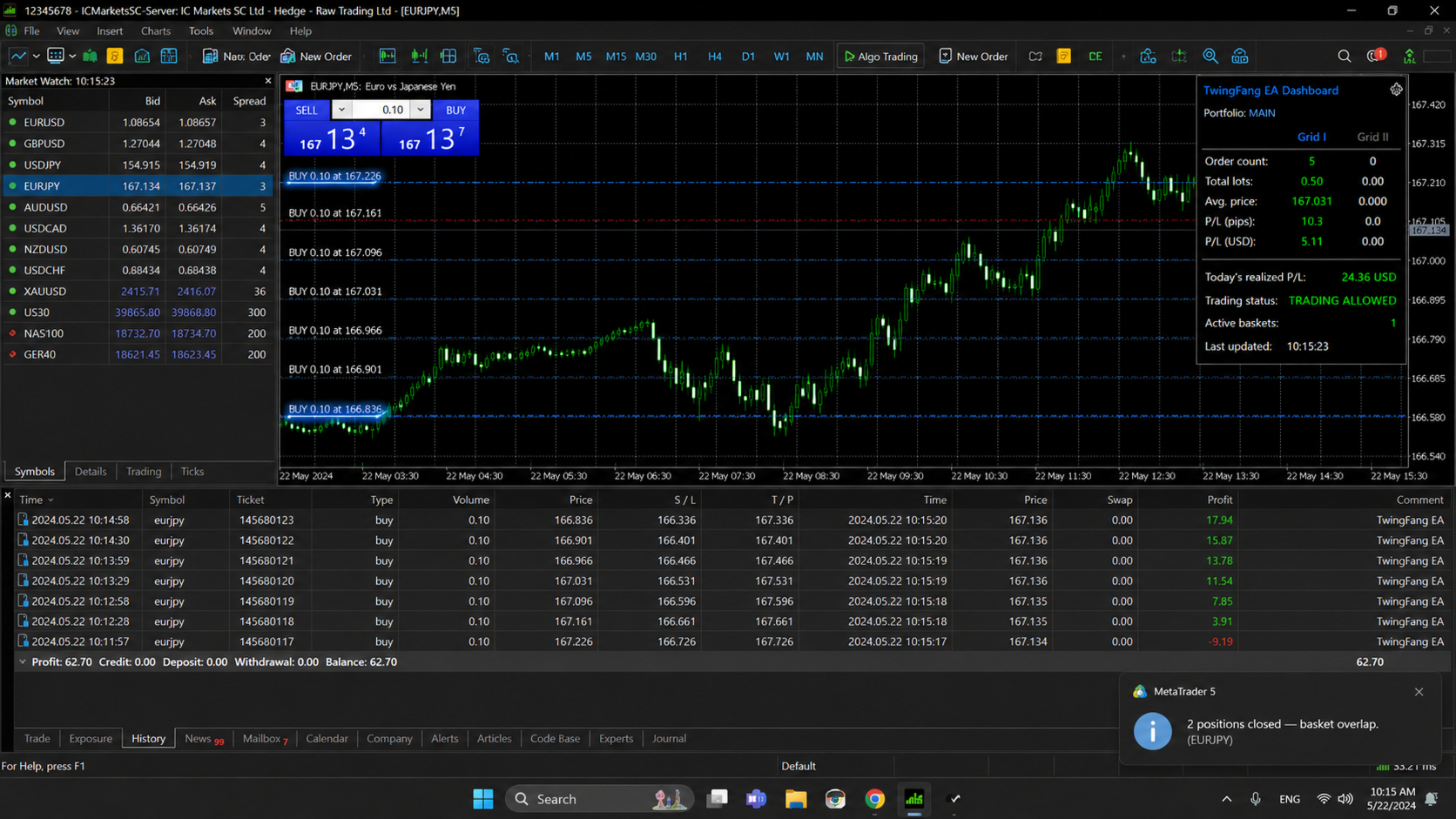
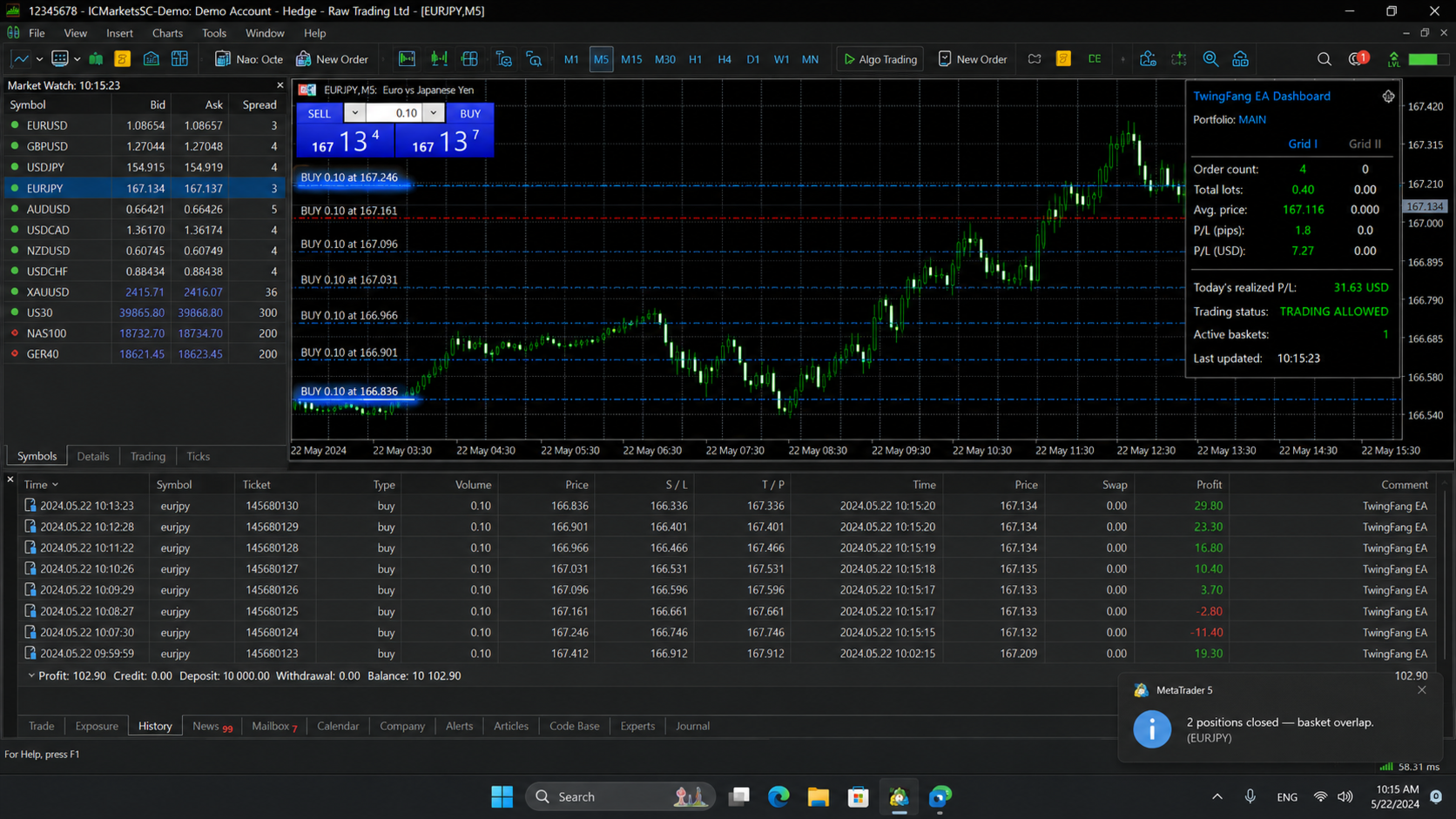
Partial close and basket overlap. Rather than waiting for an entire basket to close in one shot, TwingFang continuously looks for a chance to use profit sitting in its most recently opened, largest-lot order to buy out its oldest, most damaged order — closing both together the moment the combined result reaches your target, and immediately recalculating a fresh take-profit for what remains. This keeps baskets smaller and rotating instead of growing indefinitely.
Take-profit and breakeven, without the conflicts. Many grid EAs eventually throw a stuck "invalid stops" error because two different modification routines fight over the same order at the same time. TwingFang's dynamic take-profit (which recalculates and widens from the second basket leg onward) and its breakeven engine are deliberately separated by basket level and always checked against your broker's minimum stop distance before a single modification is sent — so the two systems never collide.
Portfolio-level protection, not just per-pair. TwingFang was designed to run across multiple charts at once, and it coordinates between them. A hard, race-condition-safe limit caps how many pairs can be active simultaneously, so your exposure never silently exceeds what you intended. If a defined number of pairs breach a critical drawdown percentage, TwingFang automatically shifts every other pair into a "drying" state — no new baskets are opened anywhere in the portfolio until the pressure clears — while any pair already fighting its own basket is left to trade that basket out on its own terms.
Risk controls that actually sit underneath everything else. A basket-level catastrophe stop closes an entire grid outright if price moves an extreme, user-defined distance against the average entry — a true last line of defense independent of the take-profit and breakeven logic above it. Deposit currency (USD or RUB) is detected automatically, and every dashboard figure and every drawdown percentage is calculated against your live account balance, not a static assumption.
Built to survive restarts. TwingFang does not depend on any saved file or terminal memory to know what it is doing. Every basket is re-identified purely from its Magic Number and symbol the moment the terminal reconnects, meaning a VPS reboot or a terminal restart never orphans an open grid.
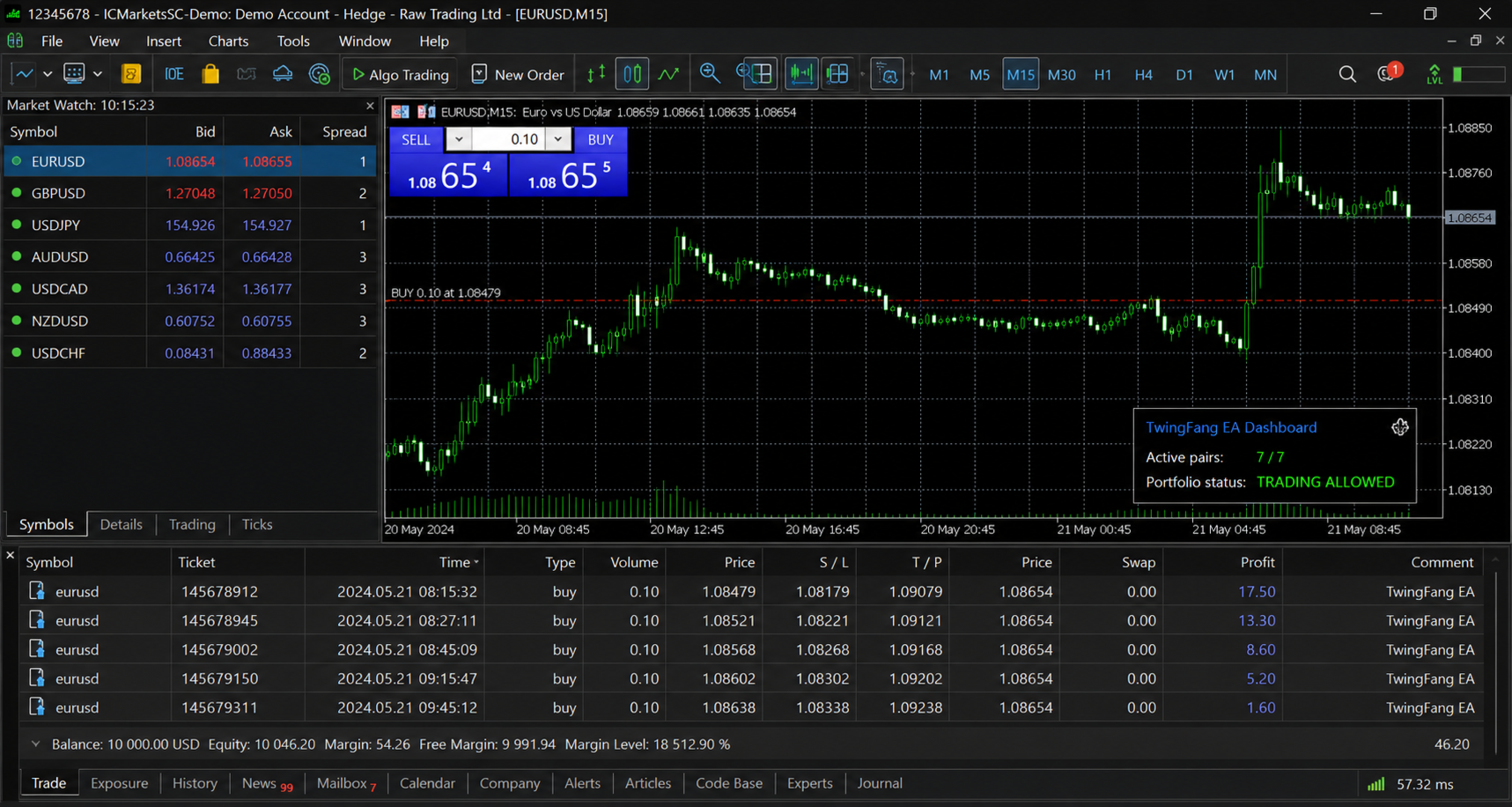
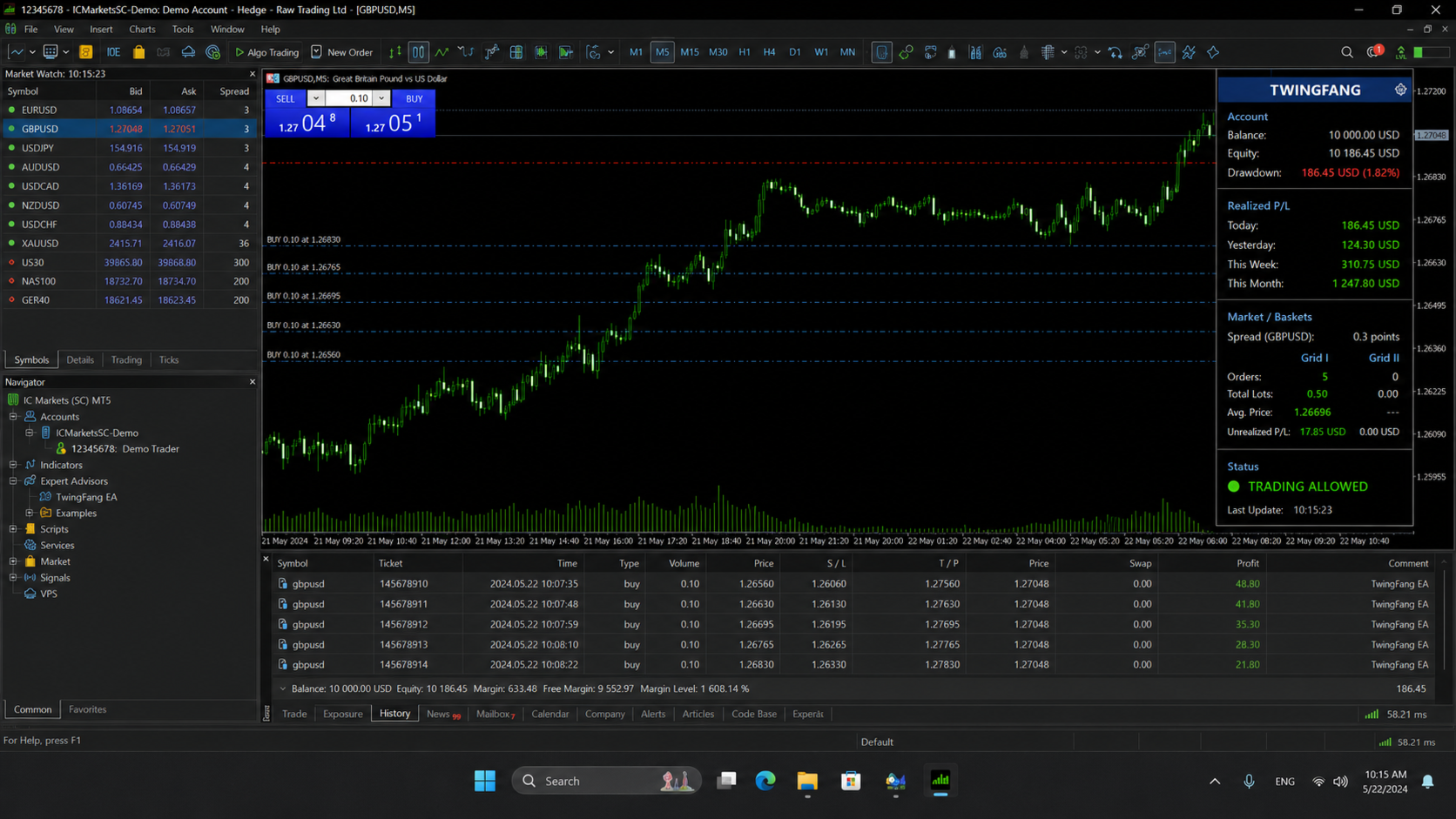
A dashboard that actually tells you something. In the top corner of every chart TwingFang trades, a live panel shows current balance and equity, floating drawdown in both money and percentage terms, realized profit broken out by today, yesterday, this week, and this month, current spread, and the live order count and lot exposure of both grids separately — plus a clear trading-allowed or drying-mode status indicator. Every color on the panel is user-configurable, so it sits cleanly on both dark and light chart themes instead of fighting your setup.
TwingFang is for traders who understand that a grid system is not a bet on being right — it is a system for managing being wrong, twice over, with a plan for each basket and a ceiling over the whole portfolio. If that is the kind of structure you have been looking for, TwingFang is built to run it for you, on every pair, around the clock.