+24,269 USD Will USD/JPY Move Again on U.S. CPI? Watch for EUR/JPY Rally-Selling Amid Intervention Risks

Will USD/JPY Move Again on U.S. CPI? Watch for EUR/JPY Rally-Selling Amid Intervention Risks
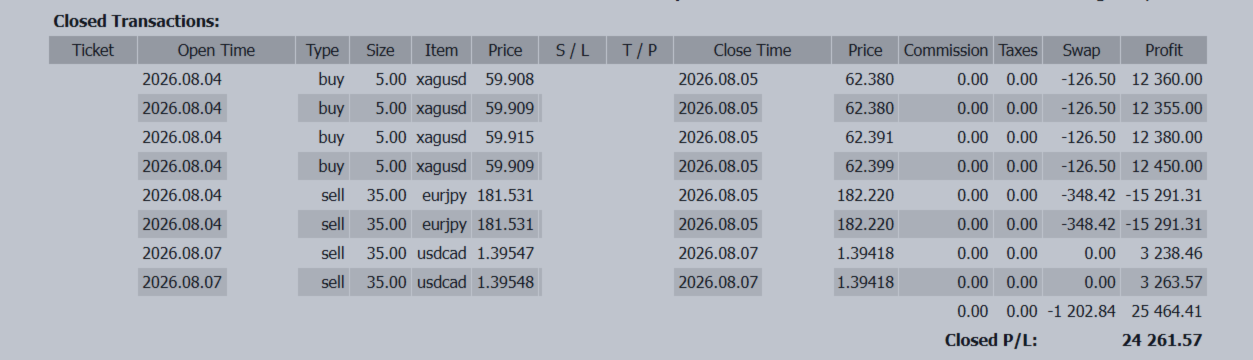
Trading Results (August 3–7)
Weekly Total: +24,269 USD
■ This Week’s Overview
This week, markets were heavily influenced by the rebound following last week’s coordinated U.S.-Japan intervention and the deterioration in U.S. employment data.
USD/JPY fell into the 155 range before rebounding to the mid-158 range. However, Friday’s U.S. employment report came in well below market expectations, strengthening dollar-selling pressure again and pushing USD/JPY back toward the 156 range.
The current market can be summarized as follows:
“Intervention risks make it difficult to sell the yen.”
“Weaker employment data makes it difficult to buy the dollar.”
Rather than committing heavily to a single direction, it is important to react in the short term while confirming incoming data and market developments.
This week’s trading result was +24,269 USD.
Although profits were secured, market volatility remains extremely high.
■ Outlook and Trading Approach
Going forward, rather than forcing trades in USD/JPY itself, the focus will be on markets where relative currency strength and weakness are clearer.
EUR/JPY is of particular interest.
During the previous coordinated U.S.-Japan intervention, there were reports that the U.S. side may have sold euros in order to buy yen. If the same approach is used again, EUR/JPY could face greater downside risk than other yen crosses.
The basic approach is as follows:
● Avoid taking a fixed directional view on USD/JPY
● Prioritize monitoring EUR/JPY for rally-selling opportunities
● Keep positions light around the U.S. CPI release
● Avoid selling the yen when intervention speculation intensifies
● Focus only on markets with a clear trend
FX Strategy Update
August 10–14, 2026 | Market Outlook
Previous Week’s Result: +24,269 USD
■ Key Market Theme for Next Week
The biggest question next week is:
“After weak U.S. employment data, will inflation also begin to slow?”
Last week’s U.S. employment report showed a significant slowdown in job growth, along with downward revisions to prior figures.
As a result, expectations for a September rate hike, which had previously supported the market, have declined sharply.
If U.S. CPI also comes in weak:
Slower employment
↓
Slower inflation
↓
Reduced rate-hike expectations
↓
Lower U.S. yields
↓
Dollar selling
This sequence could quickly gain momentum.
On the other hand, if CPI comes in stronger than expected, the market would face a very difficult situation for the Federal Reserve:
Employment is weak, but inflation remains elevated.
In that case, rate-hike expectations could re-emerge and trigger a sharp dollar rebound.
Next week, the market’s focus shifts from “employment” to “inflation.”
■ USD/JPY Strategy
USD/JPY has entered a particularly difficult phase.
Factors pointing lower include:
● Deteriorating U.S. employment data
● Reduced expectations for a September Fed rate hike
● Concerns over coordinated U.S.-Japan intervention
● Expectations of further Bank of Japan rate hikes
At the same time, upside factors remain:
● A substantial U.S.-Japan interest-rate differential
● Demand for yen carry trades
● Safe-haven dollar buying driven by Middle East tensions
● Commercial demand for U.S. dollars
In other words:
“If it rises, intervention becomes a risk. If it falls, dip buyers emerge.”
Rather than actively chasing USD/JPY next week, the priority will be to wait for the U.S. CPI reaction and confirm which direction develops into a trend.
If CPI is weak, a break below 156 could lead to a further expansion of the downside move.
Conversely, even if strong CPI sends USD/JPY sharply higher, chasing the move at elevated levels should be approached cautiously because of the risk of additional intervention.
■ EUR/JPY Strategy
EUR/JPY remains the main focus for next week, particularly for rally-selling opportunities.
EUR/JPY currently faces several downside risks:
● A policy stance by U.S. and Japanese authorities aimed at correcting excessive yen weakness
● The possibility of renewed euro-selling and yen-buying by the U.S. Treasury
● Unwinding of yen carry trades
● The ECB’s cautious monetary-policy stance
● Slowing European economic growth
● Higher energy costs resulting from Middle East tensions
Last week, EUR/JPY dropped sharply into the 179 range before recovering toward the 182 range.
Even if this rebound continues, the current market is viewed less as a buying opportunity and more as a phase to look for the next selling opportunity.
If U.S. CPI is weak and lower U.S. yields occur alongside yen buying, EUR/JPY could come under significant selling pressure again.
EUR/JPY is considered to offer a more favorable short-selling opportunity than USD/JPY.
■ EUR/USD Strategy
EUR/USD will mainly depend on the dollar.
If U.S. CPI is weak, dollar selling could push the pair higher.
However, the euro itself does not have particularly strong bullish catalysts. The ECB remains cautious, and concerns about slowing European growth remain.
Therefore, even if EUR/USD rises on dollar weakness, it may be difficult for the move to develop into a euro-led uptrend.
Rather than chasing higher prices, consideration should be given to selling rallies if the advance begins to lose momentum.
■ GBP/JPY Strategy
The British pound will be focused on UK GDP.
If economic growth is stronger than expected, Bank of England rate-hike expectations could return and support the pound.
However, for GBP/JPY, yen-market developments are likely to have a greater influence than UK-specific data.
If yen buying by U.S. and Japanese authorities strengthens again, GBP/JPY could decline sharply even if the pound itself remains strong.
Chasing yen crosses higher should therefore be approached with caution.
■ AUD/JPY Strategy
The Reserve Bank of Australia’s policy decision will be the main focus for the Australian dollar.
The central expectation is for rates to remain unchanged, but the market will closely watch the policy statement and Governor Bullock’s press conference.
Additional rate-hike expectations have declined as inflation has slowed. Even so, if the RBA maintains a strong stance against inflation, it could support the downside in AUD.
However, AUD/JPY can become highly volatile during periods of intervention. A renewed yen-buying move could lead to a sharp decline.
■ CAD/JPY Strategy
For the Canadian dollar, oil prices and trade relations with the United States remain important.
Although the Canadian economy has shown resilience, the yen is likely to be the dominant driver for CAD/JPY.
Rising oil prices due to worsening Middle East tensions would support the Canadian dollar. However, if risk-averse yen buying occurs at the same time, upside in CAD/JPY could remain limited.
■ ZAR/JPY Strategy
The South African rand is supported by high interest rates, but domestic economic concerns remain.
Lower oil prices are positive for South Africa as an energy-importing country. However, if yen-buying intervention resumes, yen carry trades against high-yielding currencies could be unwound more easily.
For ZAR/JPY as well, this is not an environment to buy aggressively based on high yields alone.
■ Basic Strategy for the Week
Next week, the priority is not to predict the CPI result in advance, but to observe the market’s reaction after the release.
The key points are:
● Keep positions light around U.S. CPI
● Do not chase USD/JPY higher
● Prioritize rally-selling opportunities in EUR/JPY
● Do not layer yen-selling positions across multiple currencies
● Respond immediately to intervention-related headlines
● Wait for a clear trend to emerge
Market volatility remains high, and a single poor decision can have a major impact on returns.
Rather than increasing the number of trades, the focus will be on situations with a clear trading advantage.
■ Final Scenario
U.S. CPI is likely to determine the direction of the dollar next week.
If CPI is weak:
Reduced rate-hike expectations
↓
Lower U.S. yields
↓
Dollar selling
↓
Declines in USD/JPY and yen crosses
This scenario could gain strength.
If the Bank of Japan’s Summary of Opinions is also hawkish, it could add further yen-buying pressure.
Conversely, if CPI is strong, the dollar could rebound sharply.
However, in USD/JPY, the higher the pair rises, the more likely concerns about additional U.S.-Japan intervention become. This is no longer a market where traders can comfortably chase prices higher.
The basic strategy for next week is:
“Do not chase USD/JPY. Prioritize selling rallies in EUR/JPY.”
U.S. CPI, the Bank of Japan’s policy stance, and intervention risk.
While monitoring these three factors, the focus will be on markets where a clear direction emerges.
■ Afterword: Being Tired Does Not Mean You Are Not Trying Hard Enough
“Lately, I just feel tired for no clear reason.”
Everyone experiences this feeling from time to time.
When we think about fatigue, we often simplify it by telling ourselves:
“I just need more rest.”
“I am not trying hard enough.”
But in reality, chronic fatigue can have many causes.
It is not only caused by a lack of sleep. Small everyday factors can accumulate, including:
● Nutritional deficiencies
● Chronic stress
● An unbalanced diet
● Excessive caffeine intake
● Dehydration
● Lack of exercise
One especially interesting point is that relying too much on coffee or energy drinks when we feel tired can reduce sleep quality, causing even greater fatigue the following day.
In other words, fatigue may be the body’s signal telling us not only to rest, but also to review something in our daily lives.
Trading is very similar.
After a losing streak, some traders:
Increase their position size.
Take more entries.
Spend even longer staring at charts.
This is similar to giving an already tired body even more caffeine.
What we need is not necessarily to try harder, but to pause and look for the cause.
Why did the loss occur?
Was the market environment unfavorable?
Was my judgment incorrect?
Or was it simply a temporary run of unfavorable probability?
With both fatigue and trading losses, looking only at the visible result does not reveal the true cause.
Once we understand the cause, there is no need to be unnecessarily afraid.
Especially when you feel out of rhythm next week, rather than forcing yourself to push forward, take a moment to ask:
“Why is this happening?”
To maintain both your health and your assets over the long term, I believe we need to make time for such reflection.