-7,106 USD | The Dollar Rally Won’t Slow Down… A Week of Heavy Selling in the Euro, Pound, and New Zealand Dollar

-7,106 USD | The Dollar Rally Won’t Slow Down… A Week of Heavy Selling in the Euro, Pound, and New Zealand Dollar
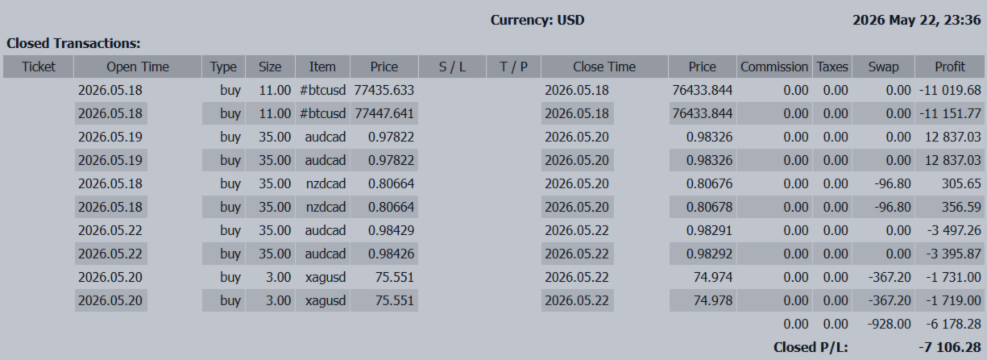
✅ Trading Results (May 18–May 22)
📊 Weekly Total: -7,106 USD
May 18–May 22 | What Happened
May 25–May 29 | Key Focus Ahead
Market Summary
If there is one phrase that best describes the FX market right now, it is:
“The dollar is the center of everything.”
The reasons behind the dollar rally are becoming increasingly clear:
-
U.S. inflation remains more persistent than expected
-
Fed rate-cut expectations continue to fade
-
U.S. Treasury yields are rising
-
Oil prices remain elevated
-
Geopolitical tensions in the Middle East continue
As these factors build,
the market is gradually shifting from pricing in
“rate cuts”
to even considering
“additional tightening.”
As a result,
most major currencies spent the week under pressure against the dollar.
At the same time,
this is not a one-way market.
Three themes continue to create sharp reversals:
-
Intervention concerns near 160 yen
-
Middle East headlines
-
Sudden oil price swings
Because of these,
market direction can shift within hours.
May 18–22 | What Happened
USD/JPY spent most of the week around the 159 zone.
Supported by rising U.S. yields and renewed hawkish Fed expectations,
the pair remained extremely resilient.
Even on pullbacks,
buyers continued stepping in.
However:
-
upside momentum slowed near 160
-
Middle East headlines repeatedly triggered sharp reversals
making the week highly unstable.
While the dollar remained strong,
the euro and pound stayed under steady selling pressure.
EUR/USD was pushed back toward the 1.15 area.
NZD also lost momentum.
Commodity currencies were pressured by dollar strength,
creating a difficult week with limited clean directional follow-through.
Current Currency Strength
Strongest Currency
-
U.S. Dollar
Weakest Currencies
-
Euro
-
British Pound
-
New Zealand Dollar
-
Canadian Dollar
-
Japanese Yen
More Difficult to Read
-
Australian Dollar
-
South African Rand
Current Market Structure
This part is especially important.
The market is currently in a
“dollar-dominant”
phase.
Compared with earlier periods,
currency-specific stories matter less.
Instead,
the dollar itself is driving nearly everything.
In simple terms:
Dollar rises
→ Euro sells off
→ Pound sells off
→ NZD sells off
The entire FX market is revolving around
the strength of the U.S. dollar.
Currency Outlook
U.S. Dollar
The strongest currency in the market.
Supported by:
-
fading rate-cut expectations
-
higher U.S. yields
-
safe-haven demand
Buying interest continues to appear on dips.
Japanese Yen
Structurally weak.
However,
one major exception remains:
the 160 yen level.
Intervention concerns remain elevated.
This leaves open the risk of
a sudden yen rally at any time.
Euro / Pound
Sell-on-rally conditions continue.
Key pressure points include:
-
slowing European growth
-
cautious ECB messaging
-
political uncertainty in the UK
Compared with the dollar,
both currencies continue to struggle.
AUD / NZD
Clearly weaker than before.
NZD in particular has shown stronger selling pressure.
AUD remains highly event-sensitive
and can move sharply in either direction.
Canadian Dollar
Normally supported by rising oil prices.
However,
this week the strength of the dollar outweighed that support.
The dollar remains dominant.
May 25–29 | Main Focus Ahead
Biggest Theme
The most important focus next week is:
U.S. Core PCE
and
the Fed’s next policy direction.
U.S. Core PCE (May 28)
This is the key event.
The market is already pricing in:
“inflation is not finished yet.”
If PCE comes in stronger:
-
expectations for further tightening may increase
-
yields may rise further
-
broad dollar strength may continue
If weaker:
-
profit-taking on the dollar may accelerate
-
short-term correction becomes more likely
Either way,
volatility could increase significantly.
Fed Leadership Expectations
Markets are increasingly discussing whether:
“the next Fed leadership may remain more hawkish than expected.”
Even a single central bank comment
could move the dollar sharply.
USD/JPY’s Biggest Risk
Still the same:
160 yen.
The closer price gets,
the stronger:
-
intervention concerns
-
downside reversal risk
become.
The pair remains strong—
but elevated levels are increasingly dangerous.
Middle East and Oil
Still impossible to ignore.
The current chain remains:
Oil rises
↓
Inflation concerns rise
↓
U.S. yields rise
↓
Dollar strengthens
Headline risk remains extremely high.
Trading Strategy by Currency
USD/JPY
Buy-the-dip bias remains.
However,
be cautious near 160.
Chasing momentum higher remains risky.
EUR/USD
Sell-on-rally continues.
Upside likely remains heavy
unless dollar momentum weakens.
GBP
Unstable.
Sell-on-rally bias remains.
AUD / NZD
More event-driven.
Both remain highly sensitive to headlines.
Summary
The market structure is clear:
The dollar remains strongest.
Main drivers:
-
persistent U.S. inflation
-
fading rate-cut expectations
-
higher U.S. yields
-
elevated oil prices
-
Middle East geopolitical tension
At the same time,
the market remains vulnerable to sudden reversals from:
-
intervention concerns near 160
-
sharp oil moves
-
Fed commentary
To summarize:
-
Dollar strongest
-
Euro and pound weak
-
Commodity currencies unstable
-
Yen vulnerable but highly sensitive to intervention
Which means:
This is not a market to chase aggressively.
The better approach remains:
-
stay shorter-term
-
avoid holding winners too long
-
reduce exposure quickly when risk rises
That discipline may matter more than anything next week.
Closing Note: It’s Hard to Keep Winning on Too Little Sleep
In trading,
it is easy to believe that
“more effort always leads to better results.”
Watching charts late into the night.
Monitoring positions nonstop.
Reading market news right before bed.
Sometimes that works—
for a while.
But over time,
one thing becomes obvious:
When sleep breaks down, decision-making breaks down.
Recent research suggests that
both too little sleep and too much sleep
may be linked to faster biological aging in the brain and body.
One particularly interesting finding:
Roughly 6.4 to 7.8 hours of sleep
was associated with the healthiest outcomes.
In other words:
instead of
“pushing harder by cutting sleep,”
it may be more effective long term to
“recover properly.”
Trading is often exactly the same.
When sleep-deprived:
-
stop losses tend to be delayed
-
unnecessary entries increase
-
emotions become unstable
-
small moves feel bigger than they are
Research has also linked lack of sleep with:
-
high blood pressure
-
diabetes
-
anxiety
-
depressive symptoms
-
elevated cortisol
Which means:
sleep deprivation is not just fatigue.
It slowly reduces judgment itself.
That is why strong traders often choose:
instead of forcing themselves to stay awake,
“I’m going to sleep.”
That is not avoidance.
That is strategy.
Good trades come from a calm mind.
A calm mind comes from proper recovery.
And proper recovery starts with good sleep.
Next week too,
rather than chasing every opportunity,
it may be best to first make sure you are in a state where you can think clearly and trade calmly.