💰 +59,275 USD — Flash-Crash Risk! “How to Win Even in Thin Holiday Markets” — Year-End Strategy

💰 +59,275 USD — Flash-Crash Risk!
“How to Win Even in Thin Holiday Markets” — Year-End Strategy
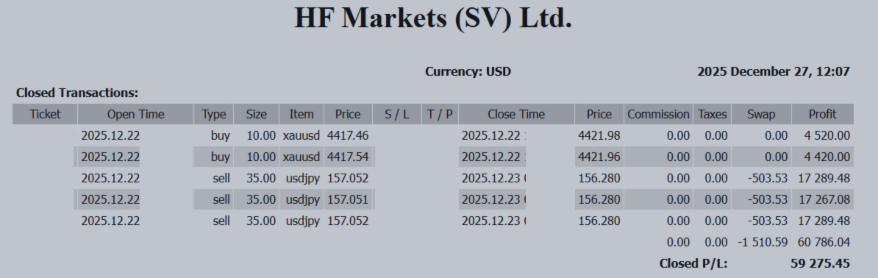
Period: Dec 22–26, 2025
Weekly P/L: +59,275 USD
🎯 Trade Review
A decisive turning point came from Finance Minister Katayama’s strong warning against yen weakness.
His remarks —
“We will firmly respond to excessive FX moves.”
“Intervention remains fully on the table.”
— instantly cooled market sentiment, and a timely switch into yen buying (USD/JPY shorts) worked well.
However…
After Governor Ueda’s speech on the 25th,
the market returned to the yen-weakening trend.
👉 It turned into a textbook week of:
“Official comments → correction → trend resumes.”
📌 Key Takeaways
✔ Christmas markets = short-term, opportunistic trading is best
✔ A single remark can briefly reverse the market
✔ But ultimately, price tends to return to the dominant trend (yen weakness)
This week was less about “winning bigger”
and more about protecting profits by not losing.
🔮 Dec 29 Week — How to Fight the Year-End Market
🎯 Theme
BoJ “Summary of Opinions” × FOMC Minutes
➡ Thin liquidity means markets tend to over-react.
Markets may look quiet on the surface —
yet sudden multi-yen swings remain possible.
BoJ “Summary of Opinions” — 3 Things Markets Will Focus On
(Released early on the 29th)
1️⃣ Conditions for additional rate hikes
2️⃣ Terminal rate
3️⃣ View on neutral rates
If the tone leans hawkish:
➡ Markets could react with yen buying.
Ueda remains cautious —
but if even one member pushes further, volatility could spike quickly.
⚠ USD/JPY Has Multiple Themes at Once
🔻 Yen-selling drivers
-
Expansionary fiscal policy → debt concerns
-
Trade pressure from the Trump administration
-
China-related geopolitical/tech risks
🔺 Yen-buying drivers
-
Revival of additional BoJ rate-hike expectations
-
Intervention risk (“free hand”)
-
Repeated government commentary
On top of that, the U.S. Treasury FX Report is coming —
➡ I see 157–158 as a zone where profit-taking and verbal warnings increase.
FOMC Minutes (Dec 30)
📌 Hawkish tone → USD higher / JPY weaker
📌 Growth-concern tone → USD selling
🌍 EUR/USD — Politics Takes the Wheel
-
Ukraine cease-fire moves
-
U.S.–EU tensions
-
France’s fiscal concerns
➡ Dips likely to be bought — but upside depends on politics.
🚨 Biggest Risk: A Flash Crash
✔ Extremely thin liquidity
✔ One headline can trigger multi-yen moves
✔ Example: Jan 3, 2019 — 4-yen drop in minutes
👉 Year-end exposure should be light, diversified, and modest.
✅ Summary (Dec 29 Week)
📌 BoJ Summary × FOMC Minutes = key catalysts
📌 USD/JPY faces resistance around 157–158
📌 Thin markets exaggerate price swings
📌 ZAR remains interesting as a theme trade
This is not a market to “predict correctly.”
It’s a market where survival through shocks is the winning strategy.
✅ Lessons From This Week’s Wins
1️⃣ Focus on the interpretation, not just the headline
BoJ raises rates → normally yen bullish
But the press conference sounded dovish → yen weakened
👉 Market reaction determines direction — not the headline.
✔ After data releases:
watch how price behaves first, then enter.
2️⃣ With official comments, the real move often comes hours later
Katayama’s remarks:
-
Immediate reaction → yen buying
-
Follow-through → broader position-unwinding, trend extended
👉 Avoid chasing the initial spike —
wait for stabilization, then participate.
3️⃣ Thin markets favor short-term trades
Christmas weeks:
-
Trends rarely sustain
-
Spikes (wicks) are large
👉 Day trading + partial profit-taking is optimal.
Holding too long only increases risk.
4️⃣ Theme currencies (like ZAR) reward persistence
ZAR/JPY:
-
Strong data
-
Platinum rally
-
Continued capital inflows
👉 When drivers are ongoing, dip-buying works best.
❌ Lessons From This Week’s Losses
1️⃣ “Rate hike = yen strength” bias
Reality:
-
Rate hike
-
Yet yen weakened
Reason:
-
No clear path for further tightening
-
“End-of-cycle” perception triggered selling
👉 Pre-conceptions lose money.
✔ Rule:
Announcement → Reaction → Direction — in that order.
2️⃣ Too much exposure before big events = dangerous
Unexpected comments + thin liquidity
➡ sudden reversals
👉 Always reduce size before major events.
3️⃣ Chasing strength at high levels
Yen weakness accelerated — tempting to chase
But intervention risk increases up there
👉 After breakouts: wait for pullbacks, don’t chase.
4️⃣ Never underestimate year-end flash crashes
Thin books + crowded trades
➡ violent swings on small news
👉 Smaller position size and diversification are prerequisites for surviving.
🎯 Action Checklist for Next Time
⏱ Avoid trading the first 3–15 minutes after data
💡 Prioritize price behavior over commentary
📉 Don’t chase highs — wait for pullbacks
✂ Lighten positions before events
🧩 Buy dips in “theme currencies” like ZAR
⚠ Year-end = half size, quicker profit-taking
🚨 Intervention headlines → don’t chase initial spikes
In short:
Building unbreakable trades beats trying to predict perfectly.
📜 Afterword —
Those Who Notice “Small Glimmers” Don’t Break, Even in Stormy Markets
Thank you, as always, for reading this week’s FX report.
This time we touched on a theme that might feel unusual:
glimmers — and joy lists.
They seem unrelated to trading,
yet they are deeply connected to mental resilience.
🌤 Glimmers — small signals that “you’re safe”
A glimmer is a tiny moment when mind and body feel calm:
-
the smell of coffee
-
the sound of gentle rain
-
a warm bath
These moments switch the brain
from fight-mode into recovery-mode.
After losing trades, we push harder to “win it back.”
But what we truly need is calm nervous systems, not more positions.
People who recognize glimmers don’t panic in crashes.
😊 Joy lists — a place to return to
A joy list is simply a list of things that refill you:
✔ Music you love
✔ Time with important people
✔ Breathing outdoors
✔ A favorite book
Just like a “bad-day trading plan,” it prevents emotional derailment.
Without a mental “home base,” emotions spiral — and trading follows.
🌊 We can't stop the waves — but we can choose our stance
Markets move like storms.
Headlines, geopolitics, rates — we can’t control them.
But we can always choose what we pay attention to.
Building habits around glimmers and joy lists
isn’t indulgence — it’s an investment in judgment.
📈 Final Thought
Traders study how to win.
But lasting success depends on how not to break.
-
Notice glimmers when uneasy
-
Return to your joy list when tired
-
Reset — then re-engage with charts
This alone reduces unnecessary losses and panic entries.
Next week, let’s listen not only to the market —
but also to the rhythm of our own minds.
Quietly, steadily, forward. 🌿📊