 MetaTrader 5
 Experts
 Indicators
 Scripts
 Libraries
 Storage
Join our fan page

MA Gauge Pro - AKM - indicator for MetaTrader 5

- Views:
- 3655
- Rating:
- Published:
- Updated:
-
 You are missing trading opportunities:
- Free trading apps
- Over 8,000 signals for copying
- Economic news for exploring financial markets
Registration Log inYou agree to website policy and terms of use
If you do not have an account, please register -
 Need a robot or indicator based on this code? Order it on Freelance
Go to Freelance
Need a robot or indicator based on this code? Order it on Freelance
Go to Freelance
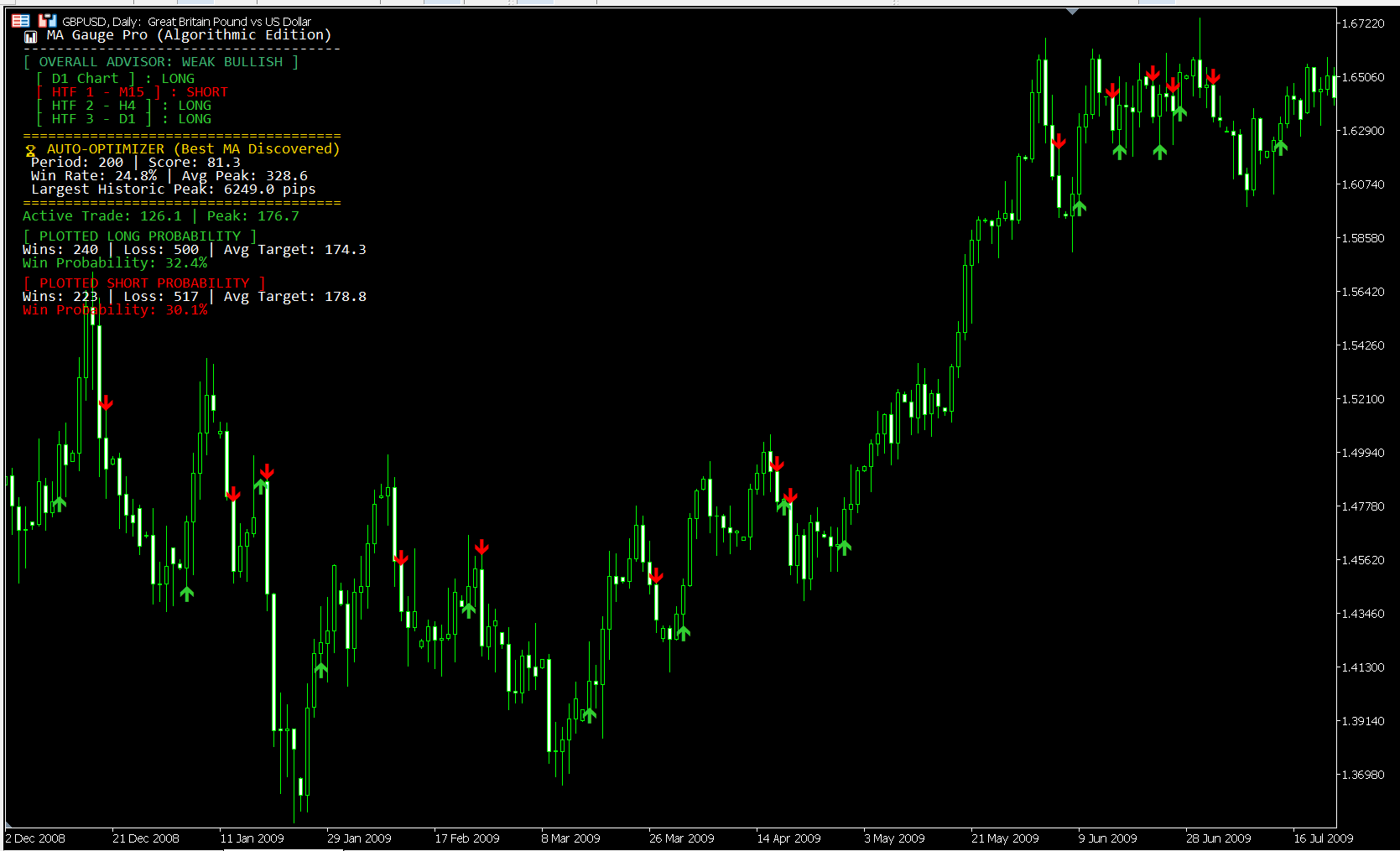
1. Escaping the "Static Trap" (Market Adaptability)
Financial markets operate in shifting regimes—they cycle constantly between high-momentum trends and choppy consolidation. A static 14-period MA might perfectly capture every swing during a strong trending phase, but that exact same indicator will generate relentless false signals (whipsaws) during a ranging market, bleeding your account dry.
The Auto-Optimizer prevents this by scanning a spectrum of periods (e.g., 10 through 100) in real-time. It dynamically hunts for the exact harmonic frequency the market is currently respecting. Instead of forcing a static indicator onto a changing market, your system automatically adapts to the current rhythm of the asset.
2. Mathematical Expectancy vs. Directional Bias
A standard MA only gives you a directional bias (up or down). It does not tell you if trading that direction is actually profitable.
The optimization engine evaluates strategies based on Mathematical Expectancy—a metric combining both Win Rate and Average Reward. This is critical because it prevents you from being fooled by:
An MA with a 90% win rate that only nets 2 pips per trade (eaten by spreads/commissions).
An MA that yields massive 100-pip wins, but only triggers correctly 15% of the time (draining your psychology and margin).
By scoring MAs based on their combined Expectancy, the engine isolates the mathematical "sweet spot" that balances consistency with maximum yield.
3. Objective, Data-Driven Take Profits
When using a standalone MA, traders typically guess their Take Profit (TP) levels using arbitrary risk-to-reward ratios (like 1:2) or recent swing highs.
This engine measures the Maximum Favorable Excursion (MFE)—the absolute peak distance a trend travels before the MA signals a reversal. By continuously calculating the historical Average Peak, the indicator provides a highly accurate, data-backed Take Profit target. You are no longer guessing where to exit; you are exiting where the mathematical average dictates the trend is most likely to exhaust.
4. Macro Noise Cancellation (MTF Alignment)
Trading a single timeframe leaves you blind to the broader market flow. A beautiful bullish MA crossover on a 15-minute chart is often a trap if the 1-Hour, 4-Hour, and Daily charts are plunging downward.
The Multi-Timeframe (MTF) Advisor acts as an institutional filter. By reading the state of higher timeframes without lagging your current chart, it prevents you from taking low-probability, counter-trend trades. You only deploy capital when the micro-trend aligns with the macro-trend.
The Bottom Line
A standalone MA is a passive tool that tells you what happened in the past. The Auto-Optimizing MTF Engine is an active statistical model. It removes human emotion, eliminates the tedious cycle of manual backtesting, and grounds your entries and exits in real-time, undeniable probabilities.
 Aegis Quantum Lite
Educational MT5 Expert Advisor using completed-candle EMA 9/21 alignment and RSI 14 filtering, with fixed-lot execution and a compact black-and-gold dashboard.
Alpha Beta Channel - AKM
1. The Core Tracking Engine (Alpha-Beta Filter)At its core, the indicator utilizes an Alpha-Beta filter—a lightweight, steady-state version of a Kalman filter designed to track position and velocity.Predictive Calculation: Instead of simply averaging past prices like an SMA or EMA, the engine calculates a predicted price based on current velocity ($v$).Error Correction:
AIS Smoothed Linear Trend
This indicator displays the smoothed value of the linear trend
MACD TradingView Style for MT5
MACD indicator replicating TradingView’s visual style for MT5. 4-colour histogram, SMA-based signal line — values match TradingView bar-for-bar.