Forex copy trading reproduces activity from a source account in a follower account under the service's allocation and execution rules. It can reduce the work of operating a strategy yourself. It does not ensure identical positions, returns or losses.
Before connecting, establish who makes trading decisions, where copying runs, how volume is calculated and what happens when you disconnect. Those questions matter more than a provider's place on a return leaderboard.
1. Follow the order from source to follower
A provider opens or changes a position. The copying service receives that activity, calculates a follower order and submits it for execution. The follower may receive a different price, a rounded volume or no trade when a constraint prevents execution.
A broker-hosted service can operate without your personal terminal; some terminal-based arrangements require a desktop or hosted platform to remain connected. Automatic does not mean unsupervised. A manually approved signal is also a different arrangement from automatic replication.
2. Understand the sizing formula
Services may use fixed lots, multipliers or proportional allocation. A multiplier of one might mean identical lots rather than identical percentage risk. Confirm the service's definition instead of assuming one-to-one means the same exposure.
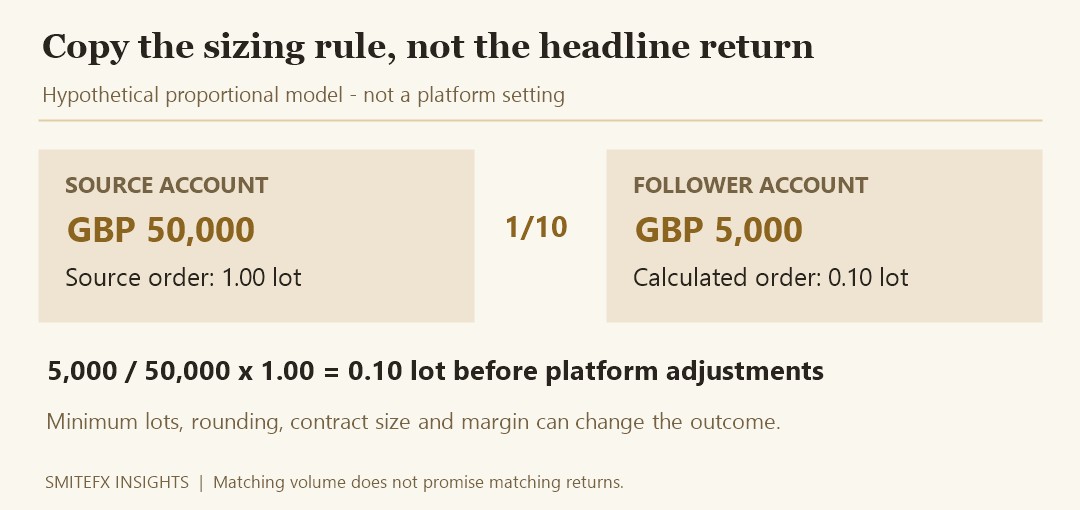
Hypothetical example: a GBP 5,000 follower copying a GBP 50,000 source at one-tenth size would calculate 0.10 lots when the source trades one lot, before platform adjustments. This is a generic proportional model, not a prescribed setting for any SmiteFX route.
If the result falls below the broker's minimum volume, the order may be skipped or rounded under the applicable rules. Contract size, account currency, leverage and existing positions matter too. Leverage affects margin capacity; it does not itself change the price-based profit or loss of an otherwise identical position.
3. Expect differences and investigate them
Provider and follower orders do not reach identical liquidity at the same instant. Spreads, commission, financing, execution and currency conversion can change the outcome. Slippage may be favourable or adverse rather than a fixed penalty.
Costs are especially important relative to a strategy's intended gain. A hypothetical extra GBP 2 per trade is material beside a GBP 3 pre-existing average net gain. It is a smaller proportion of GBP 50, although neither example predicts profitability.
Starting partway through a provider's record creates another difference. Check whether existing positions are copied at current prices and how initial synchronisation works. A provider's year-to-date return is not your starting experience.
4. Reconcile the actual money and fees
Review subscriptions, performance fees, broker costs and markups together. Ask when fees crystallise, how deposits and withdrawals are treated, whether losses carry forward and whether a high-water mark applies. The precise contract matters more than the headline percentage.
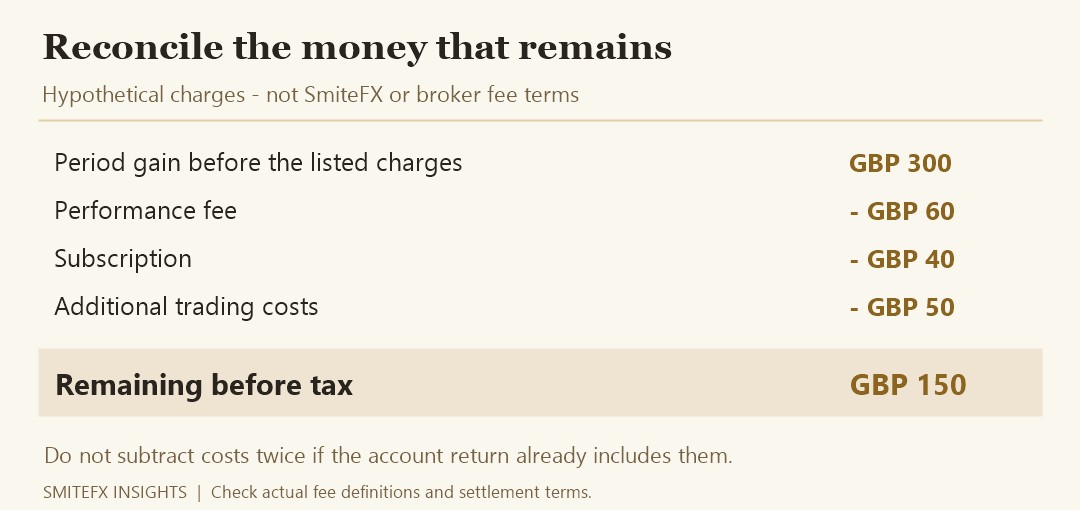
Hypothetical cost example: GBP 300 before a GBP 60 performance fee, GBP 40 subscription and GBP 50 additional trading costs leaves GBP 150 before tax. These are educational figures, not SmiteFX or broker fee terms. Do not subtract costs twice if statement profit already includes them.
Performance-based compensation does not eliminate conflicts: the provider can still be rewarded for risks borne by followers. Volume-based remuneration creates another incentive to examine. No fee label alone proves alignment.
5. Review evidence without treating verification as protection
Identify the account type, history period, reporting freshness, open exposure and equity behaviour. Check whether one instrument, month or large position dominates the result. A high win rate can coexist with occasional large losses.
Myfxbook's verification documentation distinguishes track-history checks from account-control checks. Neither promises that a follower will reproduce the source outcome. Our drawdown guide explains why equity and open exposure deserve attention.
If a hypothetical source gains 4% in a month while a follower gains 2.8% after stated charges, compare starting dates, opening positions, allocation and currency first. Then record skipped trades, rounded volumes, entry differences, partial closes and financing. If source details are unavailable, leave the unexplained remainder explicitly unresolved.
6. Plan disconnection before connecting
Stopping new copying, closing open positions, cancelling pending orders and withdrawing are separate actions. A disconnect button does not necessarily flatten exposure. Check whether a manually closed follower position can reopen while the source remains active.
Understand any equity-stop rule: what it closes, how often it checks and what happens during interruptions. Gaps or execution constraints can produce a worse realised outcome than the displayed threshold. Treat a closure request and a confirmed closed position as different states.
MetaTrader Signals documentation provides one platform-specific example. Broker-managed services must be checked against their own terms; do not assume they use MQL5 Signals mechanics. Retain secure account recovery access without sharing unnecessary credentials.
7. Compare copying with operating an EA
Running an EA leaves installation, hosting, permissions and permitted inputs with you. Copying transfers some operational decisions while adding dependence on a provider and replication service. Neither removes the need to understand trading risk.
For a practical software reference, use the Fortune MT5 product documentation to identify the platform and configuration questions you would need to manage when operating an EA yourself. That reference is not evidence that a follower will match a source account. Compare the responsibilities you can realistically fulfil rather than choosing solely from a return chart.
A connection and review checklist
- Confirm the service entity, eligibility and protections relevant to your jurisdiction.
- Document the provider, sizing rule, instruments, fees and existing exposure.
- Test synchronisation, rounding and disconnection on demo where supported.
- Choose an affordable allocation and a review process before connecting real money.
- Compare actual positions and charges with the intended behaviour.
- Keep an exit procedure covering open positions and pending orders.
The current SmiteFX copy-trading guides provide route-specific setup information. Recheck eligibility, fees and controls for the service you actually use. A short demo success reveals configuration issues; it does not establish future performance.
Source and risk note: adapted from SmiteFX Insights. The original educational source checks were dated 31 October 2026: FCA guidance in its UK context, Myfxbook verification definitions and MetaTrader Signals documentation. The FCA's copy-trading guidance does not establish protections in every jurisdiction. Examples and diagrams are hypothetical. Copy trading can lose money; past performance does not guarantee future results. This is education, not personalised investment advice.