
Opening an opposite position of equal size when a trade goes wrong — a lock — feels like buying time. The floating loss stops growing and nothing has to be decided today. In accounting terms, though, a full lock behaves much more like a closed loss with a running bill than like a repair. This article prices that bill and shows what actually decides the outcome: the exposure you carry after you lift a leg.
A full lock fixes the loss in place
Take a hypothetical EUR/USD long of 1.00 lot at 1.1000. Price falls to 1.0950. At $10 per pip for a standard lot, the floating loss is 50 pips, or $500. You now sell 1.00 lot at 1.0950.
Net exposure is zero. Whatever price does next, the combined result of the two legs stays at −$500 before costs. Close both legs at 1.0800 or at 1.1200 and the answer is the same −$500 you would have booked by closing the long at 1.0950. The only difference is what it costs to keep the lock open.
The costs that keep running
Spread and commission. The hedge leg is a new trade. A 1.0-pip spread on the 1.00-lot short costs $10, plus commission if your account charges it, and both legs must be closed later.
Swap. Both legs pay or receive overnight financing, and the two rates are rarely symmetrical. With an illustrative −$7 per night on the long and +$2 on the short, the lock costs $5 per night. Many servers charge a triple swap on one weekday, so a five-night trading week carries seven swap charges. Four weeks is 28 charges, or $140.
Margin. Brokers treat hedged positions differently: some margin only the larger leg, some apply a reduced hedged rate, and some margin both legs in full. Read the contract specification. It decides how much free margin the lock consumes and how close it sits to a stop-out if other positions move.
After four weeks, the position that was "frozen" at −$500 stands at −$650 with zero exposure.
Lifting a leg is a new trade
To get out, you close one leg. Suppose price falls to 1.0900 and you close the short. It realizes +$500 (1.0950 to 1.0900). The long is now floating −$1,000, so the total is still −$500 before costs. You are now long 1.00 lot, and the account is flat before costs only if price returns to 1.0950. Including the $150 of costs, it needs 1.0965.
If price keeps falling to 1.0850 after the lift, the total becomes −$1,000 before costs. The result after the lift depends only on the direction you are exposed to after lifting — the same directional decision you postponed at 1.0950. The lock moved the decision in time; it did not change what the decision was about. One identity keeps the ledger honest:
Total P/L = loss fixed by the lock + P/L of the net exposure carried after each action − cumulative costs.
Averaging moves the breakeven, not the arithmetic
Compare adding a second 1.00-lot long at 1.0950 instead of locking. The average entry becomes 1.0975, so breakeven is 25 pips away instead of 50. Exposure, however, is now 2.00 lots. A further fall to 1.0900 adds another $1,000 of loss, for a total of −$1,500. A closer breakeven is bought with larger exposure.
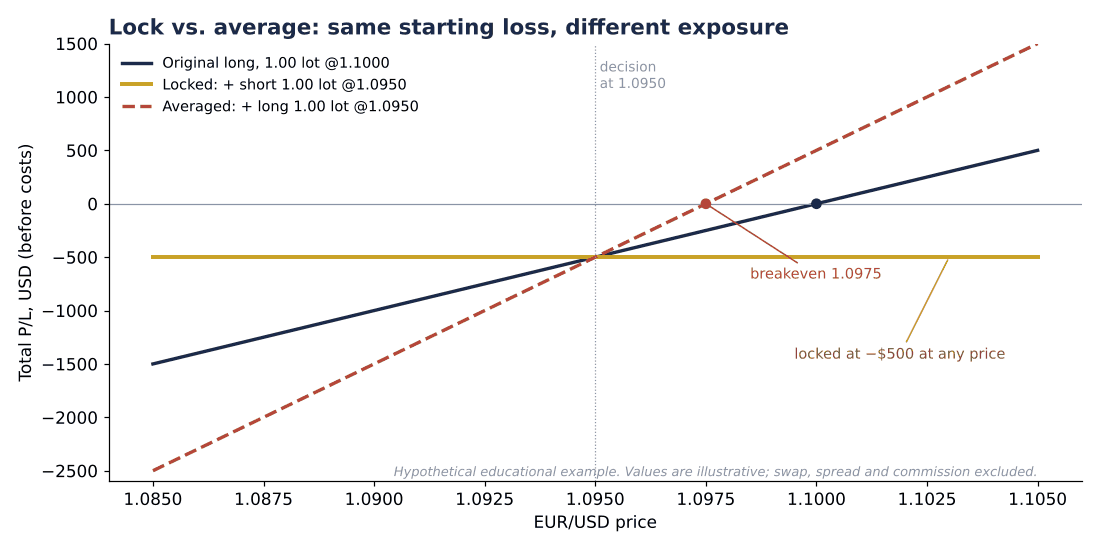
Hypothetical educational example. Values are illustrative; swap, spread and commission excluded.
Methods that combine averaging and hedging move between these states. Because each step changes gross and net exposure, the only control that survives a long adverse move is a written exposure budget.
Keep a hedge ledger
Before the first adverse step, write down five limits: maximum gross lots, maximum net lots, maximum days the structure may be carried, the account-currency loss at which everything is closed, and the worst-case margin at maximum gross size. Then record every action:
| Action | Gross lots | Net lots | Total P/L before costs | Cumulative costs | Price to be flat after costs |
|---|---|---|---|---|---|
| Buy 1.00 @ 1.1000 | 1.00 | +1.00 | $0 | $0 | 1.1000 |
| Sell 1.00 @ 1.0950 | 2.00 | 0.00 | −$500 | −$10 | None (no exposure) |
| Carry four weeks | 2.00 | 0.00 | −$500 | −$150 | None (no exposure) |
| Close sell @ 1.0900 | 1.00 | +1.00 | −$500 | −$150 | 1.0965 |
Hypothetical ledger. Closing spreads omitted for simplicity.
The last column is the one that matters. When it says "None", you are paying to wait. When it shows a price, you hold a directional position and should judge it as a new trade with that entry.
Where HedgeLogic fits
HedgeLogic Navigator and HedgeLogic Assist in the Forex Top Team Trading Toolkit combine averaging and hedging to work out of positions on MT4 and MT5. The toolkit page classifies HedgeLogic as high risk: exposure increases during adverse moves, and the method needs strict limits. Use the Navigator's levels together with the ledger above. The Assist EA asks you to approve each trade and needs a Windows VPS for continuous position management. If you cannot fill in the five budget limits before the first trade, the method does not suit that account.
Before your next lock, calculate what it will cost per night to keep it open, and write that figure next to the trade.
Educational content only, not investment advice. Margin trading in forex and CFDs carries a high risk of loss. The tools are decision aids and do not guarantee profits. Forex Top Team receives introducing-broker compensation from partner brokers for accounts opened through its links.