The Hidden Math Behind Prop Firm Breaches: Why "1% Risk Per Trade" Still Blows Funded Accounts

The Hidden Math Behind Prop Firm Breaches: Why "1% Risk Per Trade" Still Blows Funded Accounts

23 November 2026, 15:44
Antony Famulari
0
13
The Hidden Math Behind Prop Firm Breaches: Why "1% Risk Per Trade" Still Blows Accounts

If you ask ten traders how much they risk per trade, nine of them will give the exact same textbook answer: "1% of my account."
Yet, statistically, over 85% of Prop Firm evaluation challenges still end in a hard breach—and a surprisingly large percentage of those breaches happen to traders whose underlying strategy actually has a positive expectancy.

Why does a trader risking "only 1%" violate a 5% Daily Drawdown limit in a single afternoon? Because in real-world execution on MetaTrader 5, risk is rarely linear. When you combine floating equity rules, correlated positions, ECN commissions, and midnight rollover spreads, the math on your screen diverges sharply from the math in your head.

In this article, we break down the three most common mathematical blind spots in Prop Firm risk management—using a realistic 1,000 EUR account example—and how to build an objective, automated safeguard around them.

1. The "Static Balance" Illusion vs. Floating Equity Reset

Most modern Prop Firms calculate Daily Drawdown using the higher of your Start-of-Day Balance or Start-of-Day Equity (often at 00:00 server time).

Consider a 1,000 EUR account with a 5% (50 EUR) Daily Loss Limit:
- At 23:55, your closed balance is 1,000 EUR, and you hold an open swing trade floating at +30 EUR.
- At 00:00, your Start-of-Day Equity is recorded at 1,030 EUR. Your new Hard Daily Stop Equity for the day is now 980 EUR (1,030 EUR minus 50 EUR)—not 950 EUR.
- If price retraces and returns to your entry point at breakeven (1,000 EUR equity), you have lost 0 EUR from your initial deposit, yet you have already consumed 30 EUR (60%) of your daily drawdown allowance.

Without tracking the exact Hard Daily Stop Equity level dynamically, traders routinely overestimate their remaining buffer.

2. Combined Worst-Case Stop-Loss Exposure (Plus Hidden Friction)

Opening three separate 1% trades across EURUSD, GBPUSD, and XAUUSD does not mean you are risking 1%—and during a USD liquidity shock, it often behaves like a single 3% correlated bet.

Even worse, most traders calculate their Stop-Loss distance using raw pip value alone. On an ECN account trading multiple pairs, two hidden costs eat directly into your remaining drawdown buffer at the exact moment your Stop-Loss is triggered:
- Proportional round-trip commissions and ECN fees (entry + exit).
- Accumulated overnight swaps.

To know your true exposure before the market moves, you have to compute the exact worst-case scenario:

Worst-Case SL Exposure = Sum of [ OrderCalcProfit(Entry -> SL) + Swap + Estimated Round-Trip Commission ]

If your remaining Daily Drawdown buffer is 35 EUR, and your combined Worst-Case SL Exposure across open trades is 48 EUR, your account is mathematically one news spike away from termination—even if every single trade currently has a Stop-Loss attached.

3. The Execution Gap: Human Willpower vs. Automated Circuit Breakers

The third blind spot is behavioral. After taking a sharp -2.5% loss during the London or New York session, cognitive fatigue sets in. Looking at a manual spreadsheet or trying to close four positions one by one during high volatility introduces precious seconds of slippage—or worse, leads to an impulsive "revenge trade" to make back the loss before the daily reset.

Institutional trading desks never rely on human willpower to enforce risk limits. They use hard pre-trade and post-trade circuit breakers that flatten exposure automatically when predefined equity boundaries are reached.

Automating This Framework on MetaTrader 5

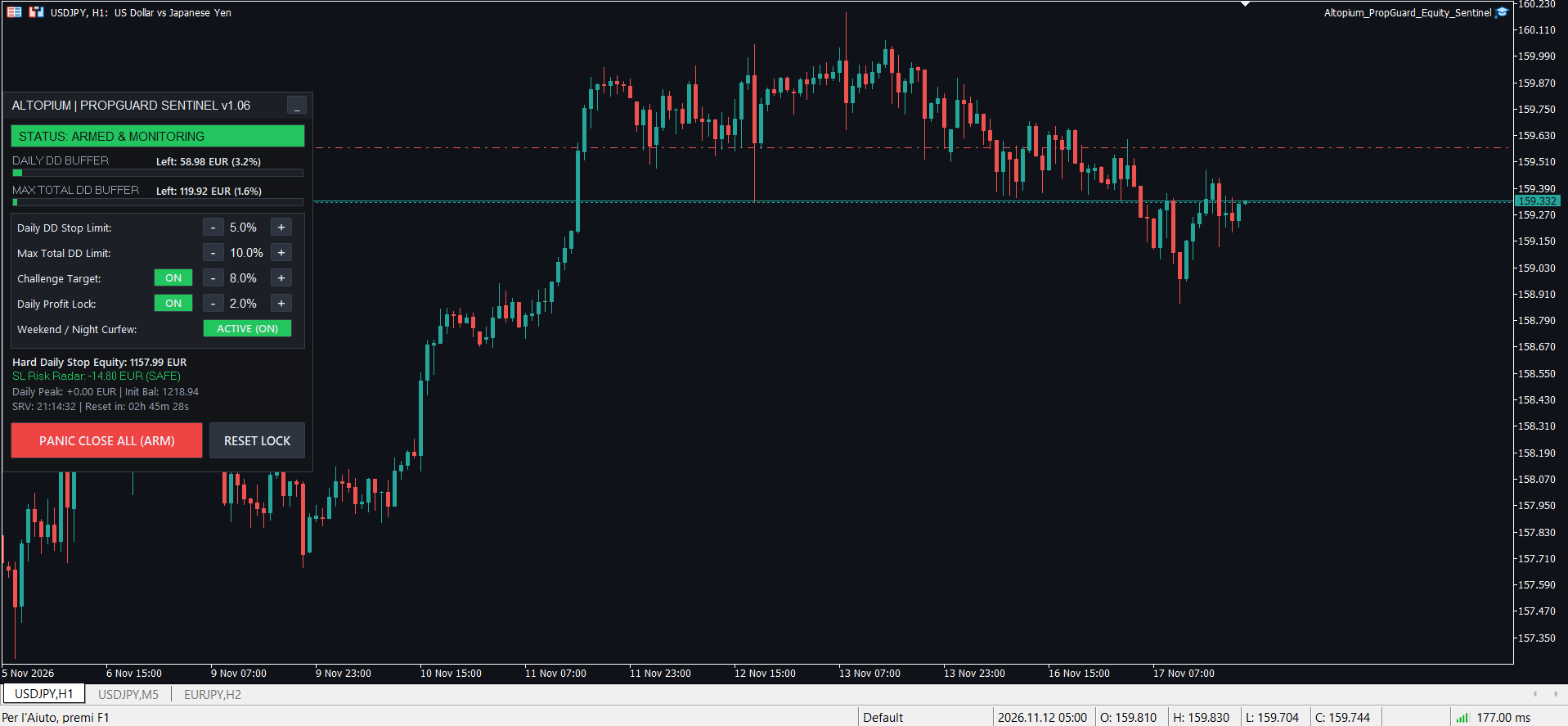
You can track these metrics manually using spreadsheets and strict session timers. However, if you want this entire risk architecture running natively inside MetaTrader 5 without manual calculations, we built Altopium PropGuard Equity Sentinel (part of the Altopium AlphaEdge Tools suite).
Sentinel

We designed it around the exact pain points outlined above:

- Predictive Worst-Case SL Risk Radar: Continuously scans every open position, factors in swaps and proportional round-trip ECN commissions, flags any position missing a Stop-Loss ("NO SL!"), and alerts you in red ("OVER DAILY LIMIT!") if your combined SL risk exceeds your remaining daily buffer.

- Multi-Rule Prop Firm Engine: Supports Start-of-Day Max(Equity, Balance), Balance-only, and Equity-only resets, alongside Static, Trailing End-of-Day, and Trailing Intraday max drawdown rules.

- Automated Circuit Breaker & Anti-Tilt Guard: Flattens all positions and cancels pending orders the exact millisecond a limit is hit, with an optional Hard Lock mode that prevents manual unlocking until the next daily reset.

- Daily Profit Lock & Curfew Protection: Secures floating intraday gains via a trailing profit shield and automatically flattens trades ahead of midnight rollover or Friday market close.

If you would like to inspect the full technical specifications or test it on your MT5 terminal, you can find it on the MQL5 Market here:

https://www.mql5.com/it/market/product/210806

How do you currently track your combined Stop-Loss exposure across multiple pairs during volatile sessions? Feel free to share your workflow in the comments.