Lot size from risk: size the trade from the stop, not from habit

"How many lots should I trade?" is one of the questions I see most often. The usual answer is a habit: 0.10 lots because that is what the last trade had, or 1 lot per 10,000 because someone said so. A fixed lot size looks simple, but it hides the one number that matters: how much money you lose if the stop is hit. This post shows how to turn that number around and calculate the lot size from it.
The idea in one sentence
You first decide how much you are willing to lose on this trade. Then you place the stop where the chart says it belongs. The lot size is whatever makes those two fit together.
The formula:
Lots = risk money / (stop distance × value of that distance for 1 lot)
On EURUSD with a USD account, one standard lot (100,000 units) is worth about 10 USD per pip. With a 10,000 USD account and 1 % risk, the risk money is 100 USD. A stop 20 pips away costs 200 USD per lot, so the trade gets 100 / 200 = 0.50 lots.
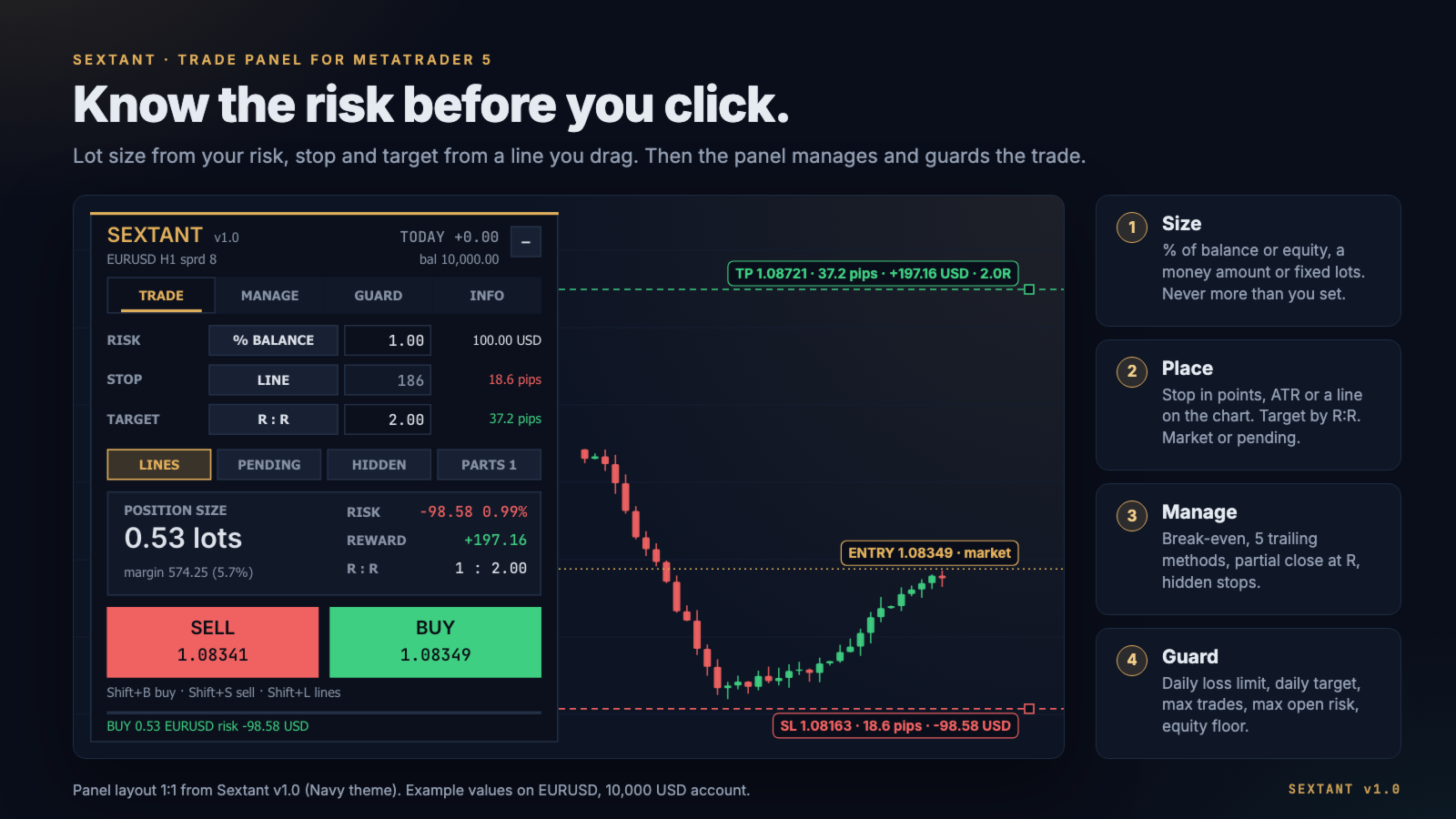
The picture above uses an 18.6 pip stop. 100 / (18.6 × 10) = 0.537 lots. That is rounded down to 0.53, and the loss at the stop becomes 0.53 × 18.6 × 10 = 98.58 USD, a little less than the 100 USD that were allowed.
Why the stop decides, not the lot
The same 1 % risk gives very different lot sizes, depending only on where the stop is:
| Stop (EURUSD) | Exact lots | Rounded down | Loss at the stop |
|---|---|---|---|
| 10 pips | 1.000 | 1.00 | 100.00 USD |
| 20 pips | 0.500 | 0.50 | 100.00 USD |
| 30 pips | 0.333 | 0.33 | 99.00 USD |
| 50 pips | 0.200 | 0.20 | 100.00 USD |
| 75 pips | 0.133 | 0.13 | 97.50 USD |
(10,000 USD account, 1 % risk, 10 USD per pip and lot, no commission.)
If you trade 0.50 lots every time instead, the 75 pip stop costs 375 USD, almost four times as much as the 10 pip trade. Your results then depend on where the stops happened to be, not on your trading. With risk-based sizing every trade costs about the same when it fails, so a wide stop is not punished and a tight stop is not a free ticket for a big position.
Always round down
Brokers accept volume only in steps, usually 0.01 lots, and have a minimum and maximum per order. Rounding to the nearest step can take you above your risk. Rounding down never does. If the rounded-down result is below the broker's minimum lot, the honest answer is: this trade does not fit your risk with this stop. Either skip it or accept that it is a bigger risk than you planned, knowingly.
What the simple formula leaves out
The 10 USD per pip is a rule of thumb for EURUSD on a USD account. In practice a few more things count:
- Pip value is not always 10. It depends on the symbol, the contract size and your account currency. For gold, indices or a EUR account, read the value from the symbol specification in MetaTrader (tick value and tick size), not from memory. Contract sizes differ between brokers.
- Commission. If your broker charges a commission per lot, it belongs in the risk. With an example commission of 7 USD per lot round turn and a 20 pip stop, one lot costs 200 + 7 = 207 USD at the stop, so 100 / 207 = 0.483, rounded down 0.48 lots.
- Spread. A buy is opened at the ask and its stop is hit at the bid. If you measure the stop from the chart line (bid), the spread is part of the distance.
- Slippage and gaps. A stop is an order, not a guarantee. Over a weekend gap or a news spike it can fill further away. Risk-based sizing limits the planned loss, not the worst case.
- Several trades at once. Five open trades with 1 % each are 5 % at risk if they all hit their stops, and correlated pairs often do that together.
% of balance, % of equity or a fixed amount
There are three common bases for "risk money":
- % of balance: stable, ignores open trades. Simple and predictable.
- % of equity: shrinks while open trades are in a loss, grows while they are in profit. More conservative in a losing phase.
- Fixed money amount: the same number every trade, for example while you test a strategy or work against a prop-firm limit.
None of them is right for everybody. What matters is that you choose one and stay with it, so the results of different trades can be compared.
A daily limit on top
Per-trade risk answers "how much can this trade cost?". It does not answer "how much can today cost?". Ten trades of 1 % on a bad day are still 10 %. A daily loss limit closes that gap, and a room check goes one step further: before a new trade is opened, it asks whether hitting its stop could break today's limit, and if so, the trade is not sent.
How I do it in practice
I don't do the maths by hand at the moment I want to trade, because that is exactly when mistakes happen. My trade panel Sextant does it: you set the risk as % of balance, % of equity, a money amount or fixed lots, and place the stop in points, as a multiple of ATR or as a red line on the chart. The lot size is rounded down, commission per lot can be included, and if a market order slips, the stop is moved to the planned distance from the real fill.
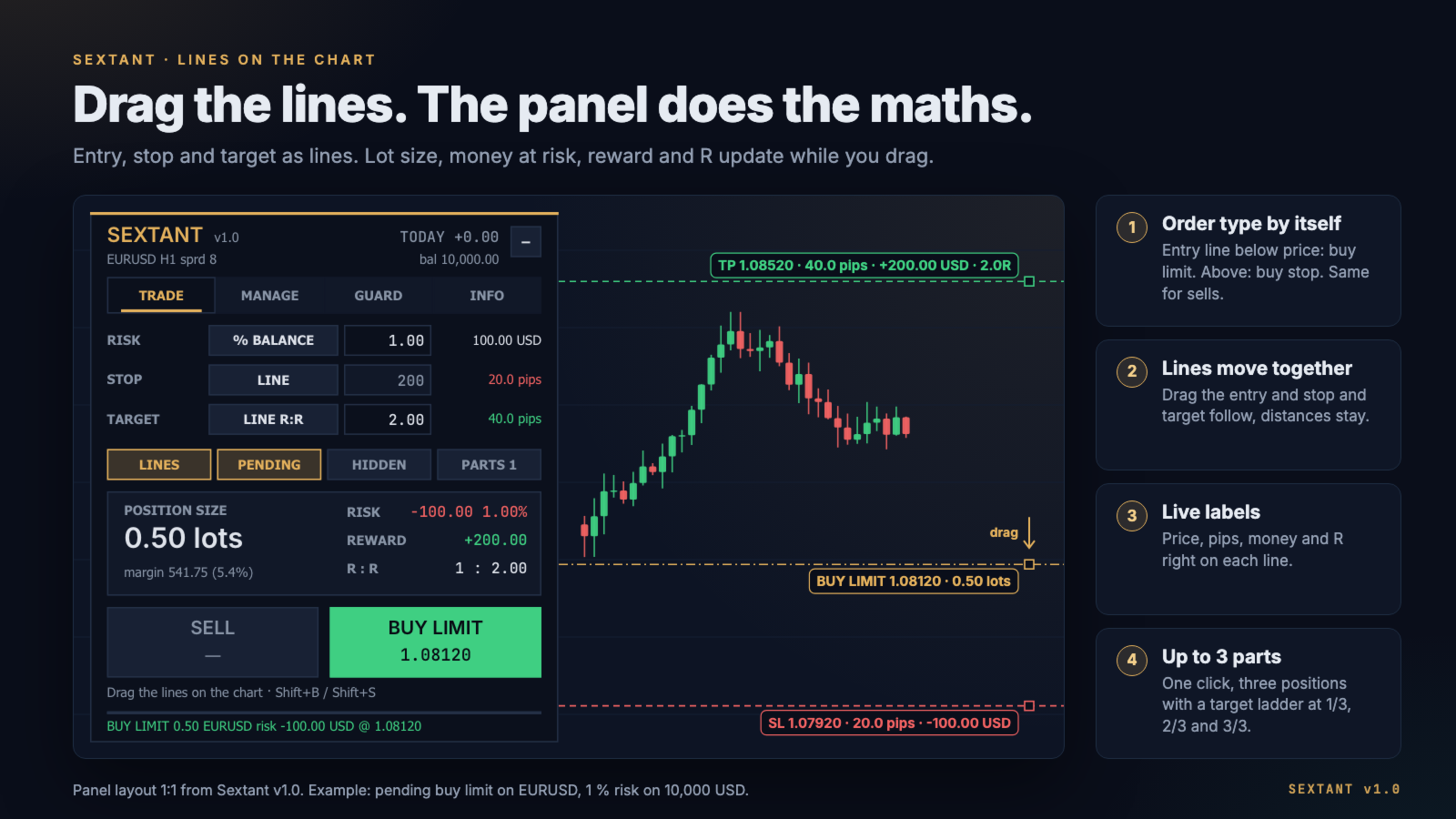
Before sending, it also checks the broker's minimum stop distance, volume limits, free margin and your maximum spread. The guard tab adds the daily loss limit, max trades per day, max open risk and the room check described above.
Checklist
- Decide the risk per trade first (money or %), before you look at the lot field.
- Place the stop where the setup is invalid, not where the lot size looks nice.
- Calculate the lot size from both, using the real pip or tick value of the symbol.
- Include commission, round down, check the minimum lot.
- Add up the risk of all open trades and keep a daily limit.
- Practise on a demo account until the numbers are routine.
A note for grid and basket EAs: they usually have no stop per trade, so this formula does not apply directly. For those I size from the worst basket instead, explained here: https://www.mql5.com/en/blogs/post/780312
Risk warning: trading forex and CFDs on margin carries a high risk of loss. Position sizing limits the planned loss per trade; it does not make a strategy profitable and cannot prevent gaps or slippage.
Sextant Trade Panel (MT5): https://www.mql5.com/en/market/product/199309
Complete Sextant guide: https://www.mql5.com/en/blogs/post/778504
Free Daily Loss Limit MT5: https://www.mql5.com/en/market/product/200696