Automated Forex Trading: Five Methods and the Work They Leave You

Automated forex trading can take over parts of market analysis, order submission and position management. It cannot make an untested rule profitable or relieve you of responsibility for the account. Start by asking which tasks the software performs, what evidence supports its rules and what you will do when actual positions differ from what the system expects.
Five approaches, five sets of responsibilities
1. MetaTrader Expert Advisors. An EA applies trading or management logic in a supported terminal. You control installation and permitted settings, but may never see the source code. Check the correct MT4 or MT5 version, broker symbol, account mode and instrument specifications before assuming that a product or preset will work. The Fortune MT5 listing is an example of a product page to consult for the intended platform and setup. A listing is a starting point for evaluation, not proof that a configuration is suitable for your account.
2. Copy trading. A follower receives a provider’s trading activity according to the service’s sizing and execution rules. You may do less installation work, but your costs, fills and exposure can differ from the provider’s. Some arrangements require a continuously connected terminal; others use different hosting arrangements. Read the exact service documentation. The MetaTrader Signals subscriber guide describes its own synchronisation and subscription rules.
3. A custom broker API. A program can submit requests and read positions directly through an available broker API. That gives developers control over data and checks, and responsibility for maintaining them. Decide how to distinguish a rejected request from an uncertain response. If the connection drops, reconcile the account before assuming an order failed or submitting another request.
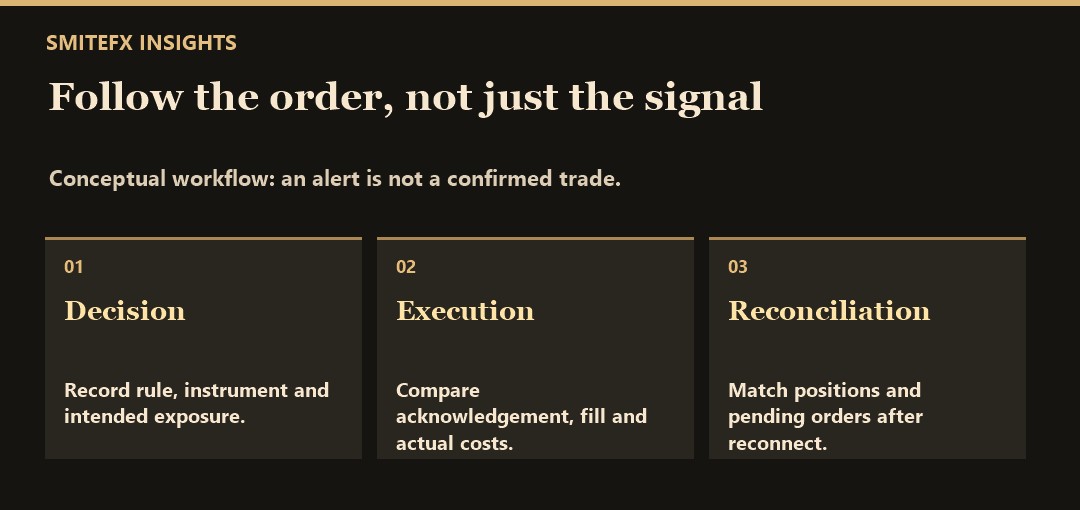
4. Platform strategies and alert bridges. Some platforms can execute a strategy or relay an alert to another application. Trace the path from rule to alert, bridge, request and fill. A backtest of the signal can’t show whether a later component will handle duplicates, rejected orders or lost connectivity. Test those separately in an appropriate non-live environment.
5. Managed allocation. Allocating to an externally managed arrangement delegates more decisions than running an EA on your own terminal. Check who can act, what they charge and what happens if you want to stop. Verify the entity and current terms; the description “automated” tells you little about permissions or protections.
Count costs on the same basis
Separate fixed expenses, such as a licence or hosting plan, from spread, commissions, financing and execution differences. Use the same reporting period and account currency. Ask which charges are already included in the result so you do not subtract them twice. A gross backtest and a net live statement answer different questions.
Hypothetical example: £40 in monthly software and hosting charges plus £90 in trading costs totals £130. Gross trading profit would need to exceed that amount for a positive monetary result before tax and the value of your time. These are illustrative figures, not typical SmiteFX costs, an expected return or a trading recommendation.
Write the operating rules before testing
Record the instrument, software version, entries, exits, allowed exposure and trading sessions. State whether each decision depends on a completed bar or can occur while a bar is forming. Then write the behaviour you expect after a restart: should the program recognise an existing position, wait for you to confirm the account state, or resume only after a documented check?
Keep a version record. Repeatedly adding a filter after seeing losses can make a historical test look cleaner without demonstrating that the rule will hold up on unused data. Retain rejected versions and note why you changed them. A useful comparison keeps the important settings, costs and dates clear.
Know what each test can establish
Historical testing examines defined rules on earlier data. An unused period can help reveal dependence on the development sample. Demo operation is a separate check of installation, the broker connection, permissions and recovery. Live execution introduces further differences. MetaTrader’s Strategy Tester documentation describes simulation options; simulated fills remain distinct from observed live execution.
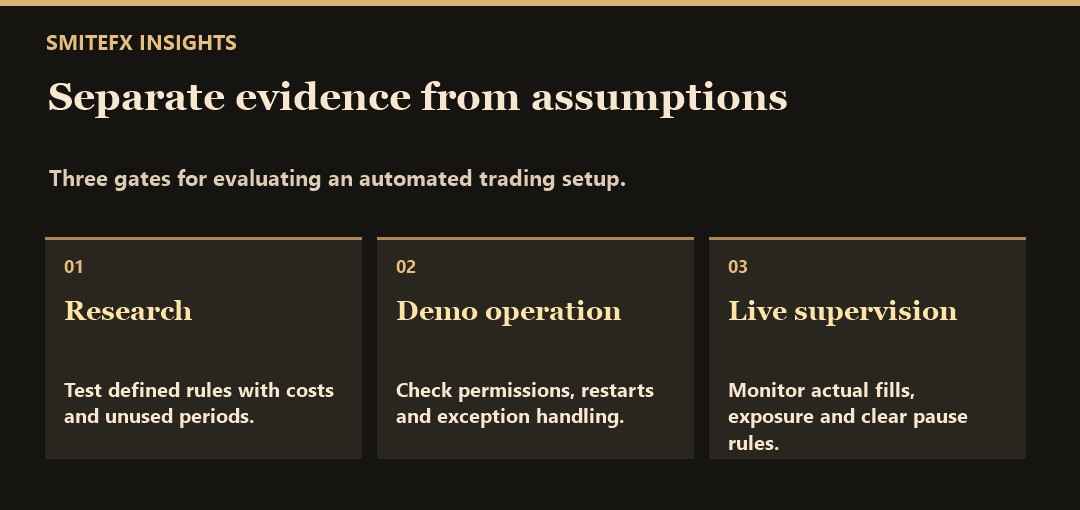
Agree in advance what you will observe: rejects, actual costs, differences in position size and whether the account reconciles after an interruption. A week of uptime can establish that the software remained open. It does not establish that the rules are profitable or that orders will always be accepted.
A practical supervision checklist
- Check data freshness, open positions and pending orders against the expected state.
- Record observed spread, commissions and slippage alongside the assumptions used in testing.
- Track combined exposure where multiple strategies trade related currency directions.
- Define when to pause new activity and who is responsible for positions already open.
- Keep a dated change log. Change one major factor at a time where practical.
Normal inactivity is not automatically a fault: a strategy may be waiting for its conditions. Duplicate orders, unexpected volume or a failure to reconcile do require investigation. Disabling new automatic orders should not be confused with closing positions or cancelling pending broker orders. Document your manual stop procedure and verify what remains active.
A machine-learning or AI label does not replace any of these checks. Ask what the model does, what evidence was kept separate from its development and how real orders and risk are supervised. Treat any claimed advantage as something to evaluate, not as a certificate of performance.
Leveraged forex and CFDs can produce substantial losses. This is educational material, not personalised investment advice. Both diagrams are conceptual and contain no actual test or trading results. This article adapts the original SmiteFX Insights guide linked in the source field.