Why Gross Risk-to-Reward Can Mislead MetaTrader Traders

A trade with a 1:2 risk-to-reward ratio sounds straightforward.
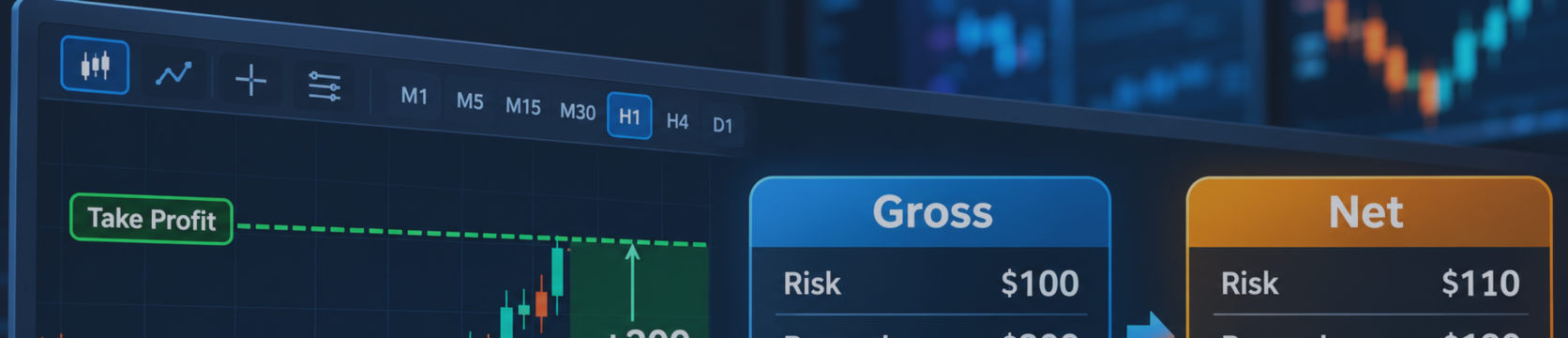
Risk $100 to potentially make $200.
But that calculation usually describes price distance, not the actual financial outcome after trading costs.
For traders who frequently evaluate short-term setups, the distinction can be significant.
Gross Versus Net Risk-to-Reward
Imagine a hypothetical trade with the following estimates:
- Gross potential loss: $100
- Gross potential profit: $200
- Estimated total trading costs: $10
The gross risk-to-reward ratio is 1:2.
Once the modeled costs are included:
Net risk = $100 + $10 = $110
Net reward = $200 - $10 = $190
The estimated net risk-to-reward ratio becomes approximately 1:1.73.
The price levels have not changed. Only the accounting has become more realistic.
What Should Be Included?
A pre-trade planning calculation should consider commission, additional transaction fees, and plausible slippage.
Spread needs careful handling. If executable Bid and Ask prices are already included in the entry and exit assumptions, adding the spread again could double-count that expense.
Overnight financing is another consideration for positions held across rollover periods. Its treatment depends on the broker's contract specifications and the expected holding period.
Position Sizing Should Account for Costs
Suppose a trader wants to risk 1% of account equity.
Calculating volume using only the distance to stop-loss may result in actual planned risk exceeding that budget after estimated costs.
A more comprehensive sizing calculation considers both the price-based loss and anticipated trading expenses.
The resulting volume must also respect the broker's minimum lot size and permitted lot increments.
Estimates Are Not Guarantees
Even a detailed calculator cannot guarantee the eventual loss or profit.
Slippage, market gaps, changing quotes, broker specifications and financing adjustments can all affect execution.
A trading-cost calculator is therefore best understood as a pre-trade scenario planner, not a guarantee of future results.
The purpose is not to make an unprofitable strategy profitable. It is to make the assumptions behind every trade more visible.
A realistic net risk-to-reward estimate is more informative than an attractive gross ratio alone.