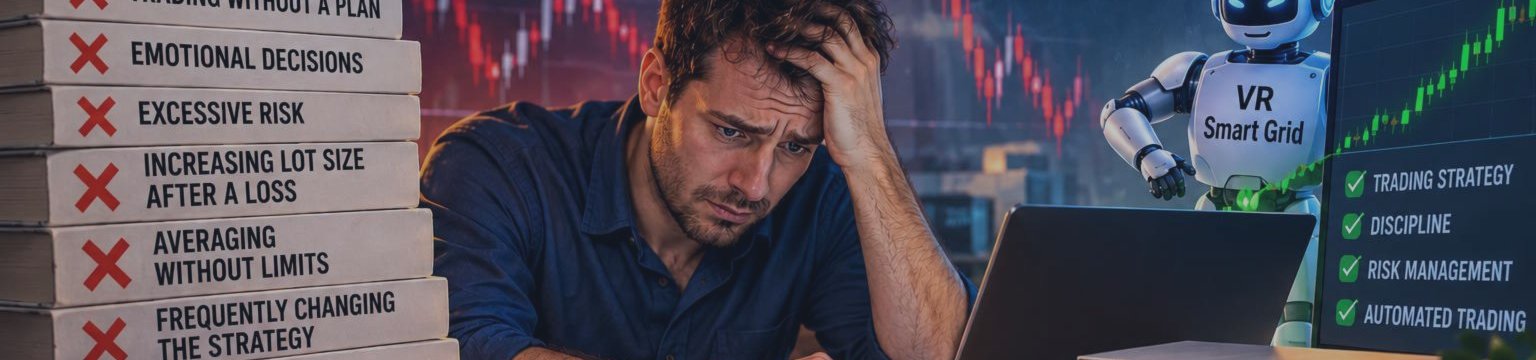

When I study trading strategies and backtest results, I notice a recurring pattern: beginners often spend too much time searching for the perfect indicator or a profitable trading system and not enough time examining their own decisions. Even a well-designed strategy can produce disappointing results when its rules are ignored.
In this article, I will discuss eight common mistakes and explain how to avoid them. On Trading-Go, I also publish articles about trading strategies, market analysis, and automated trading. If you are interested in developing trading robots, you can find more of my work on my MQL5 profile and follow new posts and discussions in the Trading-Go Telegram channel.

1. Trading Without a Plan
One of the most common mistakes is opening a trade simply because the price is moving quickly or an indicator has generated a signal. Without predefined rules, it becomes difficult to understand why a trade was opened and under what conditions it should be closed.
I recommend defining entry and exit conditions, position size, acceptable loss, and situations in which no new trades should be opened before starting to trade.
Example: if a strategy requires confirmation before entering the market, opening a position early because you are afraid of missing a move means abandoning the original trading rules.
2. Increasing Position Size After a Loss
After a losing trade, traders may want to recover their money as quickly as possible. Some respond by increasing their position size, hoping that the next trade will compensate for the previous loss. This emotional decision can significantly increase drawdown.
I believe position size should be determined before entering the market and should not be changed merely because of the previous trade's result. If a strategy adjusts position size, that adjustment should follow predefined and tested money management rules.
3. Ignoring Risk Management
A series of profitable trades does not guarantee future success. If a single position can cause substantial damage to an account, the risk may be disproportionate to the potential reward.
I recommend setting a maximum acceptable risk per trade, a drawdown limit, and a cap on total exposure. It is important to consider the combined risk of all open positions, not just the risk of each trade individually.
A stop-loss can help limit losses, but the actual execution price may differ from the requested level. Gaps, slippage, and market liquidity can affect the final result.
4. Averaging Losing Positions Without Limits
Averaging involves opening additional positions when the market moves against the initial trade. This approach can be part of a defined strategy, but without clear limits, it can rapidly increase exposure and drawdown.
I do not recommend adding positions simply because the market has moved against you and you want to improve the average entry price. Before trading, define the maximum number of positions, total volume, acceptable drawdown, and conditions for stopping the strategy.
For example, a grid strategy should be evaluated not only during profitable periods but also during prolonged directional market movements. Under these conditions, the number of open positions and floating losses may increase substantially.
5. Changing a Strategy After Just a Few Trades
One profitable trade does not prove that a strategy is effective, just as one loss does not prove that it is useless. Constantly changing settings after every result makes objective evaluation difficult.
I prefer to test trading rules on a sufficient amount of historical data, evaluate them on out-of-sample data, and, where possible, conduct forward testing on a demo account.
Trading costs must also be included, such as commissions, spreads, swaps, and slippage. Backtest results depend on historical data quality and the accuracy of the simulation settings.
6. Trading Under the Influence of Emotions
Fear, greed, and the desire to recover losses can prevent traders from following their plans consistently. After a losing streak, a trader may open unnecessary positions. After several profitable trades, the same trader may increase risk without a sound reason.
I recommend keeping a trading journal that records not only financial results but also entry reasons, compliance with trading rules, and emotional state. If you notice impulsive decision-making, taking a break is often better than forcing another trade.
7. Assuming Automation Guarantees Success
A trading robot can execute predefined rules without constant manual intervention. However, automation does not turn a weak strategy into a profitable one or eliminate market risk.
Before using an Expert Advisor in MetaTrader 5, I recommend studying its logic, checking its settings, examining maximum drawdown, and testing its behavior under different market conditions.
If you want to explore automated trading, Trading-Go offers materials on different approaches to developing trading systems. VR Smart Grid is one example of an automated trading system that should be evaluated in terms of its algorithm, position management, and behavior during adverse market movements. Before using any trading robot, understand its settings and independently assess the associated risks.
8. Evaluating a Strategy by Profit Alone
High returns alone do not reveal how robust a trading system is. Two strategies may generate the same profit while having very different drawdowns, recovery periods, and numbers of simultaneously open positions.
I recommend analyzing several metrics together: net profit, maximum drawdown, recovery factor, number of trades, and consistency across different historical periods.
It is particularly important to study unfavorable market conditions. They help reveal the risks that may be hidden behind an attractive equity curve.
Recommendations
If you are new to trading, do not try to fix every mistake at once. Start with a few practical steps:
- Write down your trading plan.
- Define acceptable risk and a maximum drawdown limit.
- Never increase position size simply to recover a loss.
- Test strategies while accounting for trading costs.
- Keep a trading journal and review deviations from your rules.
- Study a trading robot's logic and conduct your own tests before using it.
In my view, discipline and systematic analysis are more important than constantly searching for new indicators. First, learn to understand risk and follow trading rules consistently. Only then should you consider adding complexity to your strategy.
Tags: trading, trading strategy, risk management, trading psychology, automated trading, MetaTrader 5, trading robots