COPYLATOR – MT5 Trade Copier: Running Multiple Senders Into One Receiver Account

Product link:
https://www.mql5.com/en/ market/product/191385
Following one signal provider means relying on a single strategy. Following several can create a more diversified portfolio, but only if the strategies behave differently enough to reduce overall risk.
The distinction becomes important when one sender experiences a prolonged drawdown. If the entire account depends on a single trading approach, the account remains exposed to that strategy's weaknesses. Multiple senders can help distribute exposure, but simply adding more senders does not automatically create diversification.
Each sender has its own instruments, trade timing, position sizes, and behavior during adverse market conditions. How these characteristics interact determines whether the combined portfolio is genuinely diversified or merely more complicated.
This guide explains how to run multiple senders into a single receiver account using COPYLATOR, including configuration, lot sizing, drawdown protection, monitoring, and common risks.
What Multiple Senders Actually Solve
A single sender produces a pattern of returns shaped by its strategy. It experiences winning periods, losing periods, and drawdowns that reflect its trading decisions.
Adding another sender does not necessarily improve the overall results. If both senders trade the same instruments in the same direction under similar conditions, their results may be highly correlated. In that case, the combined account can behave much like a larger position in a single strategy.
The potential benefit of multiple senders comes from diversification. Strategies that use different instruments, trading sessions, or decision-making methods may experience losses at different times. When their returns are not strongly correlated, combining them may reduce portfolio volatility or drawdown compared with allocating the same capital to just one strategy.
However, diversification is not guaranteed. Strategies that appear different can still lose simultaneously during major market events, changes in volatility, or broad shifts in market direction.
The key principle is simple: the number of senders matters less than how their risk and returns interact.
The First Question: Do They Actually Diversify?
Before adding a sender, examine whether it provides meaningful diversification relative to the strategies already in the portfolio.
One approach is to compare daily or weekly returns over a sufficiently long period that includes different market conditions. Correlation can provide useful information, although historical correlation may change over time and does not guarantee how strategies will behave in the future.
Instrument selection can offer an initial clue. For example, two senders that both trade EURUSD in the same direction during the same session may share substantial market exposure, even if their internal trading logic differs.
Senders that trade different instruments or use different approaches may provide more diversification, but instrument names alone are not enough to establish independence. Different currency pairs can share exposure to the US dollar, while strategies on different instruments can still respond similarly to the same economic announcement.
Before combining strategies, review their trading history, drawdown periods, average exposure, and behavior during adverse market conditions. Do not rely on recent profitability or a low historical correlation figure alone.
The Second Question: Can the Senders Conflict?
One of the most important issues in a shared receiver account is the possibility that different senders will issue opposing trades on the same instrument.
For example, Sender A may open a Buy on EURUSD while Sender B opens a Sell on EURUSD. The consequences depend on the receiver account's position accounting system and the copier configuration.
- Hedging account: Opposing positions may coexist as separate positions, subject to the broker's rules. This can create simultaneous long and short exposure, additional trading costs, and more complicated position management.
- Netting account: Trades on the same instrument are generally combined into a net position. An opposing order can reduce, close, or reverse the existing position, depending on its volume and the account's current exposure.
In either case, the resulting account exposure may differ from what either sender intended when considered individually.
One way to reduce conflicts is to assign different instruments to different senders. For example:
- Sender A: EURUSD and GBPUSD.
- Sender B: USDJPY and AUDUSD.
- Sender C: selected indices, if supported by the broker and the configured symbol mapping.
This approach can reduce direct instrument overlap, but it does not eliminate correlated market risk. Where overlapping instruments are unavoidable, any available trade-direction filters or other compatible configuration controls should be tested carefully before live use.
The Architecture: One Receiver or Several?
When working with multiple senders, traders generally consider two account structures.
Option 1: A Separate Receiver Account for Each Sender
Each sender copies to its own receiver account. This makes it easier to evaluate the performance of each strategy independently and maintain separate account-level risk limits.
- Performance attribution is more straightforward.
- Each receiver can have its own capital allocation and risk settings.
- Opposing trades from different senders do not interact within the same account.
- Monitoring and reporting can be organized separately for each strategy.
The disadvantages include managing multiple accounts, potentially higher minimum capital requirements, and the need to monitor each account separately.
Option 2: Multiple Senders Into One Receiver Account
Multiple sender configurations can direct trading activity to one receiver account when the copier setup supports the intended arrangement. Each sender must be identified and configured correctly, and the combined behavior must be tested before live deployment.
- Capital is consolidated in one account.
- Account-level reporting provides a view of the combined result.
- Trading activity from different senders can overlap.
- Conflicting trades and shared drawdown limits require additional attention.
- Identifying which sender contributed to a loss may require separate trade attribution.
A shared account may simplify capital management, but it does not automatically improve margin efficiency or reduce risk. Margin requirements depend on the broker, instruments, account type, position sizes, and whether offsetting positions receive any margin treatment.
Choose separate accounts when strategy-level isolation is the priority. Consider a shared account when consolidated capital is important and you can reliably monitor combined exposure.
Lot-Sizing Allocation
When multiple senders share one receiver account, position sizing should be planned across the portfolio rather than chosen independently for each sender without considering the others.
If every sender uses the same balance-ratio setting, a sender that trades frequently or opens larger positions may account for a disproportionate share of the portfolio's activity and risk.
For example, one sender might open twenty trades in a week while another opens only two. Applying identical sizing rules does not necessarily mean they contribute equally to total exposure, drawdown, or trading costs.
A more deliberate approach is to define a risk allocation for each sender and configure its lot sizing accordingly. The allocation should account for more than trade count: average stop distance, simultaneous positions, instrument volatility, holding time, and potential exposure during correlated losses all matter.
For example, a trader might initially assign separate portions of the portfolio's risk budget to three senders. Equal allocations are one possible starting point, but they are not automatically optimal. A strategy with larger historical drawdowns or substantial simultaneous exposure may warrant a smaller allocation.
COPYLATOR supports flexible lot-sizing methods, including fixed lots, multipliers, balance-ratio sizing, and maximum lot limits. The appropriate method and settings depend on the account structure and the risk policy being used.
Remember that a maximum lot limit restricts position volume; it does not guarantee a maximum monetary loss. Gaps, slippage, and changing market conditions can cause actual losses to differ from expectations.
The Drawdown Protection Question
Drawdown protection requires particular attention when multiple senders share one receiver account.
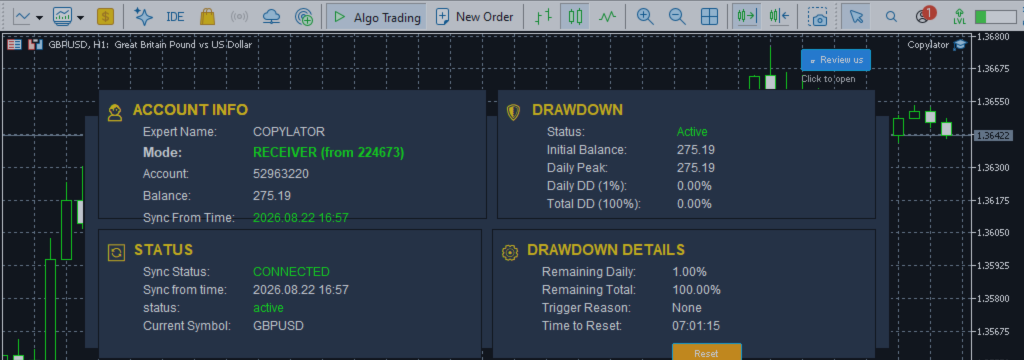
A drawdown limit applied to the combined receiver account evaluates the account-level drawdown according to the configured settings. If the threshold is reached, the protection may block further copying and, when the relevant close-on-drawdown option is enabled, close positions and delete pending orders according to the protection's behavior.
The combined drawdown does not necessarily reveal which sender caused the loss. One sender may account for most of the negative performance while another remains profitable. Nevertheless, an account-level threshold applies to the shared account, not only to the sender responsible for the loss.
This is an important distinction: account-level drawdown protection protects the combined account, not each sender's individual performance.
Separate receiver accounts make it easier to apply independent account-level drawdown limits to individual strategies. In a shared account, separate sender-level monitoring is still useful, but it should not be confused with independent drawdown protection for each sender.
A practical approach is to evaluate each sender separately before combining them. Begin with a demo account or appropriately small live allocation, examine its trading behavior, and establish risk limits before introducing it into a shared portfolio.
Capital Allocation
Capital allocation should reflect each sender's risk characteristics and the role it plays in the portfolio, rather than defaulting to an equal division.
Factors to consider include:
- Length and quality of the sender's available trading history.
- Historical drawdown and recovery behavior.
- Average and maximum simultaneous exposure.
- Instrument and currency concentration.
- Trading frequency and holding time.
- Performance during adverse market conditions.
- Potential overlap with other senders.
A longer track record can provide more information, but it does not guarantee future performance. A strategy with a strong recent record may still be vulnerable to market conditions that have not occurred during the evaluation period.
Review allocations periodically and define in advance what would justify reducing or increasing a sender's share. Avoid increasing an allocation simply because a strategy has recently produced a few profitable weeks or months.
Portfolio allocation is an ongoing risk-management decision. The fact that trades originate from external strategies does not remove the need to evaluate their combined exposure.
The Monitoring Requirement
Multiple senders require organized monitoring. A technically active copier does not guarantee that every strategy is behaving as expected or that the combined portfolio remains within its intended risk limits.
Monitor the following areas:
- Connection and terminal status: Confirm that the relevant MT5 terminals are running and that the copier instances are operating as intended.
- Sender identification: Verify the configured sender account numbers and ensure that each receiver configuration refers to the intended sender.
- Trade attribution: Maintain records that allow positions and results to be associated with the correct sender. Where appropriate, use available comment or identification settings and verify that they remain distinguishable in the account history.
- Individual performance: Track each sender's realized results, floating profit or loss, and drawdown separately where the available records permit.
- Combined exposure: Monitor total position sizes, margin usage, overlapping instruments, and correlated risks.
- Execution differences: Investigate missing or rejected orders, symbol mismatches, and differences between sender and receiver trades.
If a sender terminal goes offline, existing receiver positions may remain open. Whether those positions continue to be managed depends on the strategy, the receiver-side configuration, and the management mechanism involved. Do not assume that an open receiver position will automatically close merely because the sender becomes unavailable.
Define a procedure for checking terminal status and managing open positions if a connection or terminal fails.
The Removal Procedure
Removing a sender from a shared account requires more care than simply disabling its copier instance. Existing receiver positions may remain open, and other senders may continue trading the same instruments.
Before removing a sender, follow a controlled process:
- Identify its existing positions and pending orders. Use the available trade records and identification settings to distinguish them from activity generated by other senders.
- Choose how to handle open exposure. Decide whether the positions should be closed, managed manually, or allowed to reach their planned exits. Consider the associated costs and risks.
- Stop further copying from the intended sender. Confirm that the configuration change affects only the sender being removed.
- Verify remaining positions. Make sure that positions associated with the removed sender are not being confused with positions from the remaining senders.
- Review the remaining portfolio. Recalculate exposure, margin usage, and risk allocation after the removal.
- Update records and configuration. Remove obsolete settings only after confirming that doing so will not interfere with the remaining sender configurations.
Do not assume that stopping a copier automatically closes its existing receiver positions. Verify the actual behavior and the account's current exposure before making changes.
The Practical Sequence
A gradual approach makes a multi-sender portfolio easier to understand and manage.
- Start with one sender. Test the configuration and observe its trade handling, risk profile, and performance.
- Document the first sender. Record its instruments, typical volume, drawdown, trading frequency, and behavior during adverse conditions.
- Evaluate a second sender. Examine its history and determine whether it adds useful diversification or duplicates the first sender's exposure.
- Test the combination. Use a demo environment or a carefully controlled allocation to investigate trade conflicts, symbol mapping, position sizing, and combined drawdown behavior.
- Add further senders gradually. Confirm that each addition contributes a clear purpose and remains manageable.
- Review the portfolio as a whole. Check whether the combined risk remains within the predefined limits and whether the additional complexity is justified.
There is no universal ideal number of senders. The right number depends on strategy quality, diversification, available capital, monitoring capacity, and the reliability of the operating setup.
The Common Failure
A common failure in multi-sender portfolios is adding strategies faster than they can be evaluated.
As the number of senders grows, trading activity becomes harder to attribute unless identification and recordkeeping are established from the beginning. When the account underperforms, the trader may struggle to determine whether the cause is one sender, a conflict between senders, excessive position sizing, or a change in market conditions.
Use a consistent identification and reporting method for each sender. Check that trade comments or other available identifiers are preserved as expected by the broker and platform, and do not rely on a comment prefix alone without verifying the actual account history.
Another common mistake is allocating too much capital to the most recent winner. A few strong months may make a sender appear more reliable than the available evidence supports. If its allocation is increased without accounting for its potential drawdown, the portfolio may become excessively dependent on that strategy.
A final mistake is assuming that several profitable senders automatically create a safe portfolio. If they share the same underlying market exposure, their losses can occur together. Portfolio risk must be assessed across the combined positions, not just by counting the number of strategies.
Summary
Running multiple senders into one receiver account can consolidate trading activity and provide access to several strategies within a single account. However, the benefits depend on diversification, correct configuration, appropriate lot sizing, and effective monitoring.
Diversification: Multiple senders are most useful when their risk and return patterns are not excessively correlated. More senders do not automatically mean less risk.
Architecture: Separate receiver accounts provide clearer strategy attribution and account-level isolation. A shared receiver consolidates capital but combines exposure and drawdown behavior.
Lot sizing: Allocate position sizes deliberately, considering simultaneous exposure and the risk contributed by each sender—not merely the number of trades.
Drawdown protection: A shared account's drawdown threshold applies to the combined account. It does not automatically isolate the sender responsible for the loss.
Monitoring: Track each sender's activity and performance while also monitoring the portfolio's total exposure, margin usage, and execution quality.
Implementation: Add senders gradually, test the combined configuration, and maintain a clear procedure for handling conflicts, terminal failures, and sender removal.
A well-managed portfolio of a few understood strategies can be more useful than a larger collection of strategies whose combined exposure is difficult to explain. The goal is not simply to copy more senders—it is to manage their combined risk intelligently.
Product link:
https://www.mql5.com/en/ market/product/191385