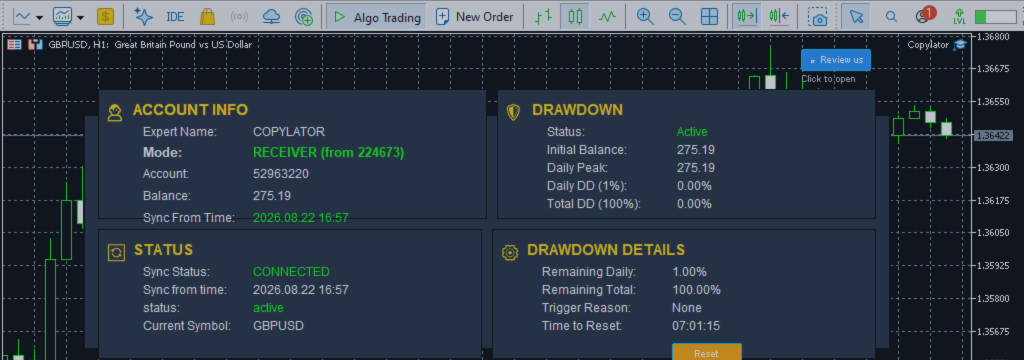
MT5 Trade Copier: Managing Multiple Senders with Conflicting Strategies in One Receiver

Product link:
https://www.mql5.com/en/ market/product/191385
Combining multiple signal providers into a single Receiver account is one of the most useful applications of an MT5 Trade Copier. Instead of maintaining a separate trading account for every strategy, traders can distribute signals from multiple Senders into one MT5 account.
COPYLATOR supports Multi-Sender and Multi-Receiver configurations, allowing traders to build setups ranging from one-to-many and many-to-one to many-to-many trade-copying environments.
However, combining independent strategies introduces an important question:
What happens when two Senders trade the same symbol in opposite directions?
For example:
Sender A: EURUSD BUY Sender B: EURUSD SELL
If both signals are copied to the same Receiver account within a short period, the result depends heavily on whether the Receiver account uses a Hedging or Netting structure and how the copier handles the positions.
1. The Core Conflict
This situation is not necessarily a copier malfunction.
It is a natural consequence of combining independent strategies that were designed without knowledge of each other.
Each Sender may be operating correctly according to its own rules. The conflict appears only when both strategies are executed inside the same Receiver environment.
Sender A Strategy
       |
       | BUY EURUSD
       v
       |
       +------ Receiver Account
       |
       ^
       | SELL EURUSD
       |
Sender B Strategy
The important question is therefore not whether the copier can receive both signals. The important question is how the Receiver account represents and manages those opposing positions.
2. What Happens on a Hedging Account?
A Hedging account can maintain multiple independent positions on the same symbol.
Therefore, if two Senders generate opposite signals, the Receiver may hold both positions:
EURUSD BUY 0.50 EURUSD SELL 0.50
The two positions remain separate.
This can create a near-neutral directional exposure if the volumes are equal, but it does not mean that the two strategies have become risk-free.
The account may still incur:
- Spread on both transactions
- Commission on both transactions where applicable
- Swap or financing costs where applicable
- Margin requirements
- Different execution prices
- Different Stop Loss and Take Profit levels
Consequently, two opposing positions can reduce net directional exposure while still generating trading costs.
3. Example on a Hedging Account
| Sender | Direction | Volume |
|---|---|---|
| Sender A | BUY EURUSD | 0.50 |
| Sender B | SELL EURUSD | 0.50 |
If both positions remain open, the Receiver may have approximately zero net directional exposure, but two independent positions still exist.
BUY  0.50
SELL 0.50

Net directional exposure ≈ 0
This should not be confused with zero trading cost or zero risk.
4. What Happens on a Netting Account?
Netting accounts work differently.
In a Netting account, only one net position per symbol can exist.
If the Receiver currently has:
EURUSD BUY 1.00
and another Sender generates:
EURUSD SELL 0.60
the Receiver's resulting net exposure can be reduced rather than maintaining two independent opposite positions.
BUY 1.00 SELL 0.60 ↓ Net BUY 0.40
If the opposite trade has equal volume:
BUY 1.00
SELL 1.00
     ↓
Net position ≈ 0
The exact accounting and execution behavior depends on the MT5 account and broker implementation, but the fundamental difference remains: Netting accounts maintain a net position rather than separate opposing positions.
5. Why Netting Can Hide Strategy Conflicts
A Netting account can make a conflict less visible.
Suppose:
Sender A: BUY EURUSD 1.00 Sender B: SELL EURUSD 1.00
The Receiver may end up flat.
Looking only at the current EURUSD position, a trader might conclude that nothing happened.
However, two independent strategies generated two separate decisions.
The result may therefore obscure the performance contribution of each Sender.
6. Performance Attribution Becomes More Difficult
One of the main reasons to combine multiple Senders is diversification.
To evaluate whether that diversification is working as intended, traders need to understand which strategy contributed to the account's performance.
Conflicting positions can make this more difficult.
For example:
Sender A:
+ $100

Sender B:
- $80

Combined result:
+ $20
The Receiver's total result does not show the complete picture of how the two strategies behaved independently.
This is particularly important when several Senders are trading the same instruments.
7. Why Conflicting Signals Are Not Necessarily a Problem
Opposing signals do not automatically mean that one of the strategies is incorrect.
Different strategies may have different:
- Time horizons
- Entry conditions
- Exit rules
- Risk models
- Market assumptions
- Trading sessions
One strategy may be designed for short-term momentum while another may trade mean reversion.
Therefore, the existence of opposite positions should be analyzed in the context of the strategies rather than treated automatically as a copier error.
8. Multi-Sender Configuration in COPYLATOR
COPYLATOR supports multiple Sender and Receiver instances.
A typical many-to-one configuration can look like:
Sender Account A | +--------+ | Sender Account B|----> Receiver Account | Sender Account C| | +--------+
Each Receiver configuration should specify the appropriate SenderAccountNumber for the Sender whose trades it is intended to copy.
This makes it possible to organize several independent copying relationships within the MT5 environment.
9. One Receiver Does Not Mean One Strategy
A single Receiver account can contain trades originating from multiple Senders.
However, this creates a portfolio-management problem that is separate from the technical copying process.
The trader should know:
- Which Senders trade which symbols
- Which Senders use Buy signals
- Which Senders use Sell signals
- Which Senders trade during which sessions
- Which Senders have overlapping positions
- How much volume each Sender contributes
10. Strategy Overlap Should Be Identified Before Deployment
Before combining multiple Senders, create a simple strategy map.
| Sender | Symbols | Typical Direction | Session |
|---|---|---|---|
| Sender A | EURUSD | Buy/Sell | London |
| Sender B | GBPUSD | Buy/Sell | London/New York |
| Sender C | EURUSD | Buy/Sell | New York |
The objective is to identify potential overlaps before the strategies are allowed to operate together.
11. Solution #1: Separate Symbol Sets
One of the simplest ways to reduce conflicts is to assign different instruments to different Senders.
For example:
Sender A → EURUSD
Sender B → GBPUSD
Sender C → USDJPY
This does not eliminate correlation between instruments, but it eliminates direct Buy/Sell conflicts on the exact same symbol.
It also makes performance attribution easier.
12. Solution #2: Direction Filtering
COPYLATOR provides direction-based filtering options that can be used to control which trades are copied.
For example, a Receiver configuration can be restricted to:
Copy Long Only
or:
Copy Short Only
This can be useful when a specific Receiver instance is intended to process only one direction from a Sender or strategy configuration.
However, direction filtering should be applied carefully because it changes the original Sender strategy.
13. Example of Direction Filtering
Suppose two Senders both trade EURUSD.
Sender A → BUY Sender B → SELL
A trader may configure different Receiver instances or copying rules so that only the intended direction is accepted for a particular strategy flow.
This can reduce direct directional conflicts, but it also means that not every original Sender trade is necessarily replicated.
14. Solution #3: Time Filters
Another way to reduce conflicts is to separate strategies by trading session.
For example:
Sender A:
07:00 – 12:00 GMT

Sender B:
13:00 – 17:00 GMT
If their trading windows do not overlap, simultaneous conflicting trades become less likely.
COPYLATOR's day and time filtering functionality can be used to define when copying is permitted.
The exact schedule should be based on the actual strategy and broker/server time configuration.
15. Time Separation Does Not Guarantee No Conflicts
A time filter reduces the possibility of overlap but cannot guarantee that conflicts will never occur.
A position opened during one session may remain open into another session.
For example:
Sender A opens: BUY EURUSD at 11:55 Sender B becomes active: SELL EURUSD at 13:05
The strategies can still overlap even though their entry windows are different.
Therefore, holding periods must also be considered.
16. Solution #4: Separate Receiver Accounts
When strong strategy conflicts are expected, using separate Receiver accounts provides a cleaner structure.
Sender A → Receiver Account A

Sender B → Receiver Account B

Sender C → Receiver Account C
This approach makes it easier to:
- Measure individual strategy performance
- Control risk independently
- Configure different lot sizes
- Apply different drawdown limits
- Analyze each strategy separately
The trade-off is increased account and operational management.
17. Solution #5: Monitor Net Exposure
If several Senders must operate within one Receiver account, net exposure should be monitored.
For example:
Sender A: BUY 1.00 EURUSD Sender B: SELL 0.50 EURUSD Net exposure: BUY 0.50 EURUSD
This provides a more useful view of directional exposure on a Netting-style basis, although the underlying strategy decisions should still be tracked separately.
18. Drawdown Protection and Multiple Senders
Combining multiple strategies creates another important consideration: drawdown protection operates at the Receiver account level according to its configured settings.
For example:
Sender A → profitable
Sender B → losing
Sender C → losing
             ↓
Receiver account drawdown increases
             ↓
Configured DD limit reached
             ↓
Copying may be blocked
The drawdown system does not automatically determine which Sender is responsible for the account-level drawdown.
Therefore, traders using multiple Senders should understand that a Receiver-level protection mechanism can affect the combined portfolio.
19. Daily and Total Drawdown
COPYLATOR supports both daily and total drawdown protection.
Depending on the configured parameters, traders can define maximum drawdown limits and specify whether positions should be closed when the limit is exceeded or whether new copying should simply be blocked.
For multi-Sender environments, these limits should be considered at the combined Receiver account level.
20. Different Lot Sizes for Different Senders
Not every Sender needs to contribute the same amount of exposure.
For example:
Sender A → 1.00x multiplier Sender B → 0.50x multiplier Sender C → 0.25x multiplier
This can reduce the influence of a particular strategy within the combined account.
COPYLATOR provides flexible lot-management methods such as fixed lot, multiplier, balance ratio, and maximum lot cap.
These settings should be evaluated as part of the overall portfolio risk design.
21. Maximum Lot Cap as a Safety Layer
When multiple Senders are active, an unexpected large trade from one strategy can create disproportionate exposure.
A maximum lot cap can provide an upper boundary for copied volume.
Calculated volume:
2.00 lots

Max Lot Size:
0.50 lots

Copied volume:
0.50 lots
This controls volume but does not determine the final monetary risk of the position.
22. Symbol Mapping in Multi-Sender Environments
Multiple Senders can introduce additional symbol-mapping complexity.
One Sender may use:
EURUSD
while another environment may use:
EURUSDm
or another broker-specific symbol name.
COPYLATOR can automatically search for corresponding symbols and can provide warnings when a suitable symbol cannot be found.
Manual mappings can also be configured when necessary.
23. Why Symbol Mapping Must Be Tested Per Receiver
Mapping is not necessarily universal across brokers.
A mapping that works for one Receiver may not work for another.
Therefore:
Sender Symbol ↓ Receiver Broker ↓ Receiver Symbol ↓ Verify Specification
Each Receiver environment should be tested independently.
24. Conflicts Between SL and TP Rules
Opposing strategies may also have completely different risk-management structures.
For example:
Sender A:
BUY
SL = 1.1000
TP = 1.1100

Sender B:
SELL
SL = 1.1080
TP = 1.0950
On a Hedging account, each position can maintain its own SL and TP.
On a Netting account, the resulting net position and subsequent modifications must be understood in the context of the account's net-position structure.
This is another reason why mixed-strategy configurations should be tested before live deployment.
25. Partial Close Conflicts
Another possible interaction occurs when one Sender partially closes a position while another Sender opens an opposite position on the same symbol.
For example:
Sender A: BUY 1.00 EURUSD Sender A: Partial Close 0.50 Sender B: SELL 0.50 EURUSD
On a multi-strategy Receiver, the resulting exposure depends on the account type, position structure, timing, and volume of each operation.
COPYLATOR supports Partial Close, but traders should test complex multi-Sender position interactions carefully.
26. Reverse Mode Can Create Additional Conflicts
Reverse Mode adds another layer to multi-Sender management.
A Sender's Buy can become a Receiver Sell, while another Sender's Sell may remain a Receiver Sell.
Sender A:
BUY
   ↓ Reverse
Receiver:
SELL

Sender B:
SELL
   ↓ Normal
Receiver:
SELL
Two apparently opposite Sender strategies can therefore become aligned on the Receiver when Reverse Mode is configured for one of them.
This makes configuration documentation particularly important.
27. Custom Comments Help With Identification
When several Senders operate on one Receiver, identifying the origin of a position becomes extremely useful.
COPYLATOR supports custom comment prefixes that can help distinguish copied trades.
For example:
Sender A → C123456_StrategyA Sender B → C789012_StrategyB
This can make trade history analysis easier and help traders identify which Sender generated a particular copied position.
28. Notifications and Monitoring
For complex multi-Sender setups, notifications can provide additional operational visibility.
COPYLATOR can provide notifications for relevant events such as:
- Trade openings
- Trade closings
- Drawdown events
- Errors
Monitoring becomes increasingly useful as the number of Senders and Receivers increases.
29. A Practical Multi-Sender Example
Consider three independent Senders:
| Sender | Strategy | Symbol | Direction |
|---|---|---|---|
| A | Momentum | EURUSD | BUY |
| B | Mean Reversion | EURUSD | SELL |
| C | Trend | USDJPY | BUY |
Sender A and Sender B can directly conflict on EURUSD, while Sender C operates independently on USDJPY.
A trader could choose to:
- Keep all three on one Receiver
- Separate A and B into different Receivers
- Use direction filters
- Use different lot multipliers
- Use time restrictions
- Monitor the combined exposure
The appropriate configuration depends on the intended portfolio structure.
30. What the Copier Can Do
A trade copier can perform the mechanical part of the process.
COPYLATOR can help manage:
- Multiple Senders
- Multiple Receivers
- Market-order copying
- Pending-order copying
- SL/TP synchronization
- Partial Close
- Symbol mapping
- Lot management
- Direction filtering
- Time filtering
- Drawdown protection
- Reverse Mode
31. What the Copier Cannot Decide Automatically
The copier cannot know which strategy the trader considers more important when two independent strategies conflict.
For example, if:
Sender A → BUY EURUSD
Sender B → SELL EURUSD
there is no universal technical rule that determines which signal should have priority.
Priority is a portfolio-design decision.
The trader must decide whether the desired result is:
- Both strategies operating independently
- Only one direction being copied
- Separate Receiver accounts
- Different trading sessions
- Different position sizes
- Another predefined portfolio rule
32. Demo Testing Is Essential
A multi-Sender environment should be tested with realistic simultaneous signals.
Do not test only isolated trades.
Specifically test:
BUY + BUY BUY + SELL SELL + SELL Partial Close + Opposite Entry SL Modification + Opposite Entry Multiple Senders + Drawdown Limit
Testing these combinations reveals how the actual Receiver account behaves under simultaneous strategy activity.
33. A Two-Week Test Is a Starting Point, Not a Guarantee
A multi-Sender demo test over a meaningful period can help reveal operational issues, but the exact testing duration should reflect the strategy frequency and market conditions.
A test should include different market environments rather than relying only on a short period of quiet conditions.
34. Recommended Pre-Live Workflow
- List every Sender account.
- List all symbols traded by each Sender.
- Identify overlapping symbols.
- Identify possible opposite directions.
- Review each strategy's holding period.
- Choose Hedging or Netting consciously.
- Configure SenderAccountNumber correctly on each Receiver.
- Configure symbol mappings.
- Configure lot sizing for each copying relationship.
- Consider direction filters.
- Consider time filters.
- Configure drawdown protection.
- Enable useful notifications.
- Use custom comments where helpful.
- Test simultaneous conflicting signals on demo.
- Review the resulting account exposure.
- Analyze each Sender's contribution separately where possible.
- Only then consider live deployment.
35. Final Checklist
- Do the Senders trade the same symbols?
- Can they generate opposite signals?
- Is the Receiver Hedging or Netting?
- Are the SenderAccountNumber settings correct?
- Are symbol mappings verified?
- Are lot sizes appropriate?
- Is MaxLotSize configured where necessary?
- Are direction filters required?
- Are time filters useful?
- Can positions remain open across different strategy sessions?
- Is drawdown protection configured for the combined account?
- Can individual Sender performance be identified?
- Are custom comments useful for tracking?
- Has the combined configuration been tested on demo?
Conclusion
Combining multiple Senders into one MT5 Receiver can create a flexible multi-strategy trading environment, but it also introduces interactions that do not exist when every strategy operates independently.
The most important issue is what happens when two Senders generate opposing trades on the same symbol.
On a Hedging account, the positions can remain separate. On a Netting account, they contribute to a single net position. In both cases, the final Receiver behavior should be understood before live deployment.
COPYLATOR provides the infrastructure needed for complex Multi-Sender and Multi-Receiver configurations, including flexible lot management, symbol mapping, direction filtering, time filtering, SL/TP synchronization, Partial Close, Reverse Mode, notifications, and drawdown protection.
However, the copier executes the configured rules; it does not automatically determine which independent strategy should have priority when strategies conflict.
The most important step is therefore portfolio design before configuration. By identifying overlapping symbols, understanding the account type, controlling position sizes, separating strategies where appropriate, and testing simultaneous signals on demo, traders can build a more transparent and manageable multi-Sender environment.
Multi-Sender copy trading works best when the trader understands not only how to copy each strategy, but also how those strategies interact once they share the same Receiver account.
Product link:
https://www.mql5.com/en/ market/product/191385