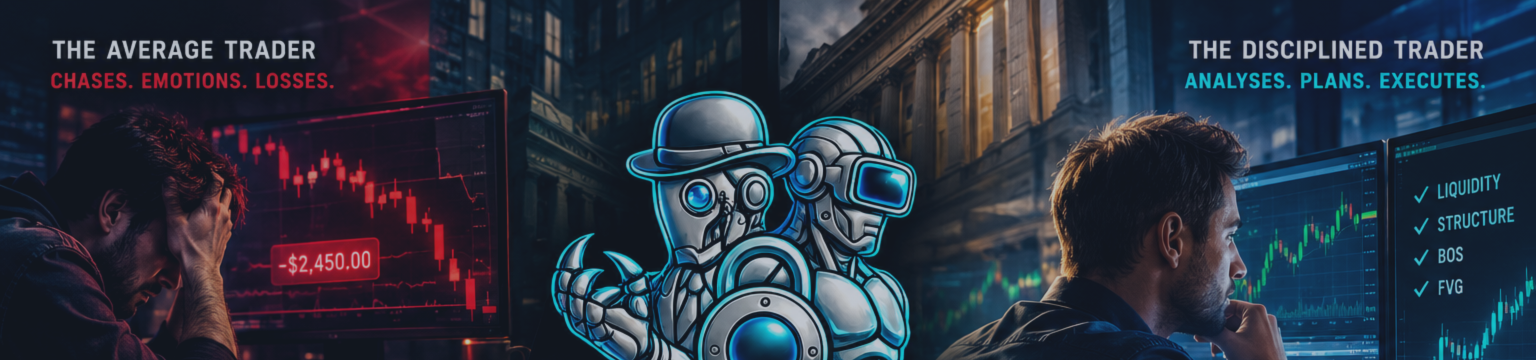
I Lost Sleep, Blew Trading Accounts, and Had No Coding Experience. Then I Built Banker & Runner.

How a struggling manual trader used AI, months of experimentation, and an obsession with better risk management to develop automated trading systems for Gold and Bitcoin.
By the creator of Banker & Runner
There was a time when trading controlled my life.
I would sit in front of my screen, watching the candles move, waiting for the perfect entry. I would analyse the market, draw my lines, study the charts, and convince myself that the next trade could be the one that changed everything.
Sometimes it worked.
Sometimes it did not.
And when it did not, the frustration could be overwhelming.
I knew the feeling of watching a trade move against me. I knew the temptation to take another position to recover a loss. I knew what it felt like to spend hours staring at a chart, wondering whether I had entered too early, exited too soon, or missed an opportunity altogether.
I started with trading accounts of around $700, $1,000 and eventually $2,000. I experienced the disappointment of losing money I had hoped to grow.
The financial losses were painful, but there was something else that bothered me just as much: the mental pressure.
The sleepless nights.
The constant chart-watching.
The emotional decisions.
The feeling that the market could demand my attention at any moment.
I began asking myself a question that would eventually change my direction:
What if I could turn my trading ideas into a system that follows rules automatically instead of relying on me to watch every movement of the market?
I did not know how to code. I had never written a trading robot. I did not have a software engineering background.
But I had a problem I desperately wanted to solve.
And I had access to a technology that was beginning to change the way people worked: artificial intelligence.
That was the beginning of Banker & Runner.

The turning point: What if AI could help me build the trading system I needed?
I did not begin this journey with a sophisticated development team or years of programming experience.
I began with questions.
Could AI help me understand how an Expert Advisor works? Could it help me translate trading ideas into rules? Could I build something that analysed market conditions, identified potential opportunities and executed trades according to a defined strategy?
I started experimenting.
The early versions were not the finished product I had imagined.
Some ideas did not perform as expected. Some versions were too restrictive. Others needed better entry logic, more thoughtful risk controls or changes to how profits were managed.
There were countless revisions, tests, adjustments and moments when I had to go back to the drawing board.
Building a trading system was much harder than simply asking AI to write a few lines of code.
A program can compile successfully and still be a poor trading system. A backtest can look attractive and still fail to reflect what happens in live markets. A strategy can find entries but struggle to manage its winning trades.
I had to learn to think beyond whether the code worked.
I had to ask whether the trading logic made sense.
I had to examine whether the system behaved as intended.
I had to test the results rather than simply believe them.
What started as an attempt to make trading easier gradually became a serious development project.
Over approximately six to seven months, I worked through the process of developing, testing and refining Banker & Runner, despite having no previous coding experience.

That experience taught me something important: you do not necessarily need to begin as an expert programmer to start exploring an ambitious technical idea. You do, however, need patience, a willingness to learn, and the discipline to test what you build.
AI helped me move forward, but the work of defining the strategy, reviewing results, identifying problems and deciding what needed to change remained essential.
And somewhere in the middle of that long process, a new idea emerged.
The lightbulb moment: Why I called it Banker & Runner
I began thinking about a problem that many traders face.
What happens when a trade moves in your favour?
Some traders take profits too early because they are afraid of losing what they have gained. Others hold a winning position for too long, hoping for a much bigger move, only to watch the market reverse.
Neither decision is easy.
A market can produce a small favourable move and then reverse. It can also begin a move that continues much farther than expected.
I wanted to explore a trading approach that recognised both possibilities.
That was the thinking behind the Banker & Runner concept.
Imagine a trade that moves in the intended direction.
One part of the strategy is designed around taking a portion of the profit. That is the Banker.
The remaining part of the trade can have the opportunity to capture a larger move if the market continues favourably. That is the Runner.
One objective is to collect profits along the way. The other is to give a potentially strong move room to develop.
It is a simple idea, but it represents a fundamental challenge in trading: balancing the desire to secure gains with the possibility of capturing more.
The Banker and Runner are not two separate promises of profit. They are two objectives within a trading-management approach, and either part of a trade can perform differently depending on market conditions.
Banker takes a piece. Runner pursues the opportunity. One strategy, two objectives.
That became the philosophy behind the name.
What exactly is Banker & Runner?
Banker & Runner is a family of automated trading systems developed for MetaTrader 5.
The versions I have been developing focus on two markets:

-
XAUUSD — Gold
-
BTCUSD — Bitcoin
These markets are different. Gold responds to factors including economic data, interest-rate expectations, the US dollar and changes in risk sentiment. Bitcoin operates in a cryptocurrency market that can experience substantial volatility, rapid price movements and changing liquidity conditions.
That is why I developed market-specific versions rather than assuming that one set of trading rules should behave identically on both instruments.
The objective is to automate a defined trading process, reduce the need for constant manual intervention and apply programmed rules consistently.
It is not a promise that the market will become predictable.
It is not a guarantee of profits.
And it is not a replacement for understanding the risks involved in leveraged trading.
It is a tool built around a trading methodology that I have spent months developing and testing.
How Banker & Runner works, explained simply
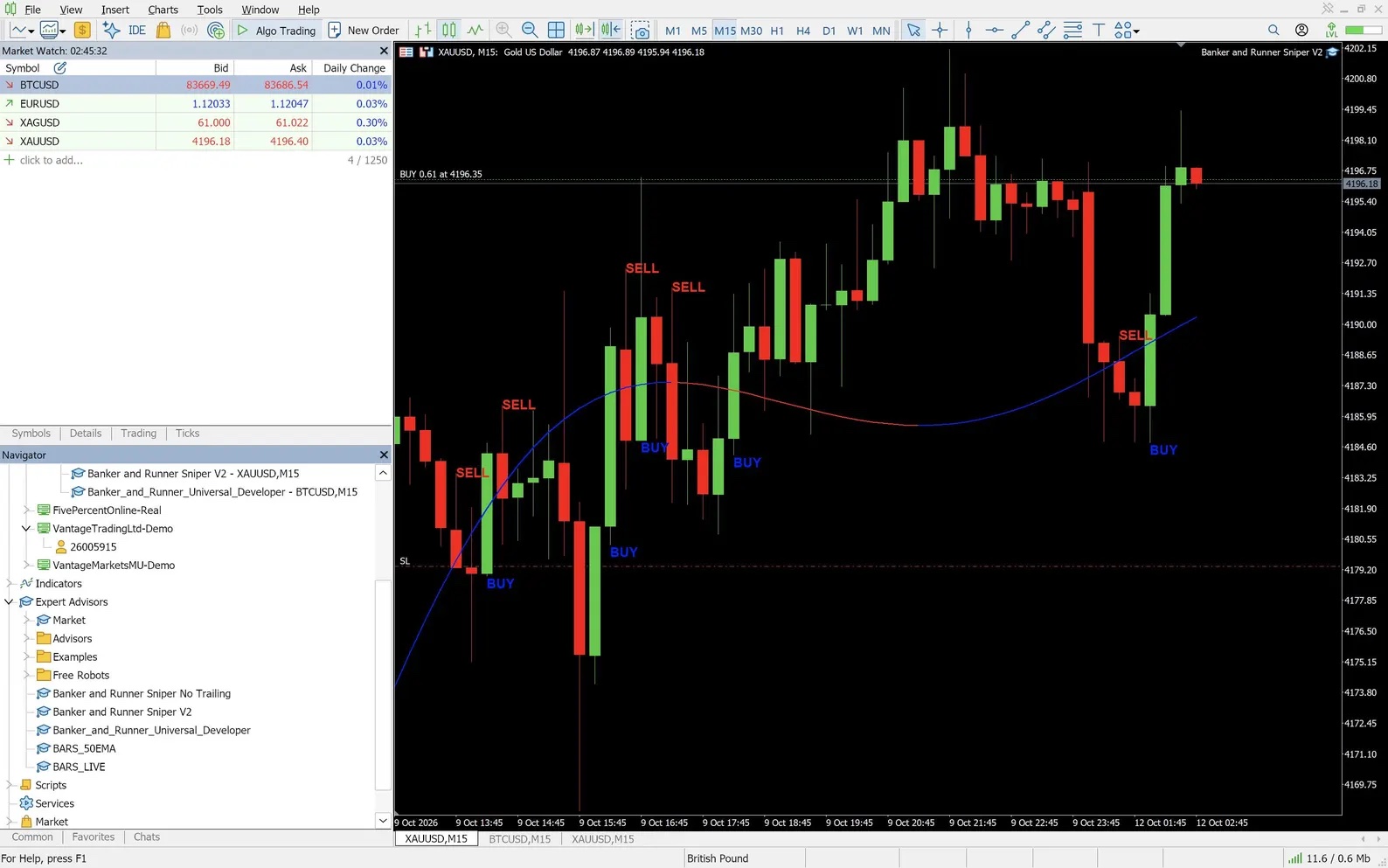
1. It looks for potential trading opportunities
The strategy can analyse market movements and price structure to identify conditions that may support a trading opportunity.
Depending on the version, its logic can include concepts such as liquidity sweeps, breaks in market structure, directional filters and other entry conditions.
A liquidity sweep, in simple terms, occurs when price moves through an area where traders may have placed stop orders before moving back in another direction.
A break of structure occurs when price moves beyond a relevant previous high or low, potentially signalling a change in short-term market behaviour.
These concepts do not predict the future with certainty. They are ways of interpreting price behaviour and defining conditions for a strategy.
2. It can execute trades automatically
When the programmed conditions are met, the Expert Advisor can place trades without requiring the trader to click manually on every entry.
That matters because manual trading can be demanding.
You might be working, sleeping, travelling or simply unable to watch a chart continuously.
Automation allows the system to apply its rules when the required conditions occur, provided that the platform, broker connection and trading environment are functioning correctly.
It does not mean the system will trade constantly. Sometimes the rules may produce no entry at all.
3. The Banker focuses on taking profits
The Banker component is designed to manage a portion of a successful position according to the relevant version's settings.
The intention is to realise part of a favourable move rather than relying entirely on the possibility of a much larger continuation.
The exact execution depends on the configuration of the particular EA. Traders should review the product's documentation and inputs to understand how their version handles position management.
4. The Runner gives a potential winner room to develop
After a portion of the trade is managed, the remaining position may stay open to pursue further movement.
If the market continues in the intended direction, the Runner may benefit from that continuation.
If the market reverses, the additional opportunity may not materialise. The Runner can give back unrealised gains or close at a loss depending on the position and its protection rules.
That is an important distinction: the Runner is an attempt to capture additional opportunity, not a guarantee of additional profit.
5. Risk management remains part of the design
A trading system needs more than entry signals.
It also needs rules governing the amount of risk taken, when positions are closed, how daily losses are handled and what happens when market conditions become unfavourable.
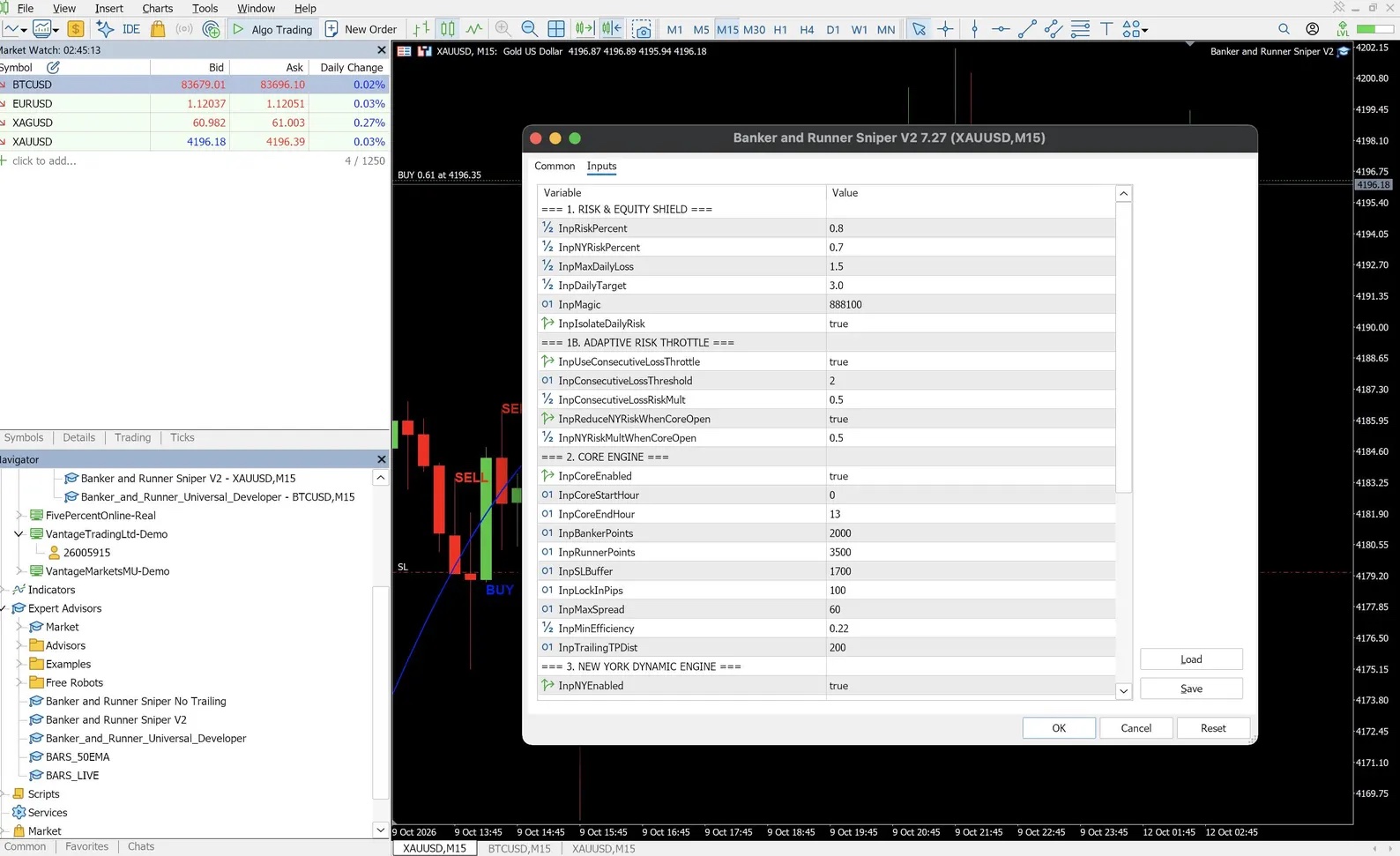
The Banker & Runner versions include risk-management features whose exact settings vary by product and configuration.
These can include stop-loss rules, position-risk settings, daily loss limits, trading targets and session restrictions.
The objective is to make risk a planned part of the strategy rather than an afterthought.
No stop loss, daily shield or other programmed control can eliminate all trading risk. Gaps, slippage, execution failures and broker conditions can affect actual outcomes.
Why I developed separate Gold and Bitcoin bots
Banker & Runner XAUUSD: The Gold engine
Gold is one of the markets that attracted me because of its price movements and the opportunities it can present during active trading sessions.
But those movements can also be unforgiving.
A gold strategy must contend with changing volatility, spread conditions, economic announcements and sudden reversals.
The Banker & Runner XAUUSD version was developed around a market-specific trading engine with defined entry conditions, risk settings and trade-management rules.
The version I have shared as my Gold baseline is Banker & Runner XAUUSD v7.27.
Its configured risk inputs include a standard risk setting of 0.80%, a separate New York risk setting of 0.70%, and a maximum daily loss input of 1.50%. Other inputs govern the trading sessions, entry filters and position management.
These are configuration settings, not a statement that every trade risks exactly those percentages in every situation. Actual exposure depends on how the EA calculates position size and how the broker executes the trade.
The key point is that the strategy is designed with defined controls rather than relying solely on discretionary decisions made under pressure.
Banker & Runner BTCUSD: The Bitcoin engine
Bitcoin presents a different challenge.
Its price can move sharply, volatility can change quickly, and a trading setup that works in one market environment may behave differently in another.
The BTCUSD version therefore has its own strategy logic and settings.
The version I have previously shared as my Bitcoin baseline is Banker & Runner BTCUSD v10.36.
Its reported configuration includes standard risk settings of 0.45%, a separate New York risk setting of 0.45%, a maximum daily loss input of 2.00% in that baseline, and a daily target input of 3.00%.
Settings may differ between the version advertised, the configuration supplied and subsequent updates. Always confirm the exact version and inputs before using the EA.
The Bitcoin engine is intended to apply its own rules to the BTCUSD market rather than simply copying the Gold configuration.
That distinction matters. A good automated system should be evaluated according to the market and conditions for which it was developed.
Risk management: The part of trading that cannot be ignored
One of the most important lessons I learned from my own trading experience is that finding a good entry is only part of the job.
A trader can identify an excellent opportunity and still lose money by risking too much.
A strategy can win several trades and then surrender its gains through a sequence of losses.
A profitable backtest can also conceal weaknesses if the developer looks only at the final balance and ignores drawdown.
That is why I believe risk management deserves serious attention.
Here are some of the principles behind the Banker & Runner approach.
Defined trade risk. Risk settings help determine how much exposure the strategy is intended to take. Higher risk may increase potential gains, but it can also increase losses.
Stop-loss rules. A stop loss is intended to limit the loss on a position. The actual execution price is not guaranteed, particularly in fast or discontinuous markets.
Daily loss controls. Daily limits are intended to restrict trading after specified loss conditions are reached. Traders should understand whether the relevant limit measures realised profit and loss, floating equity, or another calculation.
Daily trading targets. A target can restrict additional trading after a defined profit condition is reached. It does not guarantee that the target will be reached.
Session filters. Trading windows can help control when a strategy searches for opportunities. They do not guarantee that the selected session will be profitable.
Testing and monitoring. Settings should be evaluated against historical data and monitored under realistic conditions. Even a well-tested EA can encounter market behaviour it has not handled well before.
My motivation for developing Banker & Runner was not to create a machine that could never lose. That would be an unrealistic objective.
It was to develop a system that follows defined trading rules and incorporates risk controls into its operation.
The backtests: What the numbers show
After months of development, testing became a central part of the process.
I wanted to know more than whether a strategy could produce a large profit figure. I wanted to examine the relationship between gains and losses and understand how the system behaved during the test.
The following are historical results from the Strategy Tester reports I previously shared.
They are included to help readers understand the results being discussed, not to suggest that a live account will produce the same performance.
Gold: Banker & Runner XAUUSD

XAUUSD BACK TEST RESULT SHOWING FROM 2021 TO 2026
The reported Gold backtest showed the following metrics:
| Metric | Reported result |
|---|---|
| Net profit | $279,175.94 |
| Profit factor | 1.70 |
| Sharpe ratio | 3.22 |
| Recovery factor | 15.55 |
A profit factor of 1.70 means that the reported gross profit was approximately 1.70 times the gross loss during that test, subject to the tester's accounting and cost assumptions.
The Sharpe ratio is a measure of return relative to variability under a particular calculation method. The recovery factor relates profit to drawdown under the tester's definition.
These measures provide different perspectives on performance. None can establish that the strategy will remain profitable in the future.
Suggested image placement: Insert a genuine screenshot of the XAUUSD MT5 Strategy Tester report here. Include the test period, starting deposit, modelling method, trading costs, net profit, profit factor, drawdown and equity curve wherever available.
Bitcoin: Banker & Runner BTCUSD

BTCUSD BACK TEST RESULT SHOWING FROM 2021 TO 2026 with an account of $100,000
The reported BTCUSD backtest showed:
| Metric | Reported result |
|---|---|
| Net profit | $ 1,592,590.26 |
| Profit factor | 1.38 |
| Maximum drawdown | 6.01% |
| Recovery factor | 20.84 |
The BTCUSD test was reported with a $100,000 initial deposit.
The profit factor of 1.38 indicates that the tester recorded approximately $1.38 in gross profit for every $1 in gross loss, under the assumptions used in that report.
The reported maximum drawdown of 6.01% is particularly relevant because profit alone does not tell the whole story. However, readers should confirm whether the reported figure represents equity or balance drawdown and whether it is relative or absolute before comparing it with another test.
Suggested image placement: Insert the original BTCUSD Strategy Tester report and equity curve here. Make the test dates and drawdown figures readable.
What should a buyer take away from these results?
Not that the bots are guaranteed to make money.
The more useful takeaway is that the developer has been evaluating the systems using measurable performance criteria.
Before purchasing any automated trading product, I encourage traders to ask questions such as:
-
What period does the backtest cover?
-
What was the starting deposit?
-
Was the test based on realistic tick data?
-
Were spreads, commissions and swaps accounted for?
-
What was the maximum drawdown?
-
How many trades were taken?
-
How did the strategy behave during losing periods?
-
Do the settings match the version being sold?
-
Has the system been tested on a demo account under realistic conditions?
These are the questions that help distinguish serious evaluation from simply being impressed by a large profit number.
Past performance is not a reliable indicator of future results.
Why the development journey matters to me
When I look back at the beginning, I remember the frustration of manual trading and the feeling that I needed a better way to approach the markets.
I did not start with the intention of becoming a software developer.
I started because I wanted to solve a problem in my own trading life.
AI opened a door that I might otherwise have struggled to enter. It gave me a way to explore programming concepts, develop ideas and work through technical challenges that once seemed beyond my reach.
But AI was not a magic button.
It did not remove the need to understand the strategy, inspect the code, investigate errors or test the results.
There were versions that needed to be reconsidered. There were settings that required adjustment. There were moments when a result looked promising but needed further investigation.
The process forced me to think like a developer as well as a trader.
What is the system supposed to do?
Under what conditions should it trade?
What happens after a loss?
How does it manage a winner?
Does the backtest support the idea, or does the result suggest that something needs to change?
Those questions became part of the development process.
After roughly six to seven months of working through that journey, Banker & Runner became more than an idea. It became a collection of automated trading systems that I could continue to test, refine and make available to other traders.
I am proud of that journey not because it proves that I have discovered a perfect trading system, but because it shows what persistence, experimentation and a willingness to learn can make possible.
Who might Banker & Runner be suitable for?
Banker & Runner may be worth investigating if you:
-
Trade Gold or Bitcoin through MetaTrader 5 and want to explore rule-based automation.
-
Find it difficult to monitor the market throughout the day.
-
Want to understand how an EA manages entries and exits.
-
Prefer to evaluate a strategy using backtest metrics rather than relying only on marketing claims.
-
Are willing to learn how risk settings, broker conditions and execution affect automated trading.
It may not be appropriate for someone who expects guaranteed income, cannot afford trading losses, or intends to run an EA without understanding its settings.
An Expert Advisor is not a substitute for financial planning, and buying one does not remove the need for responsible decisions.
Before you buy: Five things I want every trader to understand
1. Start by understanding the product. Confirm whether you are buying the XAUUSD or BTCUSD version and check the supported broker, symbol, timeframe and account requirements.
2. Test before risking real money. Where a demo version or suitable trial arrangement is available, use it to understand how the EA behaves. Demo results can still differ from live execution.
3. Learn the risk settings. Do not increase risk simply because a backtest looks attractive. Understand the daily loss controls, stop-loss behaviour and the effect of running multiple strategies on one account.
4. Check the evidence. Review the original reports, including the test period and drawdown. Be cautious about screenshots that show profit without explaining the underlying assumptions.
5. Understand that losses remain possible. Automated trading can experience losing trades, losing streaks, slippage, technical failures and adverse market conditions. Only trade money you can afford to lose.
I would rather a customer understand what they are buying than purchase an EA based on unrealistic expectations.
Explore Banker & Runner
If the idea behind Banker & Runner interests you, you can explore the available products and choose the channel that suits you.
1. Visit the official shop
Start at the Banker & Runner website to explore the available offerings.
Official website and shop:
https://bankerandrunner.com/shop
2. Browse the Etsy store
If you prefer shopping through Etsy, visit the Banker & Runner shop and review the listings and product details.
Shop Banker & Runner on Etsy:
https://www.etsy.com/uk/shop/BankerandRunner?ref=shop-header-name&listing_id=4593464864&from_page=listing
3. Explore the Payhip product page
You can also visit the Payhip page to explore the available product offer.
Banker & Runner on Payhip:
https://payhip.com/b/XVSGv
Please read the listing carefully and confirm which EA version and terms are offered before purchasing.
4. Visit the MQL5 seller profile
For traders who use MetaTrader products, the MQL5 seller profile is another place to explore the developer's marketplace presence and available products.
MQL5 seller profile:
https://www.mql5.com/en/users/evans1_2/seller
5. Connect through the social and community links
Follow the available social channels, view promotional content and stay informed about updates through the central link page.
All social and website links:
https://linktr.ee/bankerandrunner
Join the Banker & Runner Telegram community:
https://t.me/+DTTXYm-y-3EzZWU8
The Telegram invitation is a place to connect with the community. Read the group information and verify any claims or offers before making a financial decision.
Watch the Banker & Runner promotional videos
Sometimes the easiest way to understand a trading product is to see it presented.
I have shared promotional content across social platforms to introduce the Banker & Runner concept and explain the products.
You can begin with the central link page:
Watch and follow Banker & Runner:
https://linktr.ee/bankerandrunner
For the TikTok promotional video, insert the direct URL to your best-performing video before publishing this article. The exact TikTok video URL was not included in the information available for this draft, so I do not want to send readers to an invented address.
I recommend placing the video link immediately below this paragraph in the published Medium article, with a clear caption such as:
Watch Banker & Runner in action — then join the community to learn more.
If the video demonstrates the actual EA, use authentic footage of the MetaTrader 5 interface, the relevant trading logic and genuine tester results. Avoid editing a demonstration in a way that makes historical or simulated performance appear to be a live profit guarantee.
The bigger lesson: You do not have to stop learning when you encounter a limitation
My journey began with trading losses and sleepless nights.
It continued through experiments, failed versions, technical challenges and months of development.
I did not know how to write code when I started. I had to learn through the process of building something I believed could address a real problem.
That experience changed how I approached trading technology.
It made me appreciate the importance of defined rules, repeatable processes, risk management and evidence.
Banker & Runner is the result of that journey so far. It represents an ongoing effort to build automated trading systems that bring together market analysis, programmed execution and a two-part approach to managing potential winners.
There is still no shortcut to understanding the markets. There is no software that removes uncertainty. And there is no backtest that can guarantee tomorrow's results.
But there is value in building, testing and evaluating a strategy with a clear purpose.
If you are curious about automated trading, Gold or Bitcoin, I invite you to explore the Banker & Runner products, examine the available information and decide whether the approach fits your needs and risk tolerance.
Explore the Banker & Runner shop:
https://bankerandrunner.com/shop
Browse the products on Etsy:
https://www.etsy.com/uk/shop/BankerandRunner?ref=shop-header-name&listing_id=4593464864&from_page=listing
View the Payhip offer:
https://payhip.com/b/XVSGv
Follow the community and social channels:
https://linktr.ee/bankerandrunner
Thank you for reading my story.
What began as an attempt to find a better way to trade became a six-to-seven-month journey into AI-assisted development, experimentation and automated trading.
I hope sharing that journey helps other traders ask better questions, manage their expectations and approach trading technology with curiosity and discipline.
Banker & Runner — Banker takes a piece. Runner pursues the opportunity. One strategy, two objectives.
Risk disclosure: Trading Gold, cryptocurrencies and leveraged financial products involves substantial risk and may result in the loss of some or all of your capital. Historical backtests are simulated and do not guarantee future performance. Results may differ materially in live trading due to market conditions, execution, spreads, commissions, slippage and other factors. The performance figures in this article are historical results supplied by the developer and have not been independently audited. This article is for informational and educational purposes only and is not personalised investment advice or a guarantee of returns.


