Market-Specific Engines: Why Different Markets Should Not Be Traded With the Same Logic

A trading system does not become diversified simply because it trades more instruments.
The deeper question is whether those instruments are being approached in a way that reflects how they actually behave.
That matters because financial markets are not interchangeable.
EURUSD, XAUUSD and WTI may all appear as price charts inside the same trading platform, but the forces behind those charts can be very different. Their volatility, liquidity, trading sessions, reactions to economic events and typical price behaviour can vary considerably.
For systematic trading, this creates an important design decision:
Should one strategy be applied everywhere, or should the trading logic adapt to the characteristics of each market?
The Axis 7even architecture was built around the second approach.
Rather than assuming that one universal model can describe every instrument equally well, the system uses dedicated strategy engines designed for the markets they monitor.
The objective is not complexity for its own sake.
It is to avoid forcing fundamentally different markets into the same behavioural assumptions.
A Chart Is Not the Market
At first glance, markets can look surprisingly similar.
Every chart contains price.
Every chart forms trends, ranges, breakouts, reversals and periods of higher or lower volatility.
This makes it tempting to build one strategy and simply run it across many symbols.
But the visual similarity of charts can hide important structural differences.
A movement of a certain size may be normal for one market and unusually large for another.
A breakout that is meaningful during one instrument's most liquid trading session may have a very different significance elsewhere.
A strategy that performs well when prices move smoothly may struggle in a market characterised by sharper intraday reversals.
The chart is therefore only the visible result.
Behind it are different market participants, different liquidity structures and different economic drivers.
A systematic trading engine needs to account for that reality.
Currency Pairs Are Not All the Same
Even within the foreign-exchange market, instruments can behave differently.
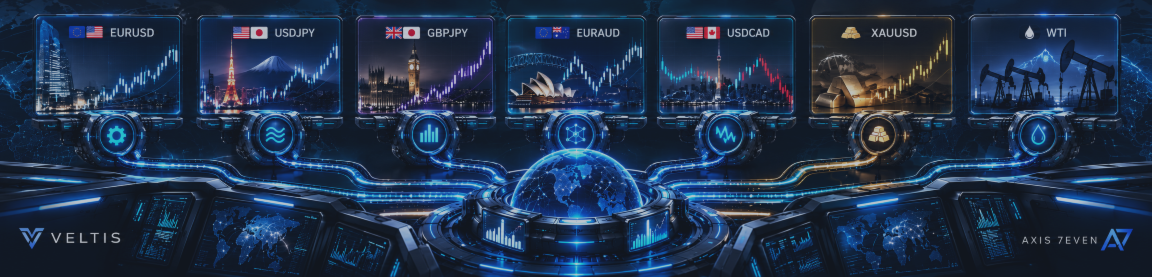
Consider several of the currency pairs used within the Axis 7even portfolio:
EURUSD is one of the world's most heavily traded currency pairs and is influenced by both European and US market activity.
USDJPY can respond differently to changes in interest-rate expectations, risk sentiment and the interaction between US and Japanese monetary conditions.
GBPJPY combines two currencies that can produce a very different volatility profile from EURUSD.
EURAUD introduces another relationship, connecting European and Australian economic influences.
USDCAD can also react to factors connected with the Canadian economy and broader commodity conditions.
All five are currency pairs.
But that does not make them identical markets.
Using one fixed interpretation of volatility, momentum or price structure across all of them can ignore those differences.
A market-specific engine can instead evaluate opportunities within the context for which it was designed.
Gold Introduces Another Behavioural Environment
XAUUSD adds another dimension.
Gold is not simply another currency pair with a different symbol name.
It can react strongly to changes in interest-rate expectations, inflation concerns, geopolitical uncertainty, risk sentiment and movements in the US dollar.
It can also move very quickly during periods of heightened uncertainty.
This creates a different environment for an automated trading system.
The same price behaviour that might be unusual in a major FX pair could represent normal activity in gold during a volatile session.
That does not mean gold is inherently easier or harder to trade.
It means the assumptions used to analyse it should reflect the market itself.
A dedicated engine allows those assumptions to remain specific rather than forcing gold into logic designed around another instrument.
WTI Adds Yet Another Market Structure
WTI introduces a different set of influences again.
Oil can react to global economic expectations, supply and demand, inventories, production decisions and geopolitical developments.
Its behaviour can therefore differ substantially from both currencies and precious metals.
This matters because diversification is not merely about putting several symbols on a screen.
It is about combining markets whose behaviour is not identical and allowing the trading system to respond appropriately to each of them.
A portfolio containing currencies, gold and oil can potentially provide broader opportunity.
But only if the system respects the fact that those markets do not behave in exactly the same way.
Why One Universal Strategy Can Become a Hidden Weakness
A single strategy running on many symbols can appear highly diversified.
Imagine that a model is deployed across seven markets.
At first glance, the system has seven different sources of trades.
But suppose every one of those instances depends on the same type of price behaviour.
For example, all seven may perform best when markets enter persistent directional phases.
If conditions become less directional across the broader market environment, several supposedly independent strategies can begin to struggle simultaneously.
The portfolio contains multiple symbols.
But underneath those symbols sits one behavioural dependency.
This is one of the reasons the number of markets alone tells us very little about the actual diversification of a trading system.
Different instruments are useful only when their differences are allowed to matter.
Dedicated Engines Do Not Mean Unrelated Systems
Market-specific design does not mean building a completely disconnected trading robot for every symbol.
There still needs to be a common architecture.
Inside Axis 7even, the individual engines operate within the same overall portfolio framework.
That allows two ideas to coexist:
specialisation at the market level
and
coordination at the portfolio level.
The engine can focus on the behaviour of its market.
The portfolio layer can focus on the combined effect of all engines.
This separation is important.
If every engine were completely independent, the system could lose control of total exposure.
If every engine were forced to behave identically, the benefits of market specialisation would disappear.
The architecture therefore needs both.
Different Engines Can React Differently at the Same Time
Another consequence of this design is that not every engine needs to reach the same conclusion simultaneously.
One market may provide conditions that satisfy its engine while another does not.
A third may be experiencing conditions that justify greater caution.
That is completely normal.
A multi-engine system should not require all of its markets to agree.
In fact, forcing them to agree would undermine one of the main reasons for separating the engines in the first place.
Axis 7even therefore allows the individual components to operate according to their own conditions while remaining subject to shared portfolio supervision.
This can result in periods where:
- several engines are active,
- only a small number are active,
- one engine is operating more cautiously than others,
- or no new trade is justified at all.
The system is not designed around constant activity.
It is designed around selective participation.
Specialisation Without Overfitting
There is also an important distinction between market-specific design and excessive optimisation.
A strategy should not become so finely tuned to historical data that it only works under one exact set of past conditions.
That would defeat the purpose.
The objective of market-specific engineering is not to memorize historical price behaviour.
It is to recognise meaningful differences between markets while still testing whether the resulting logic behaves consistently across time.
That is why validation becomes essential.
A dedicated engine should be evaluated across different market environments, different periods and, where appropriate, different execution environments.
Specialisation should improve relevance.
It should not become an excuse for curve fitting.
Why Validation Must Follow the Market
Different markets also create different testing challenges.
Trading costs vary.
Spread behaviour varies.
Volatility changes over time.
Broker symbol specifications can differ.
Execution conditions can influence results.
A robust development process therefore cannot stop after finding a profitable historical configuration.
The engine must also demonstrate that its behaviour remains coherent outside one narrow test window.
This is why Axis 7even development places significant emphasis on:
multi-period testing, broker comparison, execution robustness and portfolio-level validation.
The question is not merely:
Did this engine make money in one backtest?
The more useful question is:
Does the underlying behaviour remain stable enough to justify its place inside the portfolio?
The Portfolio Benefits From Difference
The real value of market-specific engines appears when they are viewed together.
If every component reacts to exactly the same conditions, the portfolio can become highly dependent on those conditions.
If the engines are built around different markets and different behavioural opportunities, their activity may naturally become less synchronized.
That does not guarantee lower drawdown.
It does not guarantee that one engine will always compensate for another.
And it does not remove the possibility of several markets moving unfavourably at the same time.
But it can reduce the system's dependence on one universal trading assumption.
That is a meaningful architectural advantage.
The Role of the Portfolio Layer
Specialised engines still need boundaries.
A good individual trading opportunity does not automatically mean the account should accept unlimited additional exposure.
For that reason, Axis 7even places the individual strategy engines under shared portfolio supervision.
Each engine can evaluate its own market.
But the overall system can still consider:
- combined exposure,
- current portfolio conditions,
- drawdown,
- risk state,
- available margin,
- and whether further activity should be restricted.
This is the connection between market specialisation and portfolio risk management.
The system does not ask only:
“What should this market do?”
It also asks:
“What does this trade mean for the portfolio?”
The Goal Is Not to Predict Every Market
Market-specific engines are not an attempt to perfectly predict the future behaviour of seven different instruments.
No trading system can do that reliably.
The purpose is more practical.
It is to avoid treating fundamentally different markets as if they were identical.
Each engine is given a defined responsibility.
Each market is evaluated according to the logic intended for it.
And all of those decisions are brought together under one portfolio framework.
That is the architecture behind Axis 7even.
Different Markets Deserve Different Questions
Perhaps the simplest way to describe the philosophy is this:
A professional trading system should not begin by asking:
“How can I make the same strategy trade every market?”
A better question is:
“What characteristics of this market matter, and what type of trading logic is appropriate for those characteristics?”
The answers do not need to be identical.
And in Axis 7even, they deliberately are not.
Different markets.
Dedicated engines.
Shared portfolio control.
Because diversification becomes more meaningful when the differences between markets are part of the design.