From Initial Risk to Protected Profit: Two Trade Illustrations with TradeGate Manager for MT5

The trade you planned is not always the trade that reaches the market.
You intended to trade one instrument, but the position opened on another. The spread was far higher than you expected. Price spiked just before execution. Your stop left too little room for the prevailing conditions. Or you clicked Buy when you intended to Sell.
Any one of these can undermine a carefully considered trading decision before the position has had a meaningful opportunity to develop.
I experienced the consequences personally. An intended GER40 sell became an XPTUSD position with approximately US$842 in spread cost, wiping out my accumulated profit and working capital. A later wrong-symbol execution brought another devastating spread cost of approximately US$781.


Those experiences changed the question I asked before trading:
What checks stand between my decision and the order being sent?
They also led to a second question. Once an intended trade is open, what rules reduce the original exposure as conditions improve—and protect profit as the movement develops?
These are the two connected problems behind Rehoboth TradeGate Manager for MT4 and MT5.
Before entry, its architecture follows:
SIGNAL → VALIDATION → ORDER
For orders submitted through its panel, TradeGate checks the configured execution conditions before sending the order.
After entry, PROGRESSIVE RISK REDUCTION AND PROFIT PROTECTION provides configurable rules for improving the protective stop: first reducing remaining downside where conditions permit, then protecting profit as the trade advances.
Your trading decision starts the trade. What manages the journey to its close?
You identify an opportunity, choose your direction and place an order.
Then the questions change.
How long should the original risk remain in place? When should the stop move closer? When does reducing a potential loss become protecting a potential profit? And when price retraces, how much of the favourable movement will you retain?
These questions are central to Rehoboth TradeGate Manager for MT4 and MT5.
To introduce the MT5 version, the examples below show that management process in action — from the initial exposure to the eventual exit. Let us start with GER40 sell trade, and I will walk you through from its initial exposure, through progressive stop adjustments, to its profitable stop-triggered close.
The starting point: a decision with defined exposure
On 8 September 2026, I opened a 1.00-lot GER40 sell at 25,908.55. The initial stop-distance setting was 1,500 platform points.
That initial stop defined the starting exposure. As the trade developed, TradeGate’s management rules progressively adjusted the stop.
The objective was straightforward: reduce the remaining downside when the configured conditions permitted, then protect profit as the trade advanced.
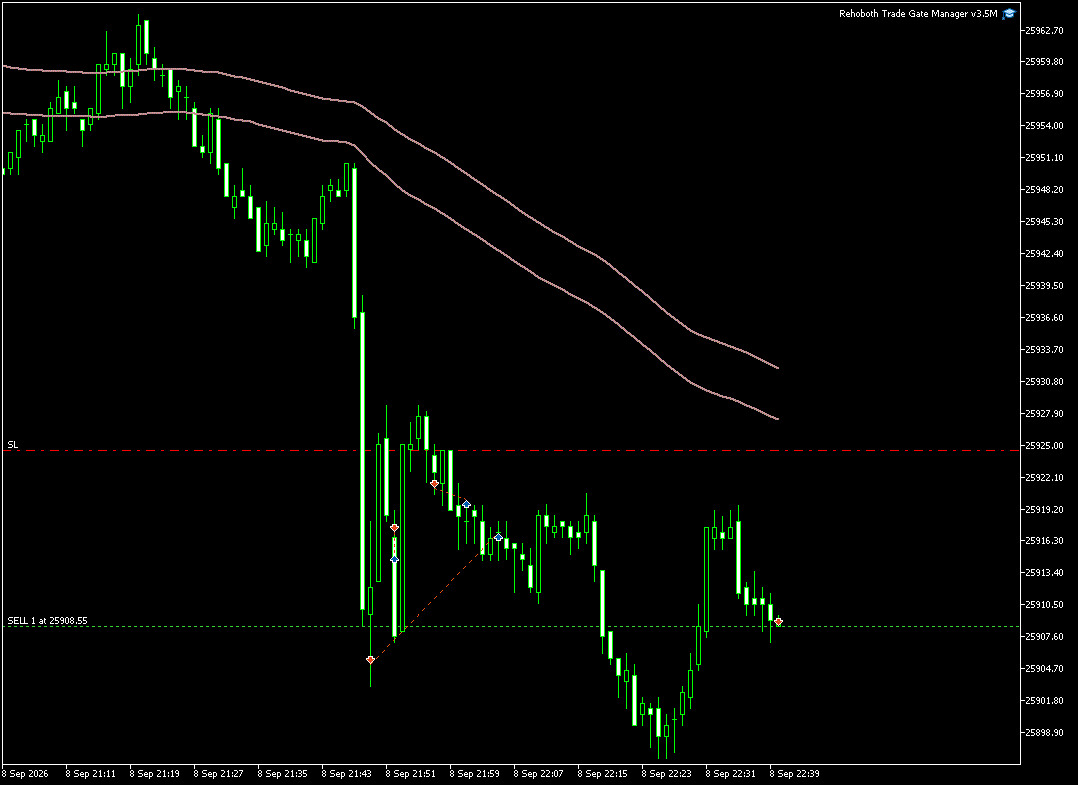
Order 106508411 accepted
Before the order: SIGNAL → VALIDATION → ORDER
TradeGate’s entry architecture follows this sequence:
SIGNAL → VALIDATION → ORDER
The trader supplies the decision. For orders submitted through its panel, TradeGate checks the configured execution conditions before sending the order.
Those checks include chart-symbol control, spread limits, stop validation, configurable candle-range filtering and optional trend validation. Two-click confirmation provides another opportunity to review the intended order.
The purpose is to make execution conditions part of the trading process.
But the gate is only the beginning.
After entry: PROGRESSIVE RISK REDUCTION AND PROFIT PROTECTION
This is an important part of TradeGate’s design—and one that deserves greater attention.
An improved stop does not necessarily protect a profit. It may first reduce the loss that would occur if the market reverses.
That distinction was visible in the early L1 and L2 adjustments in this GER40 example.
The stop moved in a more favourable direction, but remained on the loss side of entry. Those movements therefore represented risk reduction.
For a sell position, bringing the stop down towards entry reduces the remaining price distance at risk. Once the stop reaches entry, it represents price break-even. Moving it below entry places the stop on the profitable side.
The management journey can therefore be understood as:
INITIAL RISK → REDUCED RISK → BREAK-EVEN → PROFIT PROTECTION
These are descriptions of what the stop protects. The actual sequence depends on price movement and the configured settings.
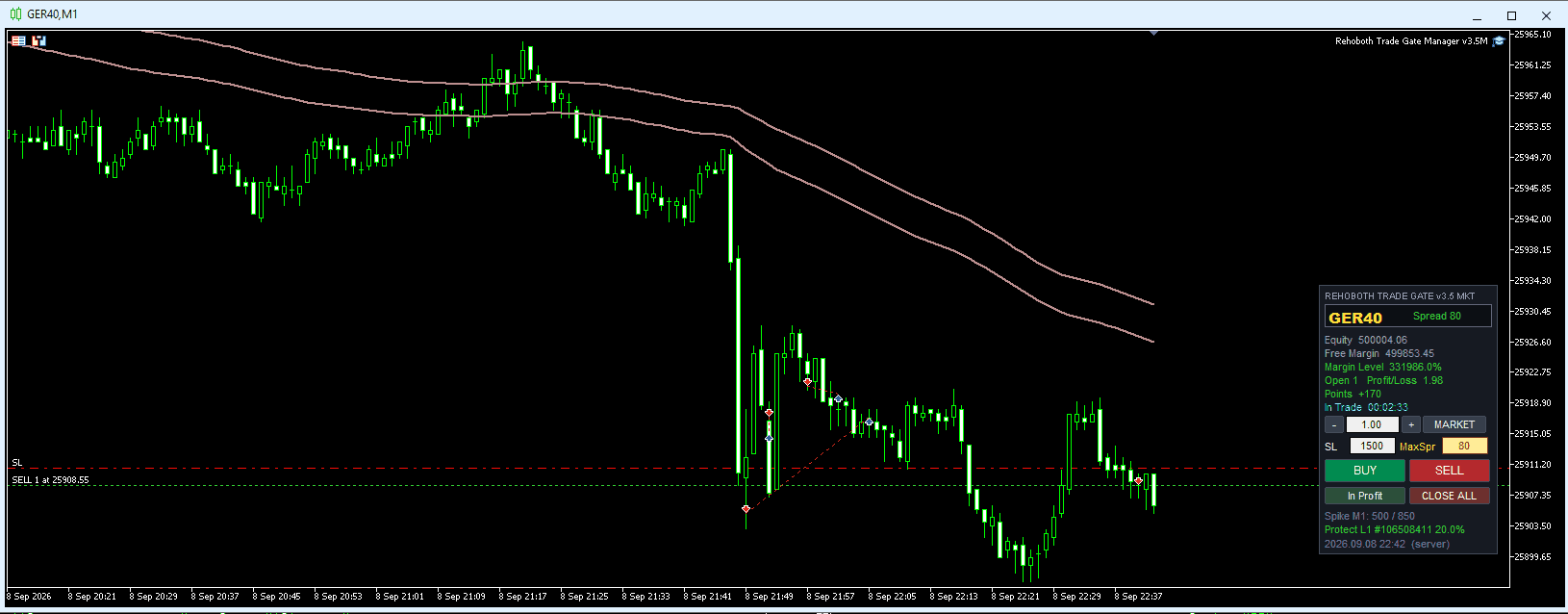
L1 Risk reduction: the adjusted stop remains on the loss side of entry but risk has been drastically reduced.
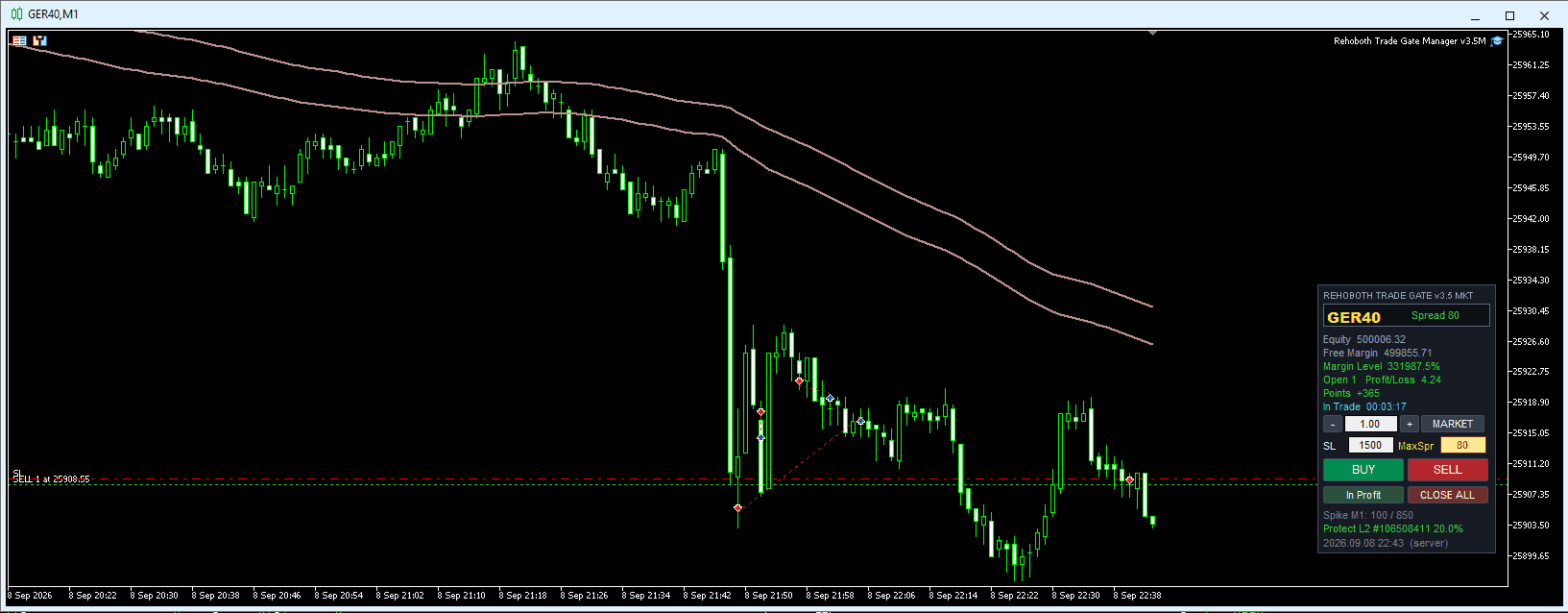
L2 Risk reduction: the adjusted stop still remains on the loss side of entry but with considerable reduced risk.
The historical screenshots above were captured before the reporting labels were updated. Captions explain whether each adjustment reduced risk or protected profit.
Protection can begin before the stop reaches break-even
This is the practical value of the early adjustments.
A position can recover from an adverse move, return to positive floating profit and qualify for a stop improvement—while that improved stop still allows a smaller loss.
TradeGate’s current ladder operates after floating profit becomes positive. It can then reduce the remaining exposure before the stop reaches entry.
That gives the trader an intermediate stage between retaining the full original stop distance and protecting break-even.
The updated reporting makes this distinction explicit:
🟠 Risk reduced: the stop has improved but remains on the loss side of entry.
⚪ Break-even: the stop is at entry price, before trading costs.
🟢 Profit protected: the stop is beyond entry on the profitable side.
As GER40 declined, the management task evolved
As the sell developed favourably, the focus shifted from reducing downside to protecting the gains already available.
The screenshots document successive management events as the position progressed. TradeGate’s configurable break-even steps and protection ladder provided rules for advancing the stop as qualifying conditions were met.
The feature retains its configurable 25-level structure. Its fuller name—PROGRESSIVE RISK REDUCTION AND PROFIT PROTECTION—describes the purpose of those adjustments more accurately.
Early adjustments may reduce potential loss. Later adjustments may protect progressively more profit.
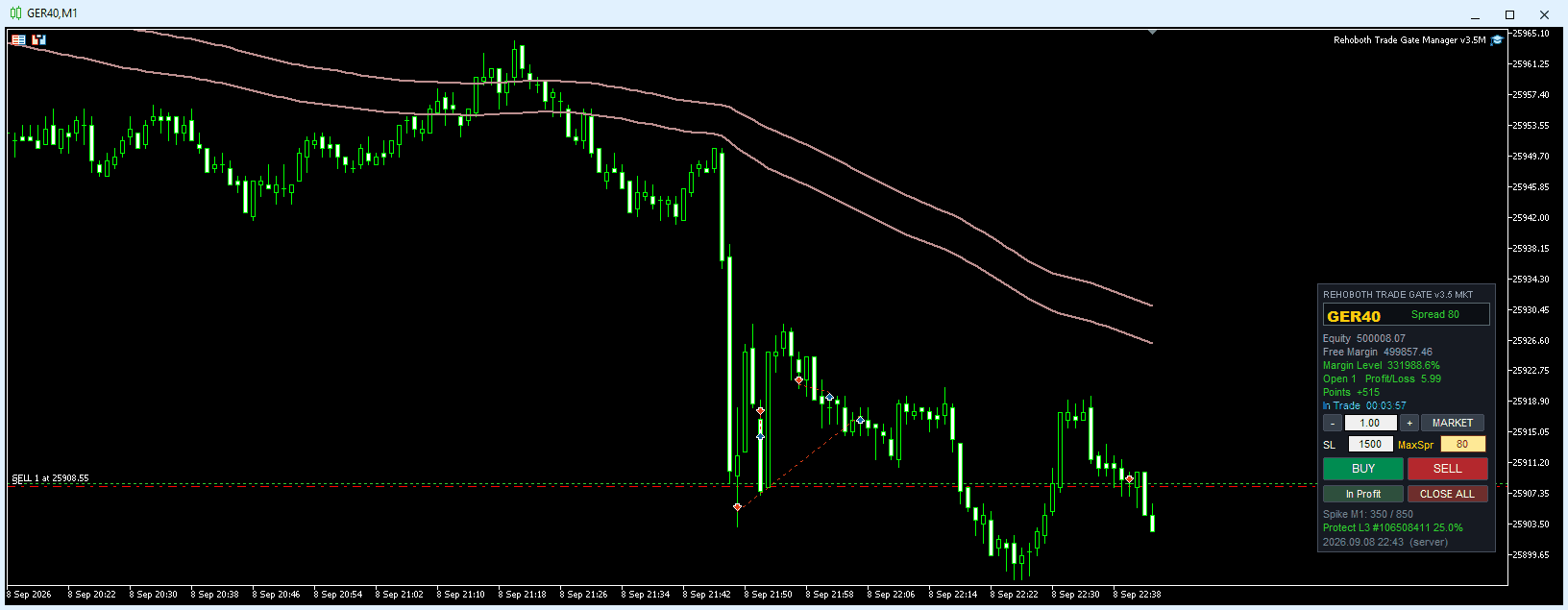
L3 25% of Profit Now Protected
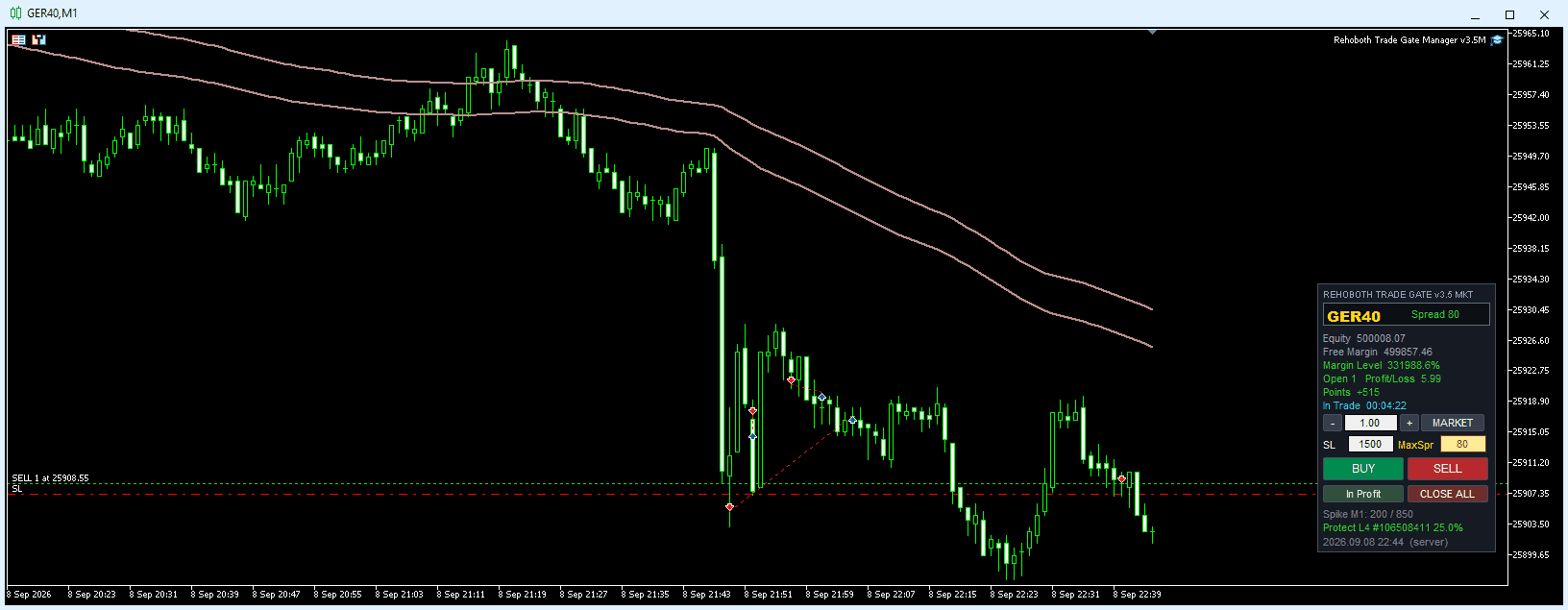
L3 25% of increased Profit Now Protected
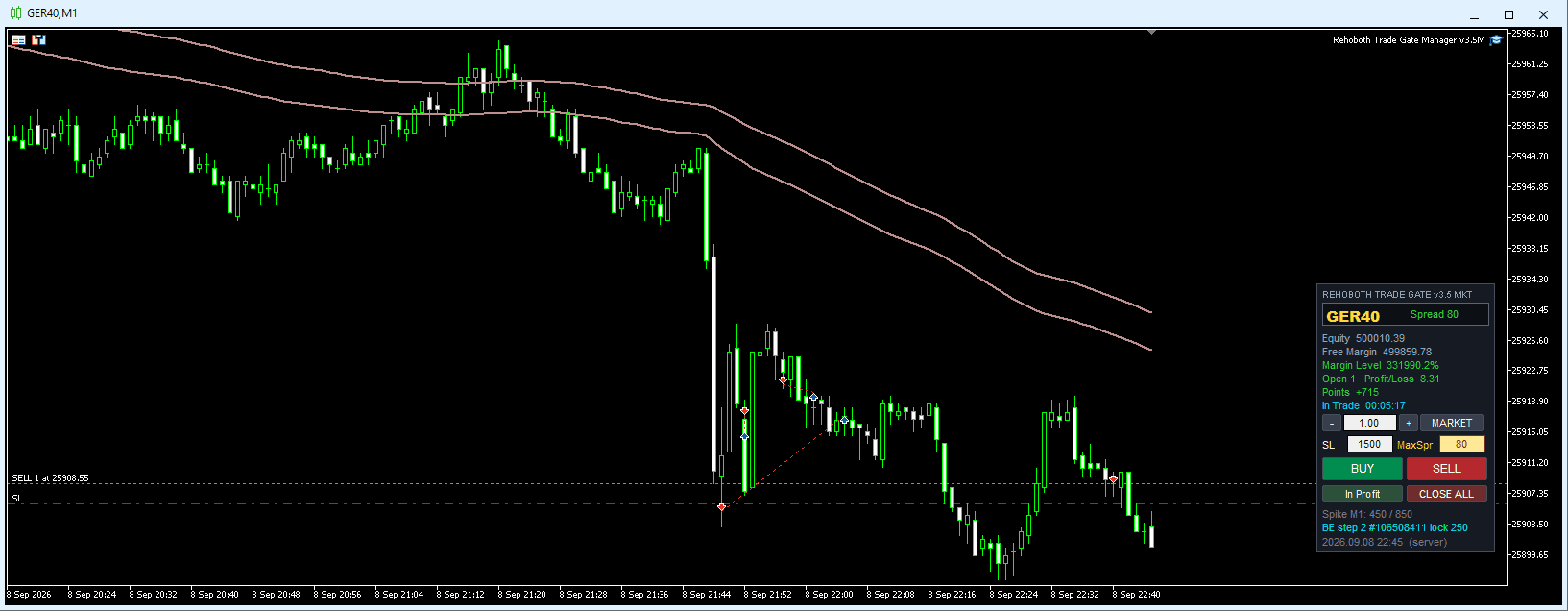
BE Step 2 Lock of 250 point profit
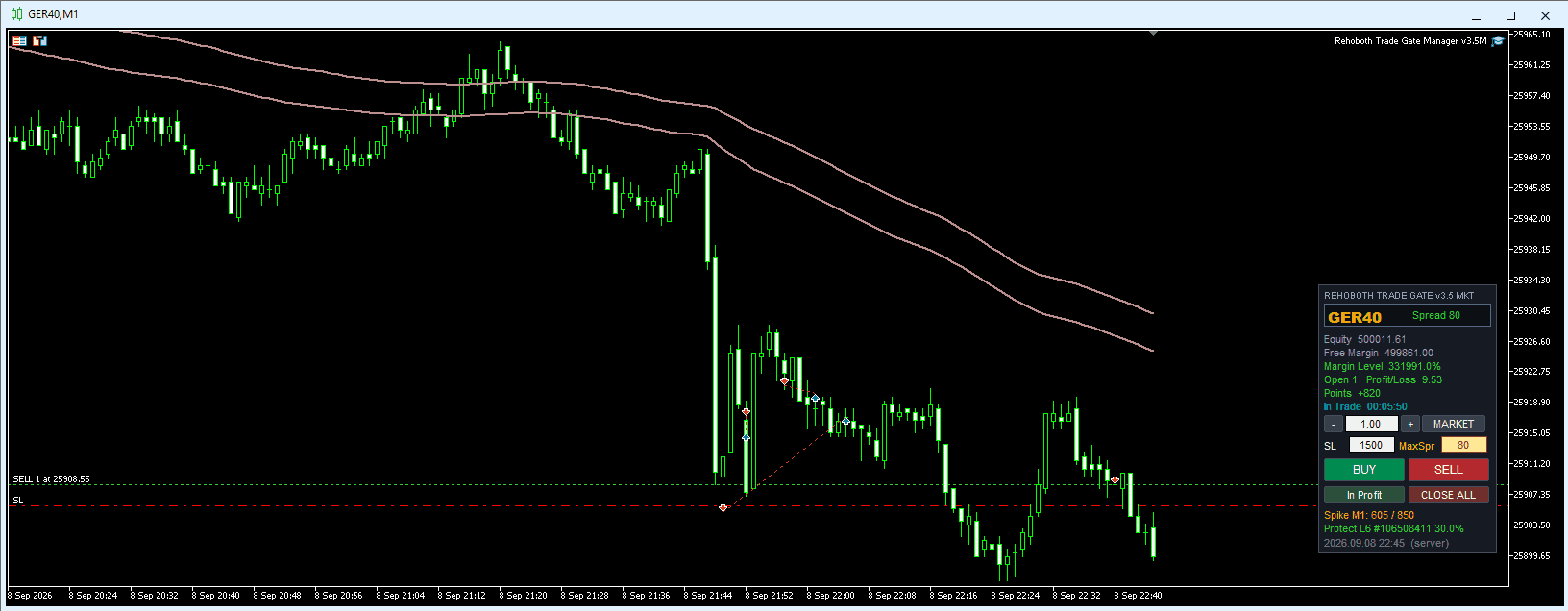
L6 30% of Profit Now Protected
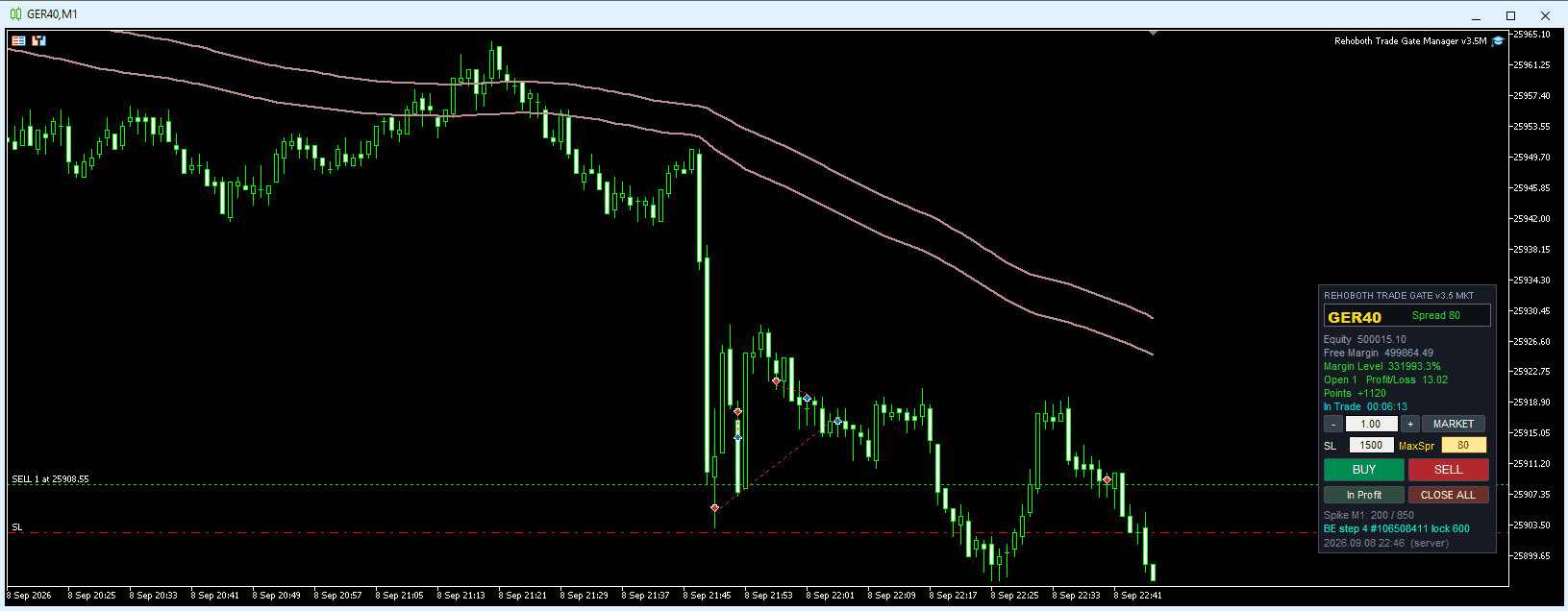
BE Step 4 Lock of 600 point profit
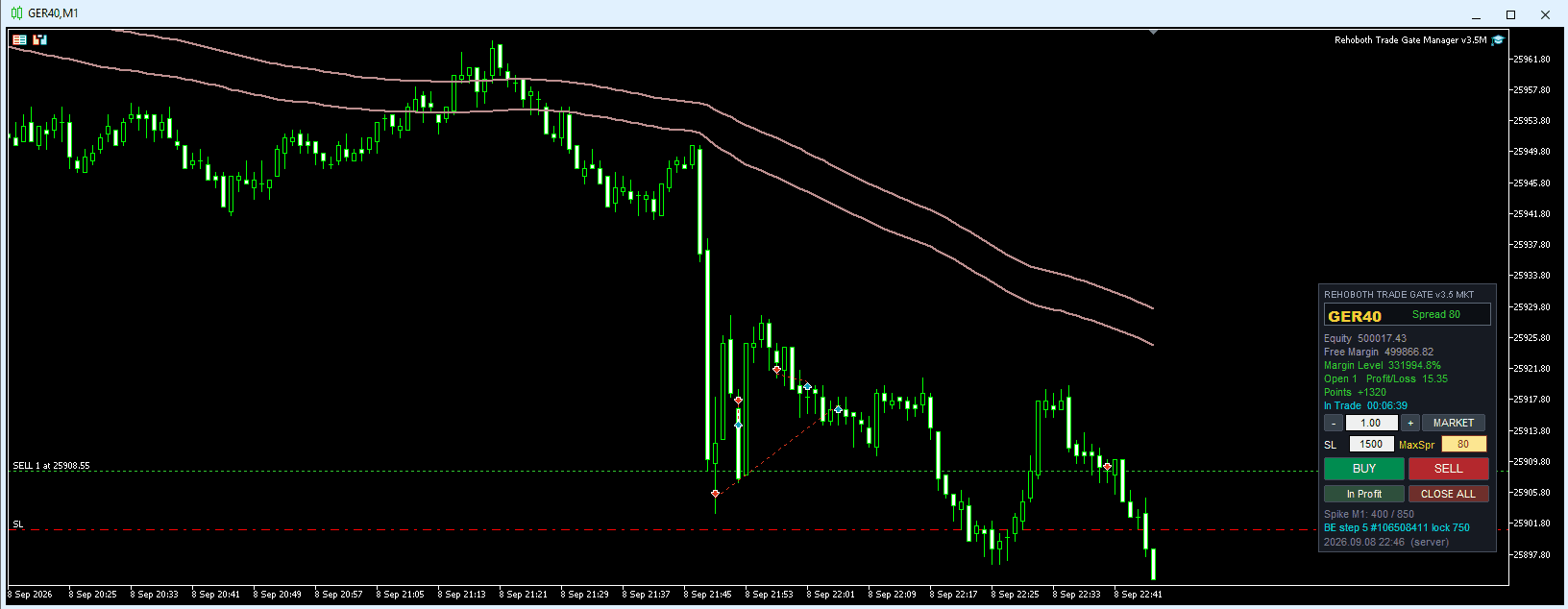
BE Step 5 Lock of 750 point profit
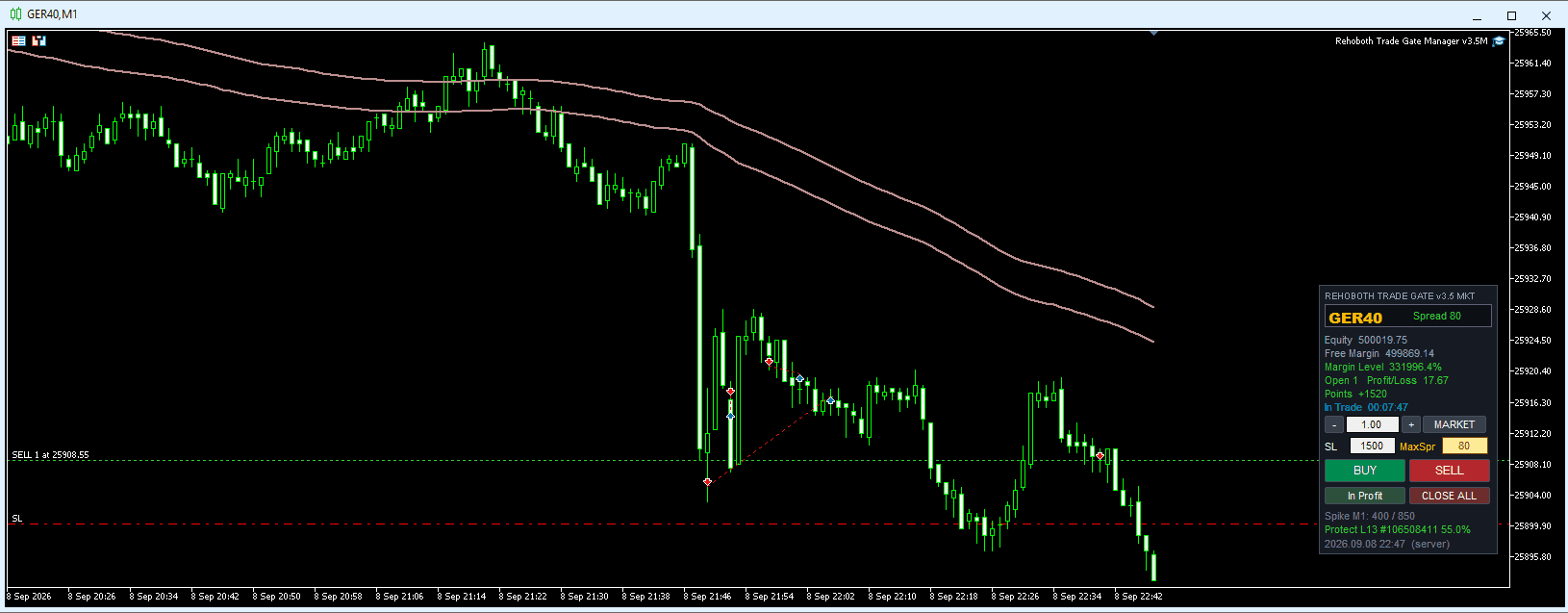
L13 55% of Profit Now Protected
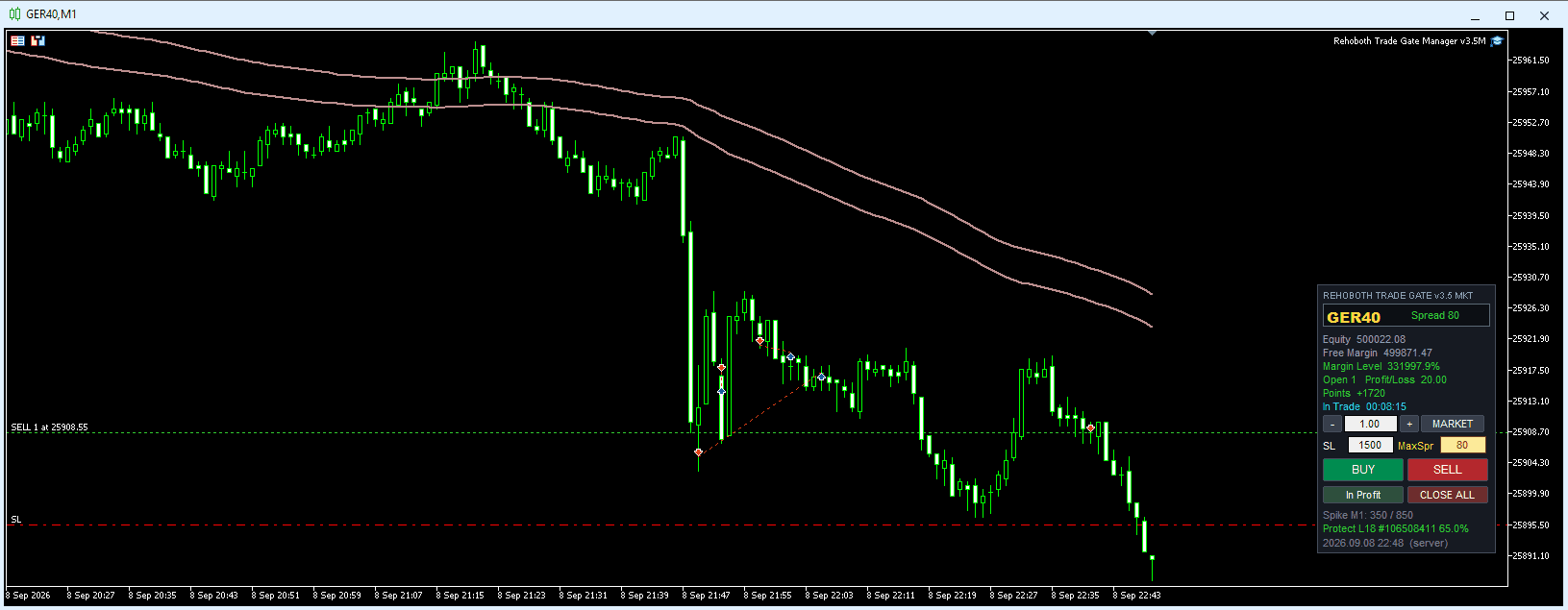
L18 65% of Profit Now Protected
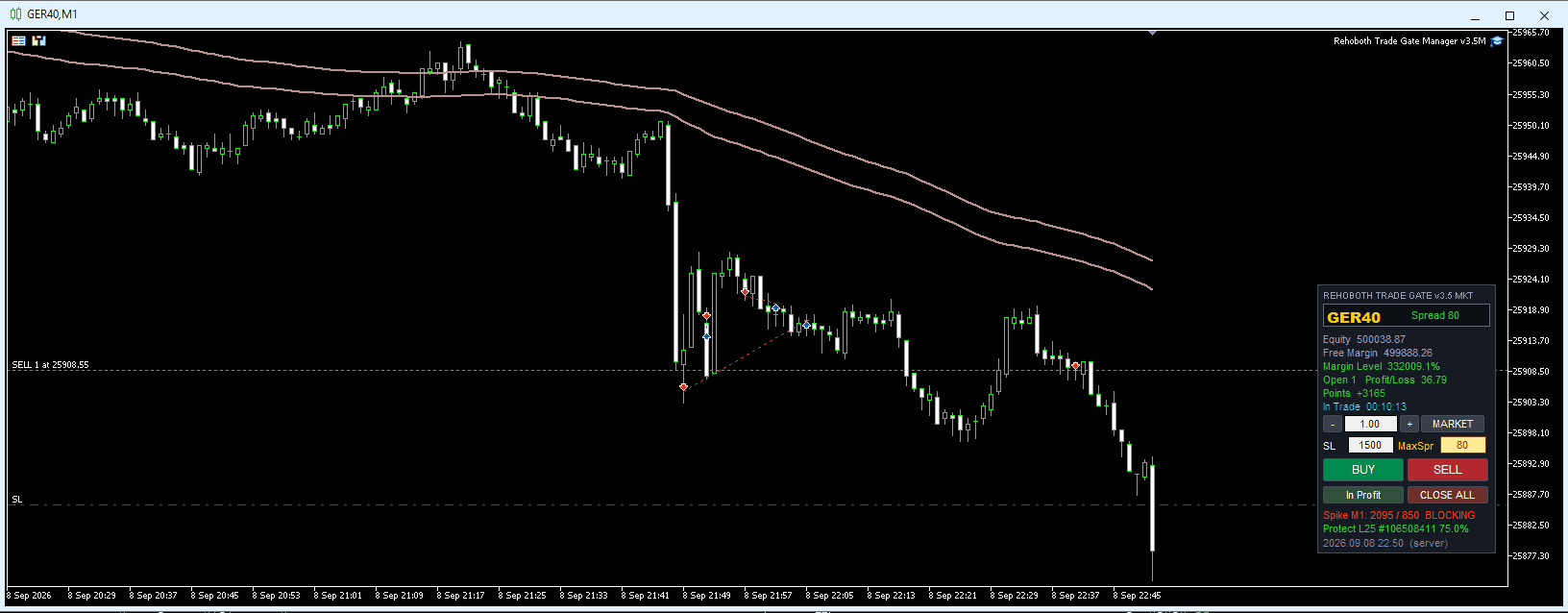
L25 75% of Profit Now Protected
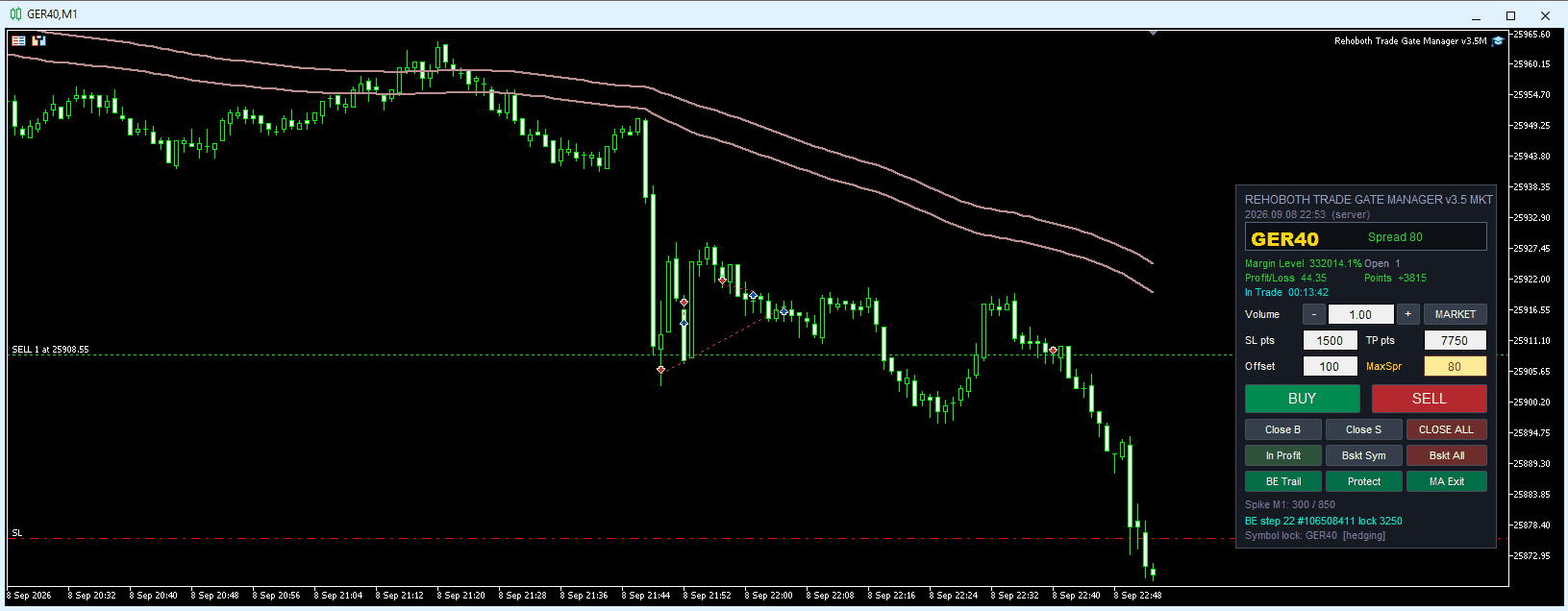
BE Step 22 Lock of 3250 point profit
The close: the protective stop completed its job
The GER40 sell eventually closed at 25,876.05, where its final adjusted stop was positioned.
The trade record shows:
- Direction: Sell
- Volume: 1.00 lot
- Entry: 25,908.55
- Exit: 25,876.05
- Opened: 22:40:01
- Closed: 22:56:53
- Duration: 16 minutes 52 seconds
- Price movement captured: 32.50 GER40 index points
- Recorded profit: US$37.78
The position closed through its protective stop before reaching its original take-profit level.
By then, the stop had moved from defining downside exposure to providing a profitable exit.
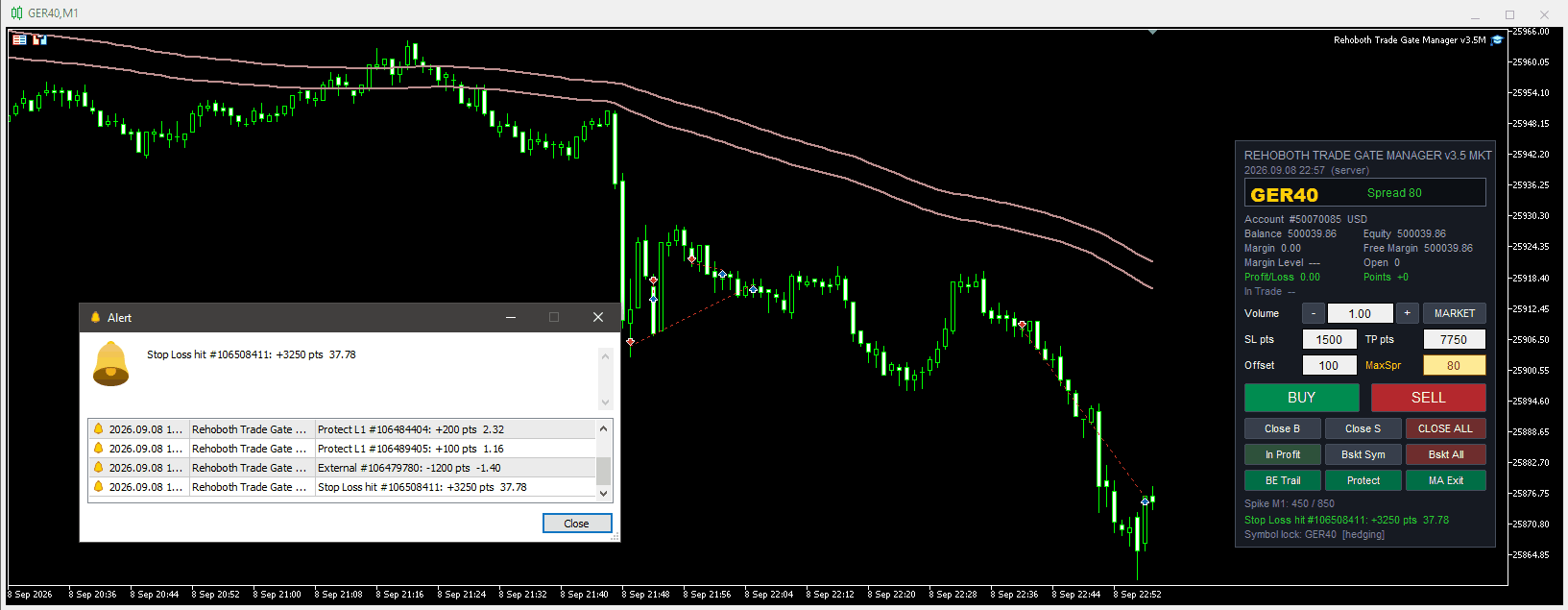
Stop Loss hit @ 3250 point profit
The same management principles apply to currencies.
The GER40 example shows TradeGate managing an index position. The same MT5 panel and management architecture also apply to currency trading.
In a separate USDJPY.pro sell trade, the position was opened at 153.753 and closed at 153.693 after the stop had progressed through several break-even and protection stages.
The position remained open for approximately 22 minutes and recorded a profit of US$39.04.
The accompanying screenshots show the sequence:
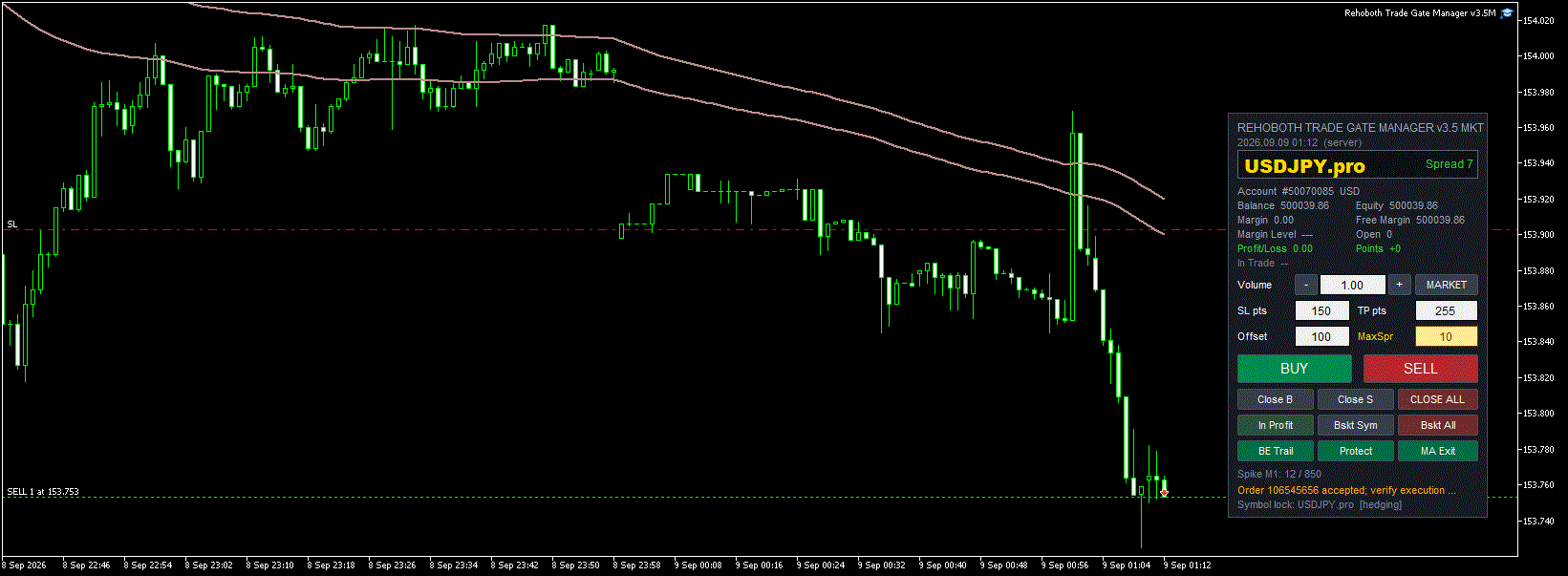
Order 106545656 accepted
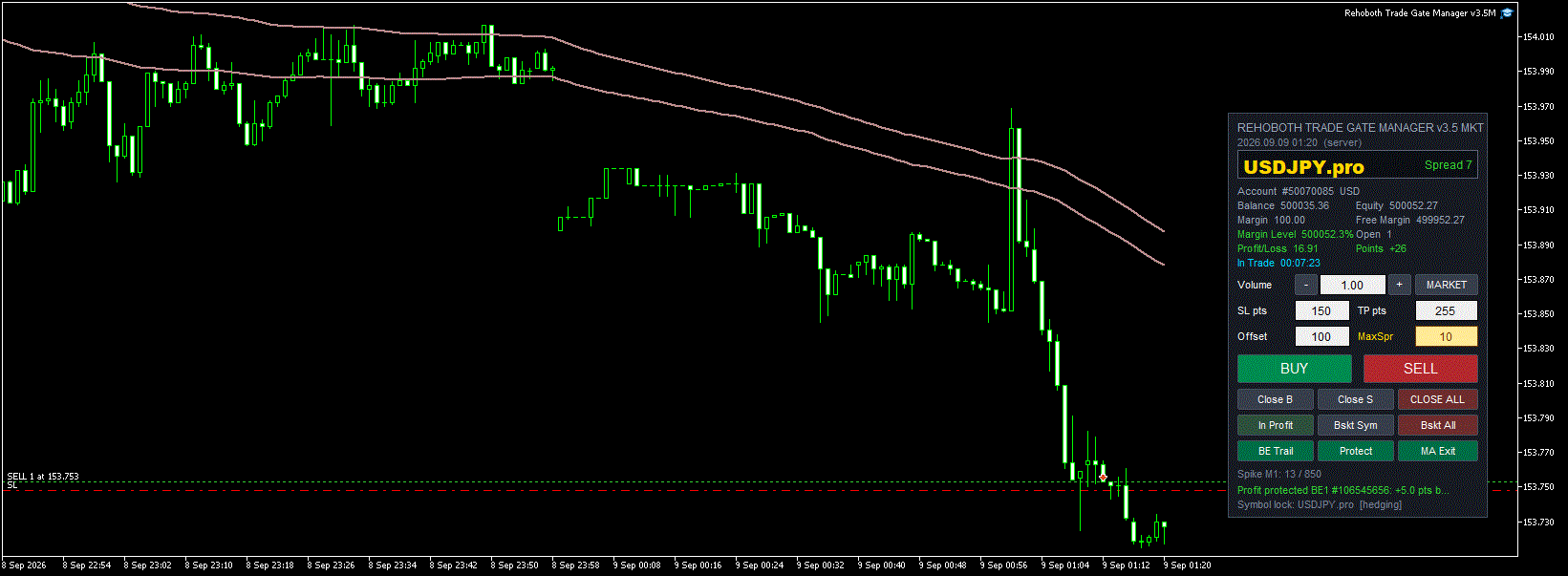
BE Step1 locked 5 point of 26 point profit
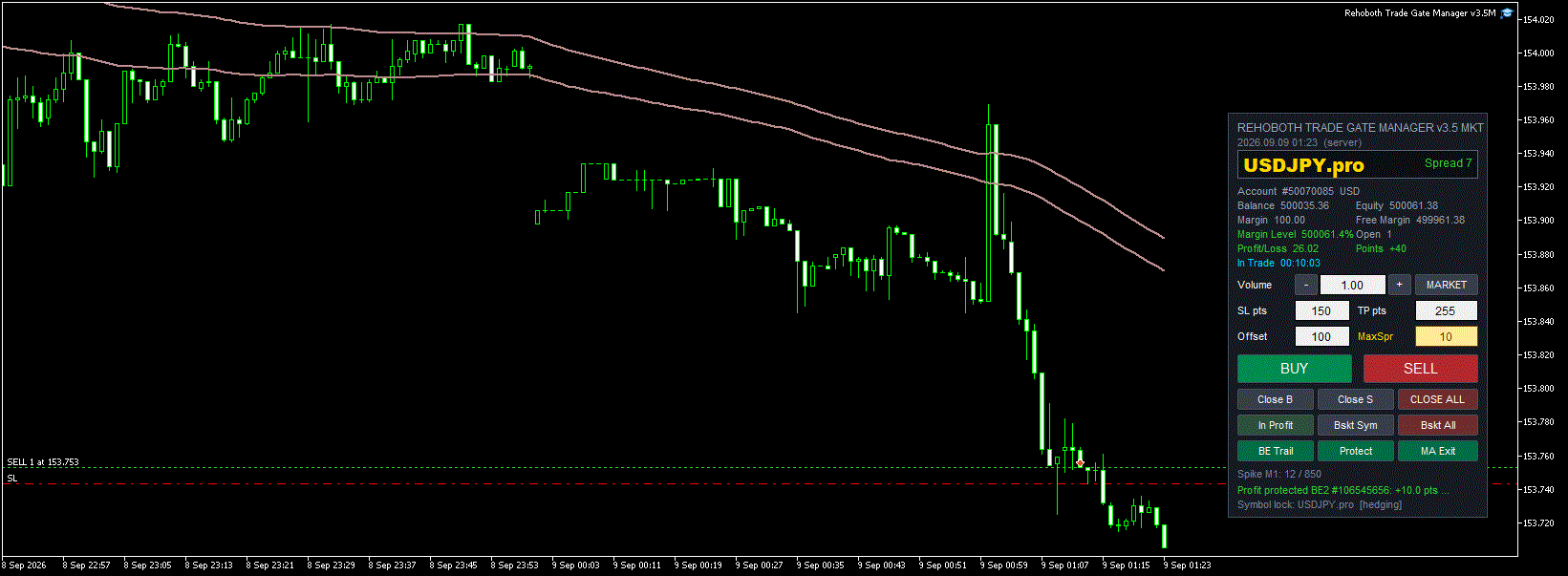
BE Step2 locked 10 point of 40 point profit
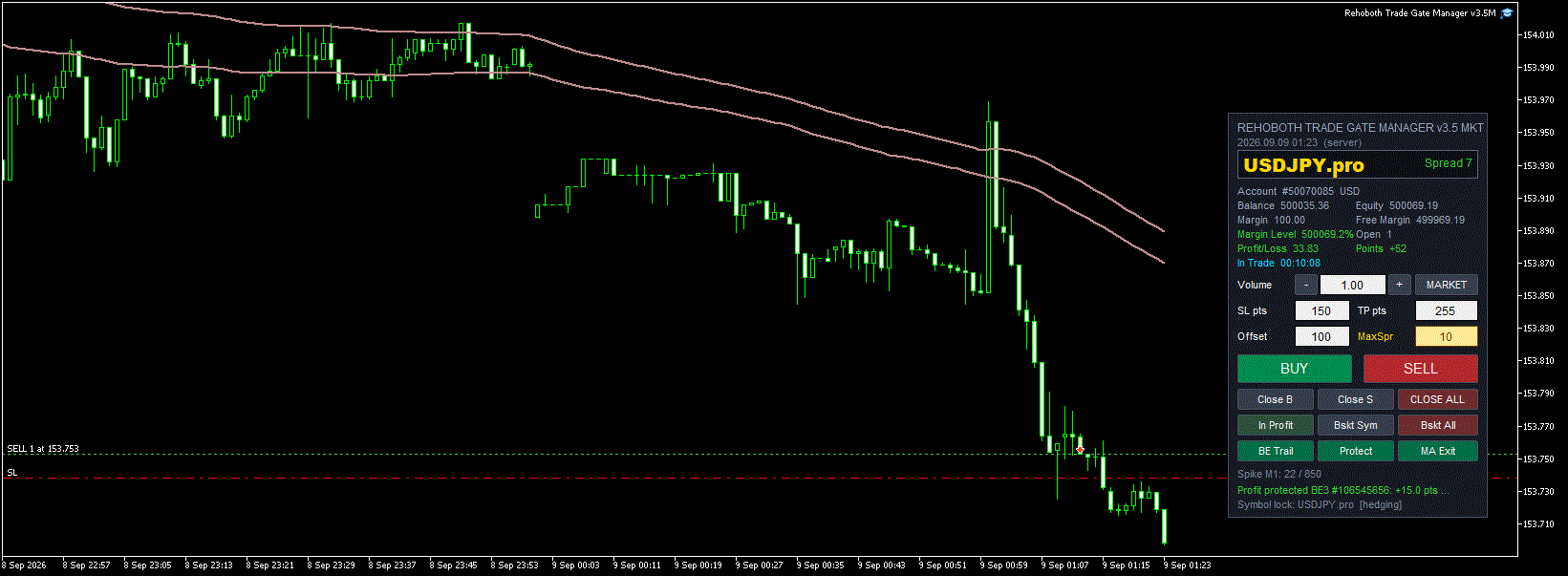
BE Step3 locked 15 point of 52 point profit
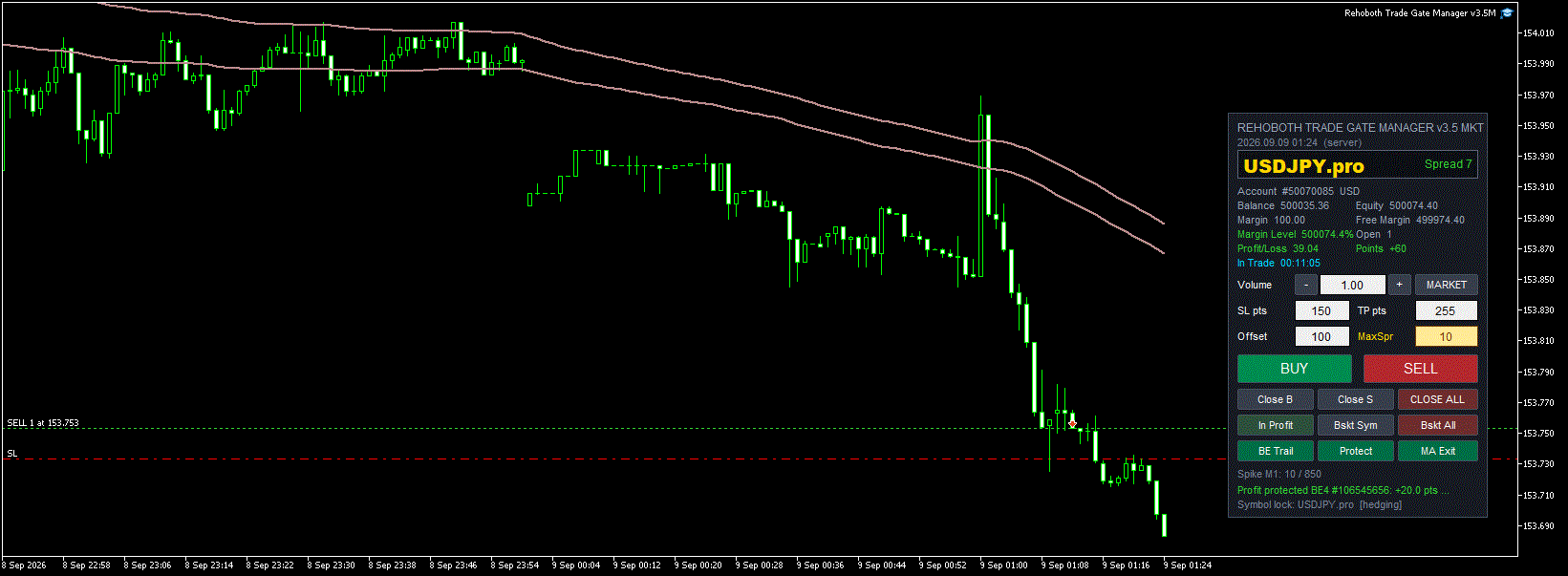
BE Step4 locked 20 point of 60 point profit
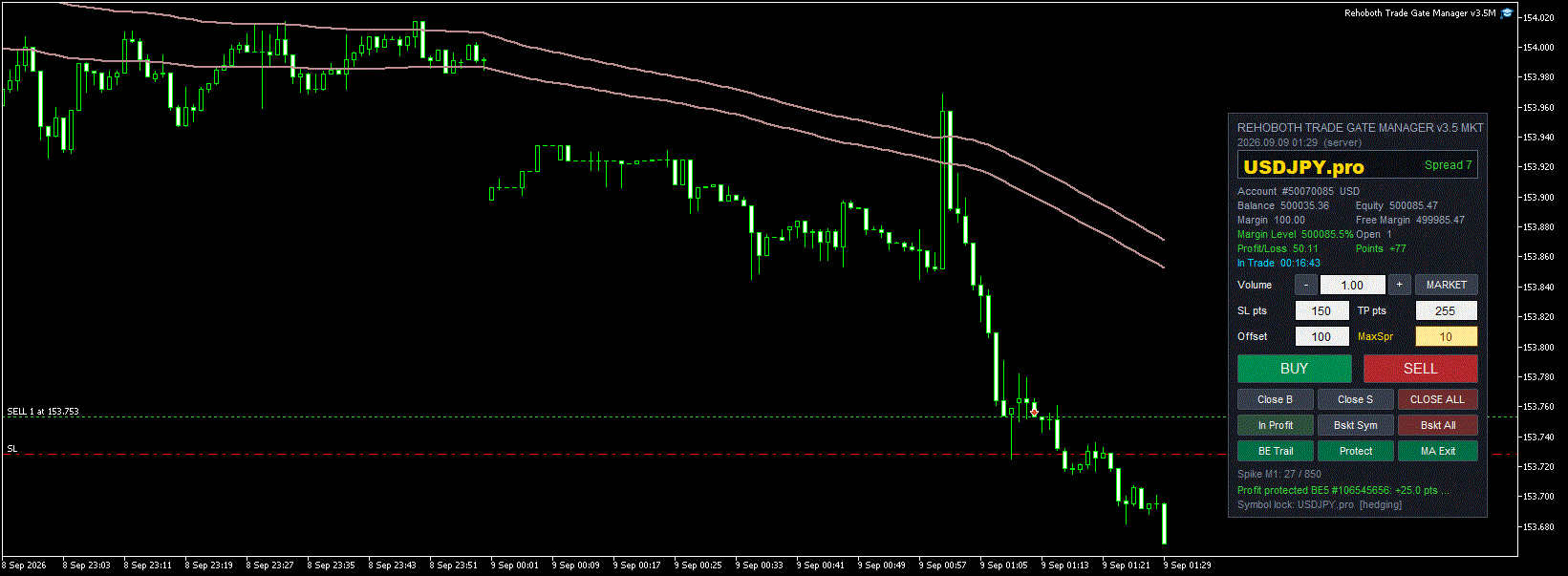
BE Step5 locked 25 point of 77 point profit
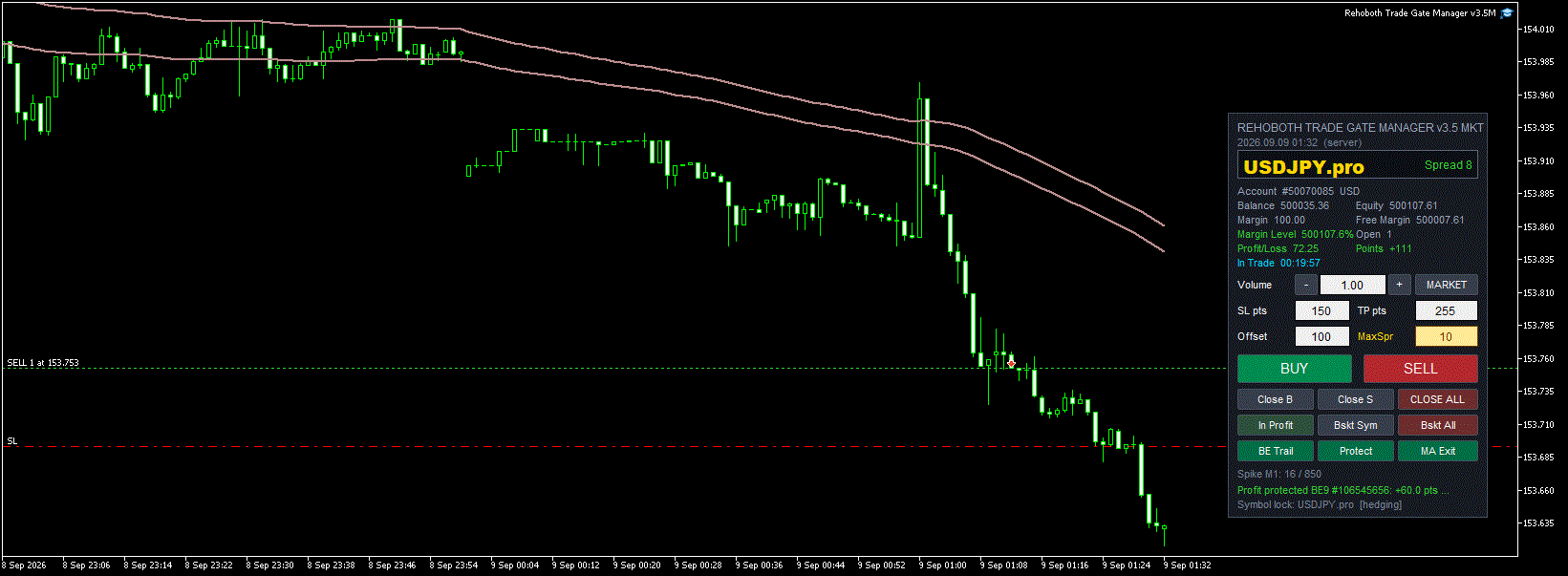
BE Step9 locked 60 point of 111 point profit
The history shows:
- Symbol: USDJPY.pro
- Direction: Sell
- Volume: 1.00 lot
- Entry: 153.753
- Final protected exit: 153.693
- Opened: 01:12:57
- Closed: 01:34:57
- Duration: 22 minutes
- Recorded profit: US$39.04
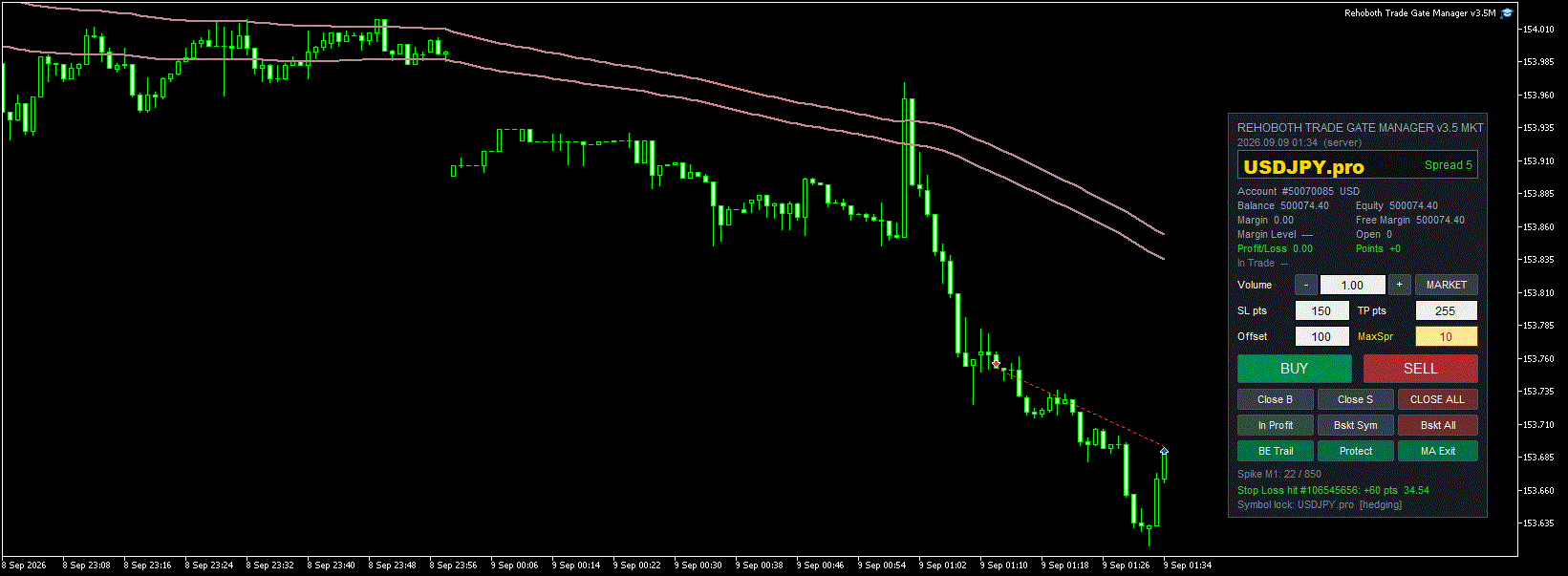
Stop loss hit at 60 point profit on price retracement
SELL ENTRY → BE1 → BE2 → BE3 → BE4 → BE9 → STOP-LOSS HIT
As the trade moved favourably, TradeGate advanced the protective stop through successive stages. The position was eventually closed when the adjusted stop was reached.
This example matters because TradeGate is not designed only for GER40 or other indices. Its purpose is broader: to apply a trader’s configured execution and position-management rules across supported MT5 instruments, including currency pairs.
The market instrument changes. The management principle remains the same:
SIGNAL → VALIDATION → ORDER → PROGRESSIVE RISK REDUCTION AND PROFIT PROTECTION → EXIT
What this trade illustrates
The value of this example lies in the management sequence.
A trading decision became an order. The position began with defined exposure. Early stop improvements reduced the remaining downside. Further favourable movement allowed profit protection. The final stop then provided the exit.
TradeGate did not create the market movement or choose the sell direction. It applied the configured execution and management rules around the trade.
That is the role I designed it to perform for traders who make their own trading decisions.
Whether the instrument is GER40, USDJPY or another supported market, TradeGate provides a structured checkpoint before the order and a configurable management process after the position is opened.
Introducing Rehoboth TradeGate Manager for MT5
TradeGate brings together:
- Pre-entry validation for orders placed through its panel.
- Progressive risk reduction when qualifying stop adjustments still leave exposure on the loss side of entry.
- Configurable break-even management as the position develops.
- Progressive profit protection through its configurable protection levels.
- Retracement and profit-spike protection tools for managing favourable movement.
- Clear reporting that distinguishes risk reduction, break-even and profit protection.
You decide when and what to trade. TradeGate helps turn your execution and position-management rules into a repeatable process.
Give your order a checkpoint—and your open trade a management plan.
Rehoboth TradeGate Manager for MT5 is now available on MQL Market.
These case studies illustrate two trades and its configured management settings. It does not establish expected returns. Stops remain subject to execution conditions; entry-price break-even excludes costs, and trading involves risk.
Previous posts in this series:
- The Trade That Was Never Going to Work
- Your Stop Loss Has Three Enemies, Not One
- The Trade Was Right, But the Order Execution Was Disastrous
- Five Reasons Your Next Order Should Be Blocked
- From Initial Risk to Protected Profit: Two Trade Illustrations with TradeGate Manager for MT5 (current article)
- Small Profits, Stronger Protection: What a 14-Day Trading Record Can Teach Us