
A trading signal can be correct and the resulting order still be one that was never capable of working.
In my first post, I described an unexpected trade that should never have happened.
In the second post, we looked at one of the less obvious problems that can affect an otherwise valid trade: the relationship between spread, stop distance and broker requirements.
There is a bigger lesson behind both.
A good trading signal does not automatically make a good order.
The Signal Can Be Right
Suppose your system identifies:
- Strong momentum
- Valid trend
- Correct currency pair or instrument
- Entry signal confirmed
Everything says:
- TAKE THE TRADE
But before the order is executed, something else can go wrong.
- The symbol may not be the one intended.
- The spread may suddenly be excessive.
- The stop may not provide adequate protection.
- Price may be moving abnormally fast.
- The conditions that generated the signal may already have changed.
I Learnt This The Most Expensive Way
This isn't a theoretical problem for me.
I have now experienced the wrong-symbol execution problem five times, and abnormal spread twice.
The first incident: Intended Instrument: GER40 | Executed: XPTUSD | resulted in a loss of $846.50 (because the spread was $842)

The second incident closed in profit: Intended Currency: AUDUSD | Executed: GBPUSD
The third incident closed in a minor loss of $0.25 because the spread was not outrageous: Intended: GER40 | Executed: US2000
The fourth incident closed in profit: Intended: GER40 | Executed: US500
The fifth incident resulted in a loss of $785.50 (because the spread was $781): Intended: GER40 | Executed: XPTUSD

That's approximately $1,632.25 lost across five unintended trades, three of them losing and two of them closed in profit.
Look at the timestamps. Opened and closed in the same second.
Not a fast loss. A trade that was already over when it opened — the stop sitting inside the spread, waiting for the first tick to reach it. Wrong symbol, outrageous spread, and nothing the market did next was going to matter.
These incidents establish that the failure is real and repeatable.
Ten Days of Disciplined Trading. One Fatal Execution Error.
Ten trading days. The account went from $284.63 to $899.64.
Then a single unintended order removed $846.50 in a matter of seconds.
That figure is larger than everything the ten days had earned. It took the gains and part of the original capital with it.
Seventy-one closed trades over those ten days. Average profit per trade, nine dollars. Average duration, fourteen minutes. This was not one fortunate position — it was a lot of small, patient work, accumulated.
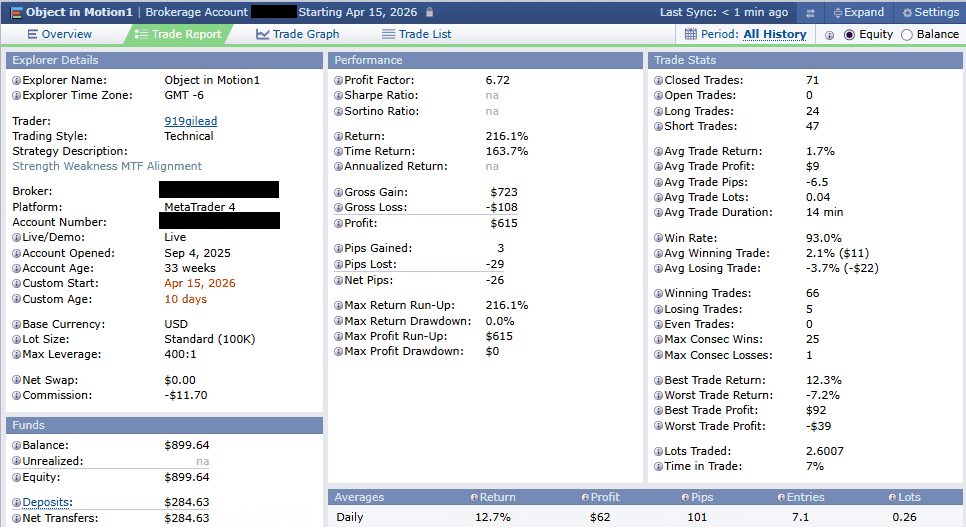
The account as it stood immediately before the incident. The loss described above is not reflected in these figures.
The point is not that profitable trading should never see losses. Losses are part of trading, and five of those seventy-one trades lost money.
The point is that this was not a normal trading loss.
A normal loss is one the market handed you: the trade was viable, the analysis was wrong or the timing was poor, and you paid for it. That is the cost of participating.
This was different. The order was executed on an instrument I had not selected, at a spread that made the stop meaningless. There was no market outcome that could have rescued it. It was not a trade that lost — it was a trade that was never capable of winning.
A trader can spend ten days developing an edge, managing risk and patiently building an account, and still have that work undone by an order that should never have been sent.
$615.01 earned over ten days. $846.50 lost in seconds.
That is why execution control belongs inside risk management rather than after it.
I do not know how common this is. What I know is that it happened to me five times in four months, and I had no mechanism for noticing until the damage had been done.
These incidents changed the way I think about trading-system design.
The Missing Step
Most trading systems are built around:
SIGNAL → ORDER
I believe there should be another step:
SIGNAL → VALIDATION → ORDER
The strategy determines whether an opportunity exists.
The validation layer asks whether the actual order meets the rules before it is allowed to proceed.
For example:
- Correct symbol?
- Acceptable spread?
- Adequate protection?
- Normal price conditions?
- Signal still valid?
If everything passes:
- ORDER ALLOWED
If one critical condition fails:
- ORDER BLOCKED
This doesn't make a trading system perfect.
It simply prevents certain known and definable execution problems from becoming trades.
And that distinction matters.
A trading strategy tells you what you want to trade.
An execution-control layer checks whether you should actually send the order.
That is the principle behind the next step in this series.
Next: Every Order Has to Pass Through the Gate (Five Checks Before Every Order).


![[EURUSD]: Weekly Liquidity Activation Points (LAP), October 12-16, 2026](https://c.mql5.com/6/1035/splash-preview-777305.png "[EURUSD]: Weekly Liquidity Activation Points (LAP), October 12-16, 2026")
![[Nasdaq]: Weekly Liquidity Activation Points (LAP), October 12-16, 2026](https://c.mql5.com/6/1035/splash-preview-777311.png "[Nasdaq]: Weekly Liquidity Activation Points (LAP), October 12-16, 2026")
![[XAUUSD]: Weekly Liquidity Activation Points (LAP), October 12-16, 2026](https://c.mql5.com/6/1035/splash-preview-777299.png "[XAUUSD]: Weekly Liquidity Activation Points (LAP), October 12-16, 2026")