
You enter a trade. You calculate your position size. You place a stop-loss exactly where your trading plan says it should go. You risk 1% of your account. Everything looks controlled. But here's the uncomfortable question:
Is your stop-loss actually your risk?
Not necessarily. A stop-loss defines an intended exit point. It does not guarantee that you will lose exactly a predetermined amount when that level is reached. Understanding this distinction is critical for anyone trading forex, CFDs or other leveraged instruments on MetaTrader 5.
A Stop-Loss Defines a Price — Not a Guaranteed Loss
Suppose you have a $10,000 trading account. You decide to risk:
1% = $100
You enter EUR/USD at:
1.1000
Your stop-loss is:
1.0950
That's a 50-pip stop.
You calculate your position size so that a 50-pip move against you should produce approximately a $100 loss. It is reasonable to describe this as a $100 planned risk. But the market doesn't promise to give you an execution at exactly 1.0950.
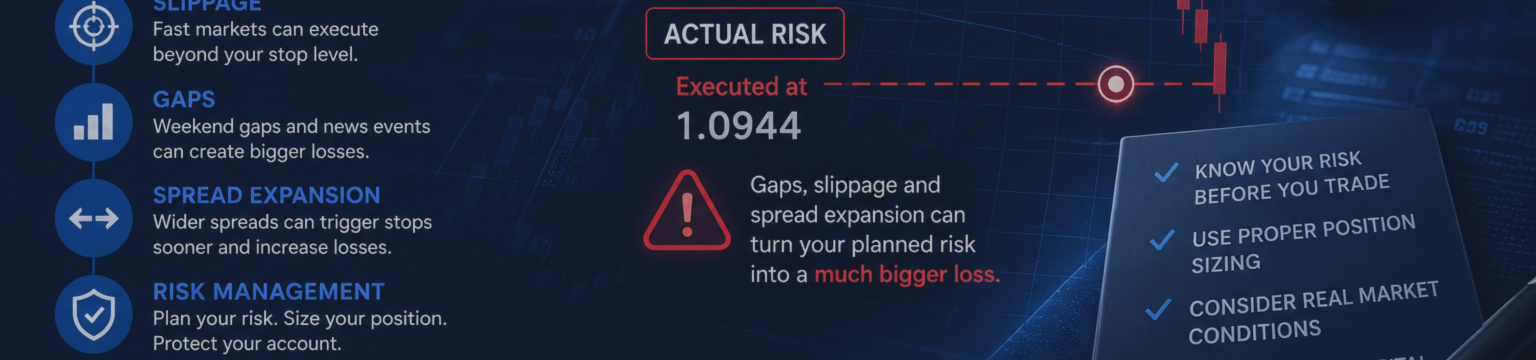
If the market moves normally and liquidity is available, your loss may be close to your planned amount. But if the market gaps, moves extremely quickly, or liquidity suddenly disappears, your order may be executed at a worse price. Your actual loss could therefore be larger. That's the difference between planned risk and realized risk.
What Can Cause Your Actual Loss to Exceed Your Planned Risk?
Several market and execution conditions can create a difference between the two.
1. Slippage
Slippage occurs when your order is executed at a different price from the one you expected.
Imagine:
Entry: 1.1000
Stop: 1.0950
You planned for a 50-pip loss. But during a rapid market move, your stop is executed at:
1.0944
Instead of losing 50 pips, you may have lost approximately:
56 pips
That difference might seem insignificant on a small position. But with larger position sizes, high leverage or repeated occurrences, execution differences can become meaningful.
2. Weekend Gaps
This is one of the clearest examples. Suppose you hold a position through the weekend. Your stop-loss is at:
1.0950
But unexpected news occurs while the market is closed. When trading resumes, EUR/USD opens at:
1.0850
Price has jumped straight through your stop. There was no opportunity for your stop order to execute at 1.0950 because the market wasn't trading at that price when it reopened. Your actual exit can therefore be substantially worse than the planned stop level. This is why weekend positions require additional consideration
3. Major Economic News
Central-bank decisions, inflation data, employment reports and other high-impact announcements can produce extremely rapid price movements. During these events, the market can move through multiple price levels in fractions of a second. A stop-loss may still perform its intended function—attempting to get you out of a losing position—but the execution price can differ from the stop level. This is particularly important for traders who use tight stops around major announcements.
4. Spread Expansion
Your stop-loss is triggered by the relevant market price used for the order—not necessarily by the price you see on a simplified chart. Forex trading involves two prices: Bid and Ask
The difference between them is the spread. During periods of reduced liquidity or increased volatility, spreads can widen. This can cause a position to reach its stop condition sooner than the trader expects when looking only at the chart. For short-term traders and scalpers, spread conditions can therefore have a significant effect on actual trading costs and stop placement.
5. Different Instruments Behave Differently
Not every MT5 symbol calculates risk in the same way. Forex pairs, metals, indices, energies and cryptocurrencies can have very different:
- Contract sizes
- Tick sizes
- Tick values
- Digits
- Minimum volumes
- Volume steps
- Trading sessions
- Liquidity characteristics
Even within forex, JPY pairs can use different quotation conventions from many other major currency pairs. This means a simplistic formula such as:
Lots × Stop-Loss Pips = Risk
is incomplete. The actual monetary risk depends on the instrument's specifications.
Your Stop Distance Is Only One Part of the Calculation
A professional position-sizing calculation should consider several variables. At a simplified level:
Risk = Position Size × Price Movement × Value Per Price Movement
The exact implementation depends on the instrument. For MT5 traders, the relevant symbol properties can include:
- Tick size
- Tick value
- Contract size
- Volume step
- Minimum volume
- Maximum volume
- Account currency
The position size should then be calculated from the amount the trader is willing to risk. In other words:
Risk first. Position size second. Not the other way around.
The Dangerous Question: "How Many Lots Should I Trade?"
This is one of the most common questions traders ask. But it's actually the wrong starting point. A trader might say: "I normally trade 1 lot." But 1 lot on one instrument does not necessarily represent the same monetary risk as 1 lot on another.
The better question is: "How much money am I willing to risk on this trade?" Once that amount is known, the position size can be calculated based on the stop distance and the instrument's specifications. For example:
Account: $10,000
Maximum planned risk: $100
Stop distance: 40 pips
The correct position size depends on the symbol's actual value per pip and the account currency. That is risk-based position sizing.
Planned Risk vs. Actual Risk
This distinction is worth remembering.
Planned Risk
The amount you expect to lose if your stop-loss is triggered under normal execution conditions.
Actual Risk
The amount you ultimately lose after considering the actual execution price, spread, slippage, gaps and other market conditions. These two values can be very close. They can also be very different. Professional traders understand the difference.
Does This Mean Stop-Losses Are Useless?
Absolutely not. A stop-loss remains one of the most important risk-management tools available to traders. The mistake is believing that a stop-loss makes your maximum loss mathematically guaranteed under every possible market condition. A stop-loss is designed to limit and manage risk.
It cannot eliminate market risk. This distinction becomes particularly important during:
- Market gaps
- Extremely fast markets
- Low-liquidity periods
- Major economic announcements
- Market opens
- Unexpected geopolitical events
You will often hear traders say: "I only risk 1% per trade." That's a useful framework. But it should not create a false sense of precision. If you calculate a position so that the stop represents exactly 1% of your account, you have established planned risk.
You haven't eliminated:
- Slippage risk
- Gap risk
- Spread risk
- Execution risk
- Correlation risk
- Liquidity risk
And if you're running several positions simultaneously, your total account exposure may be significantly greater than 1%. This is why professional risk management considers the entire portfolio, not just individual trades.
Three Trades Can Secretly Become One Trade
Imagine a trader has:
Long EUR/USD
Long GBP/USD
Long AUD/USD
They might think: "I'm risking 1% on each trade." Technically, that's three separate positions. But all three have significant exposure to the U.S. dollar. A major USD event could therefore affect all three simultaneously. The trader isn't simply dealing with three independent 1% risks.
They may have significant concentrated exposure to a common market factor. This is why position-level risk and portfolio-level risk are different concepts.
Your Stop-Loss Should Come From the Strategy
Another common mistake is choosing the stop-loss based on how much money the trader wants to risk. For example: "I only want to risk $50, so I'll put my stop 10 pips away." That's backwards. The stop should generally be determined by the strategy and market structure. Then the position size should be adjusted so that the resulting planned monetary risk is appropriate.
The sequence should be:
Strategy → Entry → Stop Location → Stop Distance → Risk Amount → Position Size
Not:
Desired Lot Size → Random Stop → Hope
Risk Management Is About Survival
A trading strategy doesn't need to win every trade. But it needs enough capital to survive its losing trades. Imagine a strategy with a genuine statistical edge. If the trader risks too much per position, a normal losing streak can cause severe drawdown before the strategy has an opportunity to express its edge.
Good risk management creates staying power. That is ultimately what position sizing is designed to accomplish.
How MT5 Traders Should Think About Risk
MetaTrader 5 provides traders with detailed information about individual trading symbols. A robust risk-management process should use the actual symbol specifications rather than relying on assumptions.
Before placing a trade, consider:
Account
How much equity is actually available?
Risk
How much money are you willing to lose under normal stop execution?
Entry
Where will the trade be opened?
Stop
Where does the strategy invalidate the trade?
Distance
How far is the stop from the entry?
Symbol
What are the instrument's contract, tick and volume specifications?
Execution
Could volatility, liquidity or spread conditions affect the result?
Exposure
What other positions are already open?
That is a much more complete risk assessment than simply asking how many pips away the stop is.
Where Risk-Management Software Helps
This is one of the reasons professional MT5 traders use dedicated risk-management tools. Ashinton Risk Console Pro is designed around trade planning, position sizing and risk/reward analysis. Instead of manually working through different calculations for every symbol, the objective is to make the relationship between:
Account → Risk → Stop → Position Size
clear before the trade is placed. For traders managing accounts under specific drawdown rules, Ashinton Prop Guard Pro adds another layer by monitoring account-level metrics such as drawdown, profit targets and compliance requirements.
And for traders using automated strategies, Ashinton Smart Ultra Pro provides an automated trading and trade-management environment on MetaTrader 5. The technology doesn't remove market risk. It helps traders make their risk decisions more systematic.
The Professional Mindset
The goal isn't to predict exactly how much every losing trade will cost. The goal is to establish a sensible planned risk and understand the conditions that can cause actual losses to deviate from that plan. That's a much more realistic approach to trading. You are not controlling the market. You are controlling:
- Your position size
- Your predefined risk
- Your stop placement
- Your exposure
- Your trading decisions
Everything else is uncertainty.
Takeaway
Your stop-loss is a price level. Your risk is a financial exposure. Those two things are connected, but they are not identical. A stop-loss can help control your losses, but execution conditions can cause the final loss to differ from the amount you originally planned.
Remember:
A stop defines where you want to exit. Position sizing defines how much you intend to risk. Market conditions determine how the trade is actually executed. The professional trader doesn't assume risk can be eliminated.
They calculate it, monitor it and respect the fact that markets can behave differently from the ideal scenario. Plan the risk. Size the position. Respect the market.