
The Physics of a Failing Move
Why I stopped asking where gold was going — and started measuring how it was travelling
Every gold trader knows the feeling.
The move looks unstoppable. The candles get longer. Every indicator on the screen agrees. And that is precisely the moment XAUUSD turns around and takes the money back.
I spent a long time on the wrong side of that moment. Long enough to stop blaming my timing and start suspecting the question I was asking.
The question everybody asks
Open any trading platform and look at what the tools actually do. Moving averages, oscillators, breakout systems, trend filters — they are all variations on a single question:
Which way is price going?
It is a reasonable question. It is also, on gold, a question the market answers dishonestly. XAUUSD fakes direction beautifully. It builds a move that looks structurally sound, drags in everyone watching, and then reverses without warning or permission.
After enough of those, I started asking something else:
How much energy is left in this move?
Not where price is going. How it is travelling. Whether the move is still building, or whether it has already spent itself and is running on fumes.
That is not a philosophical distinction. It is a measurable one.
Think of a rubber band
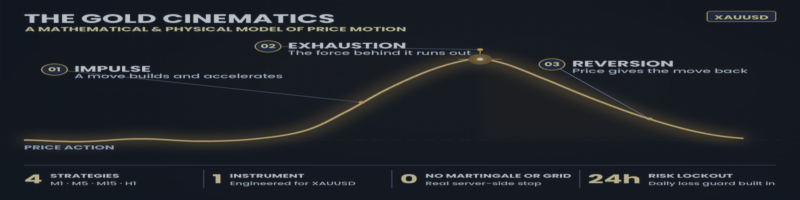
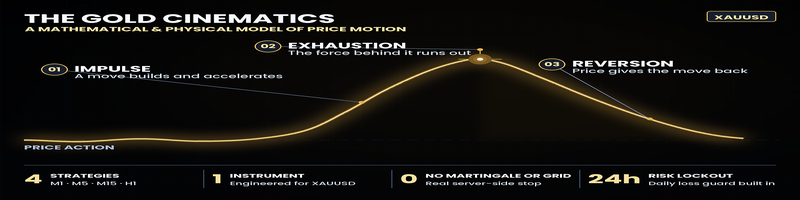
Stretch a rubber band and it stores tension. Stretch it further and it pulls back harder. Stretch it too far and something changes — it stops resisting the way it did. It has spent what it had, and it returns toward rest.
Price behaves in a comparable way during impulsive moves.
A strong directional thrust in gold is not free. It is paid for — by order flow, by urgency, by participants willing to accept progressively worse prices to get filled. That payment is finite. And when a move has consumed enough of it, gold tends to give a meaningful portion of the move back.
This is not a theory anyone needs to take on faith. Reversion following an overextended move is one of the most studied phenomena in financial markets. Academics have documented it for decades. Anyone can look it up.
The concept was never the hard part.
The part that is actually hard
Knowing that overextended moves tend to revert is worth nothing on its own. Two questions follow immediately, and neither has an obvious answer.
How far is far enough?
A move that looks extreme on a quiet Tuesday in August is unremarkable during a central bank week. "Overbought" means nothing as an absolute number — it only means something measured against what this specific instrument is genuinely capable of, right now.
Fixed thresholds are worthless on an asset whose personality changes by the session.
And how do you avoid the second half of the move?
This is the graveyard. This is where most reversion systems die.
They fade a move because it is large — and get run over by the rest of it. The move that looked exhausted at 40 points keeps going for another 90. The system was not wrong about the direction; it was wrong about the moment.
In reversion trading, being early is indistinguishable from being wrong. And it costs exactly the same.
Everything difficult about The Gold Cinematics lives in those two questions. The engine exists to answer them with measurement rather than opinion.
Why gold, and only gold
There is a temptation, once you have something that works, to point it at everything. EURUSD, indices, crypto — why not?
Because gold is not like the others.
It moves with violence. It reverses without warning. It carries a macro sensitivity that few instruments share, and a volatility profile that punishes systems designed for something calmer. A strategy built for a currency pair and repointed at XAUUSD does not adapt to gold — it simply gets hurt by it more slowly.
So the engine reads one instrument. Every threshold, every filter, every exit rule was derived from how this specific metal behaves. That is a limitation, and I am comfortable with it. A tool that does one thing properly is worth more than one that does five things approximately.
Gold did something inconvenient
Here is a problem that catches almost every automated system eventually, and it caught my attention early.
Gold at 1,800 and gold at 4,500 are not the same instrument.
A stop of 300 points represented one percentage of price a few years ago. Today it represents a far smaller fraction. The real risk level of any system built on fixed point distances shifts with every repricing of the asset — even if nobody touches a single parameter.
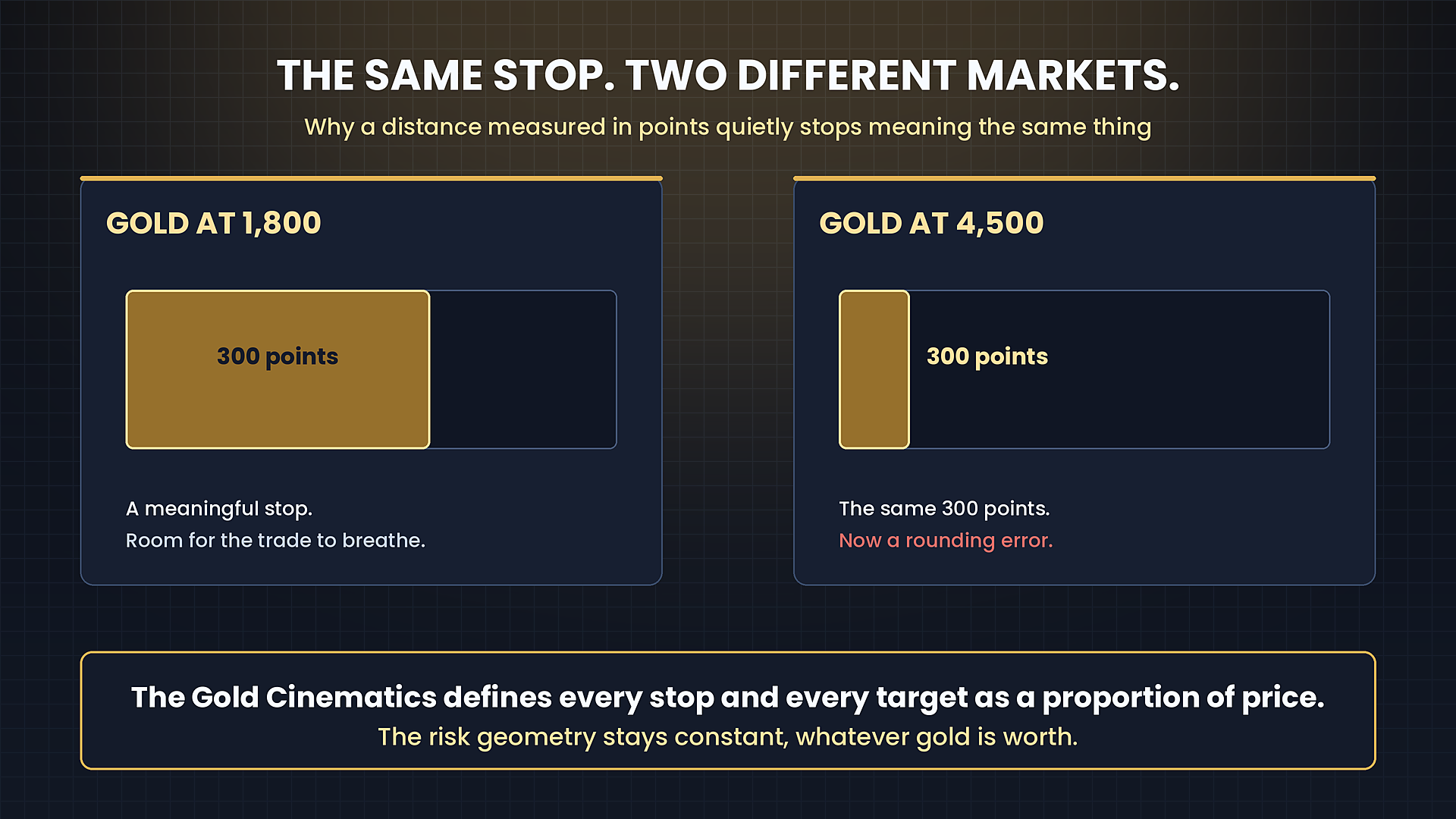
The system quietly stops being the system you tested. Not because the logic broke, but because the yardstick moved underneath it.
The fix is not complicated once you see the problem: define every stop and every target as a proportion of the entry price, not as a distance in points. The risk taken and the profit sought are then expressed in the same relative unit, and the proportion between them stays constant regardless of where gold trades.
Today's trade holds the same relationship between risk and target as one taken three years ago — and will hold it three years from now.
Four rhythms, not one
Gold does not have a single rhythm. It has several running at once: the minute-by-minute churn, the intraday swing, the multi-session structure.
What qualifies as a significant move over one minute is noise over one hour. A system that treats them the same is compromising on both.
So The Gold Cinematics does not treat them the same. It runs four fully independent strategies simultaneously — M1, M5, M15 and H1 — from a single chart. Each reads its own timeframe, carries its own calibration derived independently for that scale, and manages its own position, stop and target.
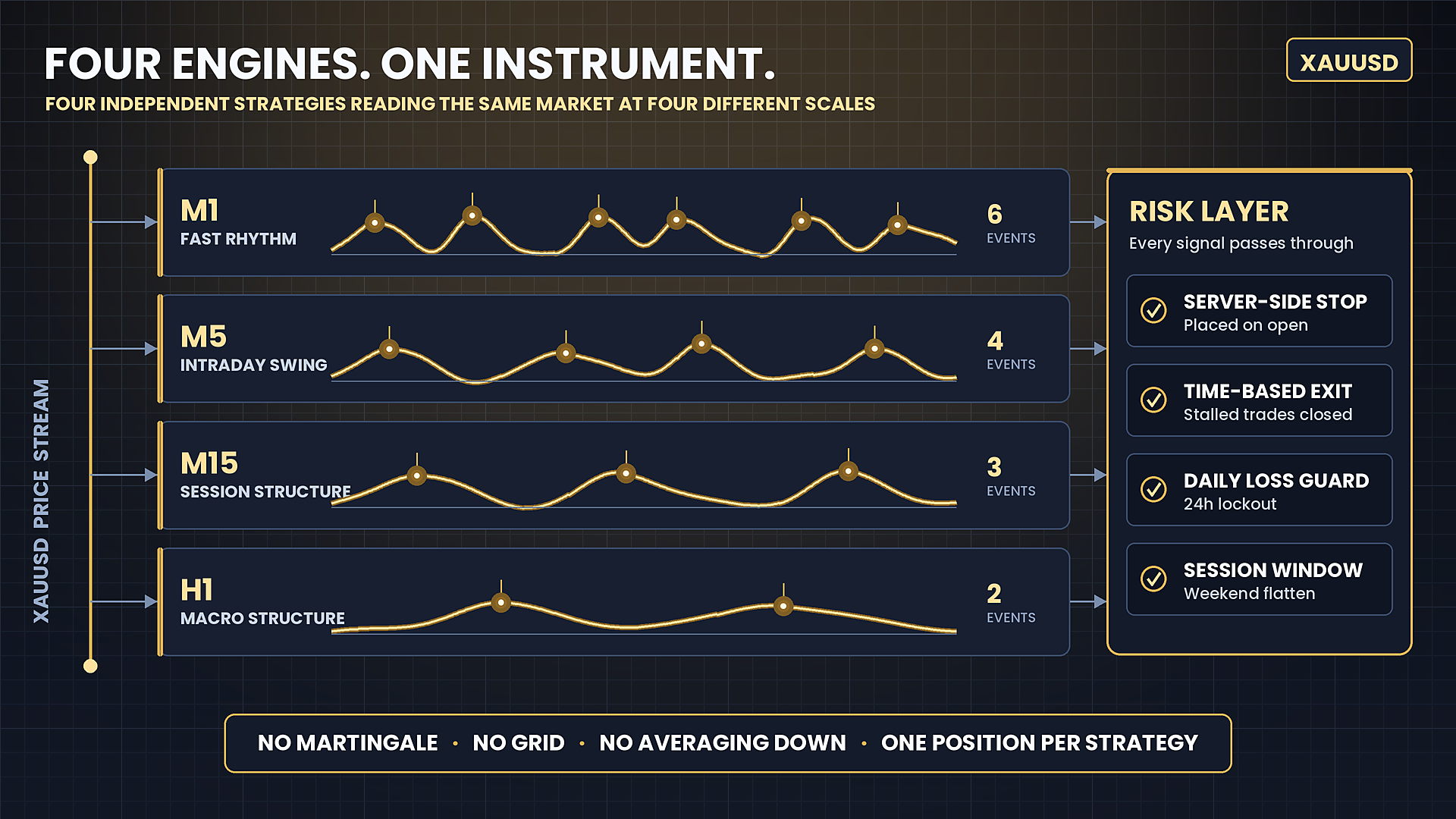
They share nothing. They do not queue behind each other. A quiet week on one timeframe does not silence the others. Where one stands aside, another finds its opportunity — and the system behaves less like a single robot and more like a geared mechanism.
The uncomfortable part: it does not trade much
This is where I lose some readers, so let me be direct.
This system enters the market only when the conditions it looks for are present and clearly defined. That requirement sets its natural pace — an intraday system of moderate frequency, working through a defined set of well-identified opportunities rather than spreading positions across the whole session.
There will be stretches where the chart moves hundreds of points and the EA stays on the sidelines.
That is not a malfunction. It is the design working exactly as intended.
If you measure a system by how often it trades, this one will frustrate you. If you measure it by the discipline of the moments it chooses, that is precisely what it was engineered for. The quality of each entry is the product, not the number of them.
Risk is the architecture, not a feature
Gold punishes carelessness faster than any instrument in retail trading. Every protective layer in this system exists because of that.
Every position opens with a real stop loss already placed on the broker's server — not calculated inside the terminal. The maximum loss on that trade is defined and held by the broker from the first second.
A daily loss guard you configure yourself: cross your limit and the EA closes its own positions and locks itself out for a full 24 hours. No revenge trading. No doubling down. No watching one bad session compound into a catastrophic one.
A time-based exit, because every entry has a shelf life. A position that has reached neither its target nor its stop after a defined number of bars is closed regardless. Stalled trades are not left to decay into a stop loss.
Full weekly scheduling — you decide when it may begin opening trades, when it must stop, and when it flattens everything ahead of the weekend.
And a set of things it will never do: no martingale, no grid, no averaging down, no offsetting positions used to postpone a realised loss. A system that needs any of those does not have an edge. It has a mechanism for delaying the recognition of a loss — and delay always ends the same way.
What I am not going to tell you
The specific model, what it measures, how it quantifies it, and what has to align before a trade is authorised — that stays where it is. Years of research went into it, and a public article is not where it goes.
But the concept is not a secret, and it is not meant to be. Physics has described bodies in motion for three centuries. Markets have shown reversion after exhaustion for as long as there have been markets.
The interesting work was never in discovering the idea.
It was in learning to measure it.
The moment, revisited
Back to where we started.
The move looks unstoppable. The candles get longer. Every indicator agrees.
The difference now is that I am not asking whether the move will continue. I am asking how much of it is left — and I have a way to measure the answer.
That single change of question is the whole system.
See it for yourself
Everything described here — the four independent strategies, the proportional risk geometry, the daily loss guard, the weekly scheduling — is running in the published product. The full test reports, the trade lists and the complete specification are on the product page:
👉 The Gold Cinematics — MQL5 Market
Judge it by what it does. Load it in your own Strategy Tester and let the numbers argue.
Quasar Innovate The Gold Cinematics — XAUUSD