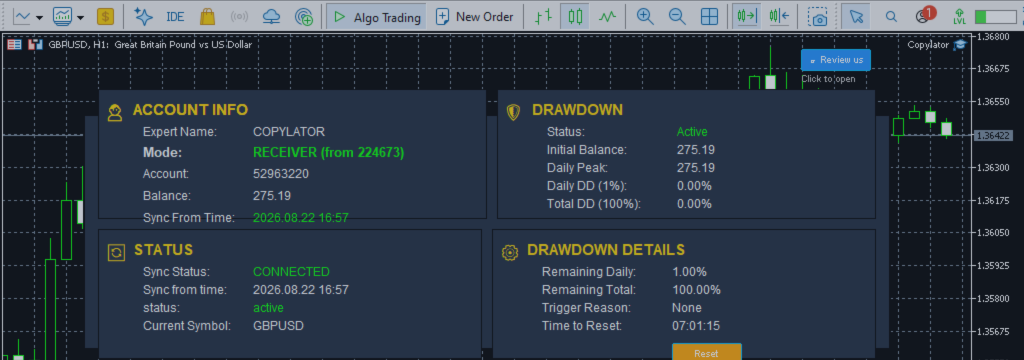
MT5 Trade Copier Real-Time SL/TP Synchronization: Keeping Every Receiver in Sync

Product link:
https://www.mql5.com/en/ market/product/191385
One of the most important features of a professional MT5 Trade Copier is the ability to synchronize Stop Loss (SL) and Take Profit (TP) levels in real time.
Simply copying a trade from a Sender account to one or more Receiver accounts is not enough. A reliable trade copier must also keep monitoring the copied trades after they have been opened. When the trader changes the risk-management settings on the Sender, those changes should be reflected on the corresponding Receiver trades without requiring manual intervention.
This is where real-time SL/TP synchronization becomes especially important.
What Is Real-Time SL/TP Synchronization?
In a basic trade copier, SL and TP may be copied only once, when the original trade is opened.
For example, a trader opens a Buy position on the Sender with:
- Entry: 1.17000
- Stop Loss: 1.16800
- Take Profit: 1.17400
The Receiver receives the same trade and initially gets the same SL and TP levels.
But what happens if the trader later moves the Stop Loss to 1.17100?
Or changes the Take Profit from 1.17400 to 1.17600?
Or adds a Stop Loss to a trade that originally had none?
A professional MT5 Trade Copier should detect these changes and synchronize them with the corresponding Receiver trades.
COPYLATOR is designed to provide this type of real-time SL/TP synchronization, including modifications made after the original trade has already been opened.
Why Initial SL/TP Copying Is Not Enough
Many trading strategies do not use fixed SL and TP values throughout the entire lifetime of a position.
A trader may initially open a position without a Stop Loss, wait for confirmation, and then add one later.
Another trader may move the Stop Loss into profit after the market moves favorably.
A third strategy may continuously adjust the Stop Loss using a trailing-stop system.
Take Profit levels can also change as market conditions develop.
If a trade copier only copies the original SL and TP values, the Receiver accounts can quickly become different from the Sender.
| Trade Stage | Sender | Receiver |
|---|---|---|
| Trade opened | SL = 1.16800 | SL = 1.16800 |
| SL moved | SL = 1.17100 | SL = 1.16800 |
At this point, the two accounts are no longer using the same risk-management settings.
Real-time synchronization is designed to prevent this type of divergence.
How Real-Time SL/TP Synchronization Works
The synchronization process continuously monitors the Sender's relevant trades and compares their current SL and TP values with the corresponding Receiver trades.
When a change is detected, the copier identifies the matching Receiver trade and applies the updated values.
The process can be summarized as:
- A trade is opened on the Sender.
- The trade is copied to the Receiver.
- The Sender's SL and TP are continuously monitored.
- The trader modifies SL or TP.
- The copier detects the modification.
- The corresponding Receiver trade is identified.
- The Receiver's SL/TP values are updated.
- The system continues monitoring for future changes.
This means synchronization does not end when the original trade is copied.
The relationship between the Sender and Receiver trade continues throughout the lifetime of the copied position or pending order.
Adding SL or TP After a Trade Is Already Open
One particularly important capability is the ability to synchronize protective levels that were not present when the trade was initially opened.
Consider this example:
A trader opens a Buy position on the Sender without an SL.
Several minutes later, after analyzing market conditions, the trader decides to add a Stop Loss.
In a copier that only synchronizes SL/TP during trade creation, the Receiver may remain without an SL.
That creates a potentially significant difference in risk between the two accounts.
With real-time SL/TP synchronization, the newly added Stop Loss can be detected and applied to the corresponding Receiver position.
The same principle applies when a Take Profit is added after the trade has already been opened.
Trailing Stops Across Multiple Receiver Accounts
Real-time synchronization becomes even more important when using a trailing-stop strategy.
Suppose a Sender position is protected by a dynamic Stop Loss that moves as the market moves in the trader's favor.
The Stop Loss might change several times:
- Initial SL: 1.16800
- First adjustment: 1.16900
- Second adjustment: 1.17000
- Third adjustment: 1.17100
- Final adjustment: 1.17200
If there are multiple Receiver accounts, manually reproducing every modification on every account would be inefficient and prone to errors.
An MT5 trade copier with real-time SL synchronization can distribute these changes automatically.
This is particularly useful for:
- Trailing-stop strategies
- Break-even systems
- Dynamic Stop Loss management
- Profit-protection strategies
- Automated Expert Advisors
- Multi-account trading
Real-Time Take Profit Synchronization
SL synchronization is only one part of the process.
Take Profit modifications can also be important.
A trader may decide to extend a target when strong momentum develops, or move the target closer when market conditions become less favorable.
For example, a position may initially have:
TP = 1.17500
Later, the trader changes it to:
TP = 1.17800
The corresponding Receiver trade should not remain at the old target if the goal is to replicate the Sender's current trade-management instructions.
Real-time TP synchronization helps maintain consistency between the accounts.
Hedging Account Support
MT5 Hedging accounts can maintain multiple positions for the same symbol.
For example, a trader can have several separate XAUUSD positions, each with different entry prices, volumes, SL levels, and TP levels.
In this environment, each position needs to be associated with the correct corresponding Receiver position.
COPYLATOR supports individual position synchronization for Hedging accounts, allowing SL and TP modifications to be applied to the appropriate copied trades.
Netting Account Support
Netting accounts work differently.
In a Netting account, the broker generally maintains a single net position per symbol rather than multiple independent positions for the same symbol.
Because of this structural difference, synchronization must account for the net position rather than treating every position as an independent Hedging ticket.
COPYLATOR automatically detects whether the account is operating in Hedging or Netting mode and applies the appropriate synchronization logic.
This means traders do not need to manually configure the EA simply because the account type is different.
Pending Orders and SL/TP Synchronization
SL and TP synchronization is not limited to already-open market positions.
Pending orders can also contain protective levels and target prices.
For example:
- Buy Limit
- Sell Limit
- Buy Stop
- Sell Stop
If the Sender modifies the relevant SL or TP values of a pending order, the corresponding Receiver order needs to remain synchronized.
This is particularly useful for strategies that place pending orders in advance and modify their risk parameters before activation.
Why Synchronization Matters in Multi-Receiver Trading
Consider a Sender account connected to ten Receiver accounts.
If the trader manually changes the Stop Loss on the Sender, manually updating ten Receiver accounts would be slow and error-prone.
Even a small delay or a single missed modification could cause one account to have significantly different risk exposure from the others.
Real-time synchronization automates this process.
The Sender remains the central source of the trade-management instructions, while the connected Receivers follow the current SL/TP configuration.
Real-Time Synchronization and Risk Management
SL and TP are not merely technical order parameters.
They are fundamental components of risk management.
A Stop Loss defines where a position should be exited when the market moves against the trade.
A Take Profit defines the intended profit target.
When these values differ between accounts, the risk/reward profile can also differ.
For example, if the Sender has moved its Stop Loss into profit but a Receiver still has the original Stop Loss below the entry price, the Receiver is exposed to a different risk profile.
Real-time synchronization helps reduce this discrepancy.
What If the Trade Has Been Open for Hours?
Real-time synchronization should not be limited to newly opened trades.
A trade may remain open for hours or even days.
During that time, its SL and TP can be modified multiple times.
A reliable copier needs to continue recognizing the relationship between the original Sender trade and its Receiver counterpart for as long as the trade remains active.
COPYLATOR is designed to continue checking the current SL/TP state rather than assuming that the original values will remain unchanged.
Reducing Manual Errors
Manual synchronization across multiple MT5 accounts creates several potential problems.
- A trader may forget to modify one Receiver.
- A Stop Loss may be entered incorrectly.
- A Take Profit may be placed at the wrong price.
- One account may be updated several seconds or minutes later.
- A large number of Receiver accounts can make manual management impractical.
Automation significantly reduces these operational problems.
Instead of repeatedly performing the same task on every account, the trader modifies the Sender and allows the copier to distribute the change.
Real-Time SL/TP Synchronization with Automated Trading Strategies
The feature is also particularly useful when the Sender is controlled by an Expert Advisor.
An EA may dynamically modify SL or TP according to market conditions, volatility, indicators, trailing logic, or other internal rules.
If those modifications are not synchronized, the Receiver accounts may execute the initial trade correctly but fail to follow the strategy's subsequent risk-management decisions.
For this reason, real-time SL/TP synchronization can be an important component of automated multi-account trading.
Real-Time SL/TP Synchronization vs. Initial SL/TP Copying
| Capability | Initial SL/TP Copying | Real-Time SL/TP Synchronization |
|---|---|---|
| Copy SL when trade opens | Yes | Yes |
| Copy TP when trade opens | Yes | Yes |
| Detect later SL modifications | No | Yes |
| Detect later TP modifications | No | Yes |
| Add SL after trade opening | No | Yes |
| Add TP after trade opening | No | Yes |
| Support dynamic trade management | Limited | Yes |
How COPYLATOR Handles SL/TP Synchronization
COPYLATOR provides dedicated settings for controlling SL and TP replication.
The relevant parameters include:
- CopyStopLoss – enables copying Stop Loss values from the Sender.
- CopyTakeProfit – enables copying Take Profit values from the Sender.
- CustomStopLoss – allows a fixed Stop Loss distance to be used instead of the Sender's value.
- CustomTakeProfit – allows a fixed Take Profit distance to be used instead of the Sender's value.
When custom SL/TP values are not being used to override the Sender's settings, the system can keep the Receiver trades synchronized with the Sender's current protective levels.
Why This Feature Matters for an MT5 Trade Copier
Trade copying is not complete when an order is opened.
The real trading process continues after entry.
Stops can move. Targets can change. Positions can be managed dynamically. A trade that started without an SL may receive one later.
For this reason, an advanced MT5 Trade Copier should be able to synchronize not only the initial order but also important modifications throughout the trade's lifetime.
Real-time SL/TP synchronization helps maintain consistent risk-management instructions across multiple MT5 accounts while reducing the need for manual intervention.
Conclusion
Real-time SL/TP synchronization is one of the key features that separates a basic MT5 trade copier from a more advanced trade-management system.
It allows changes made on the Sender—including moving SL, changing TP, or adding protective levels to an existing trade—to be replicated across connected Receiver accounts.
With support for both Hedging and Netting account structures, market positions, pending orders, and trades that receive SL/TP modifications after entry, COPYLATOR provides a comprehensive synchronization layer for MT5 multi-account trading.
For traders using automated strategies, trailing stops, dynamic risk management, prop firm accounts, or multiple Receiver accounts, keeping SL and TP synchronized can be just as important as copying the original trade itself.
Product link:
https://www.mql5.com/en/ market/product/191385


![[iVISTscalp5]: XAUUSD. Forecast First. Market Reaction Afterwards](https://c.mql5.com/6/1035/splash-preview-777232.png "[iVISTscalp5]: XAUUSD. Forecast First. Market Reaction Afterwards")
